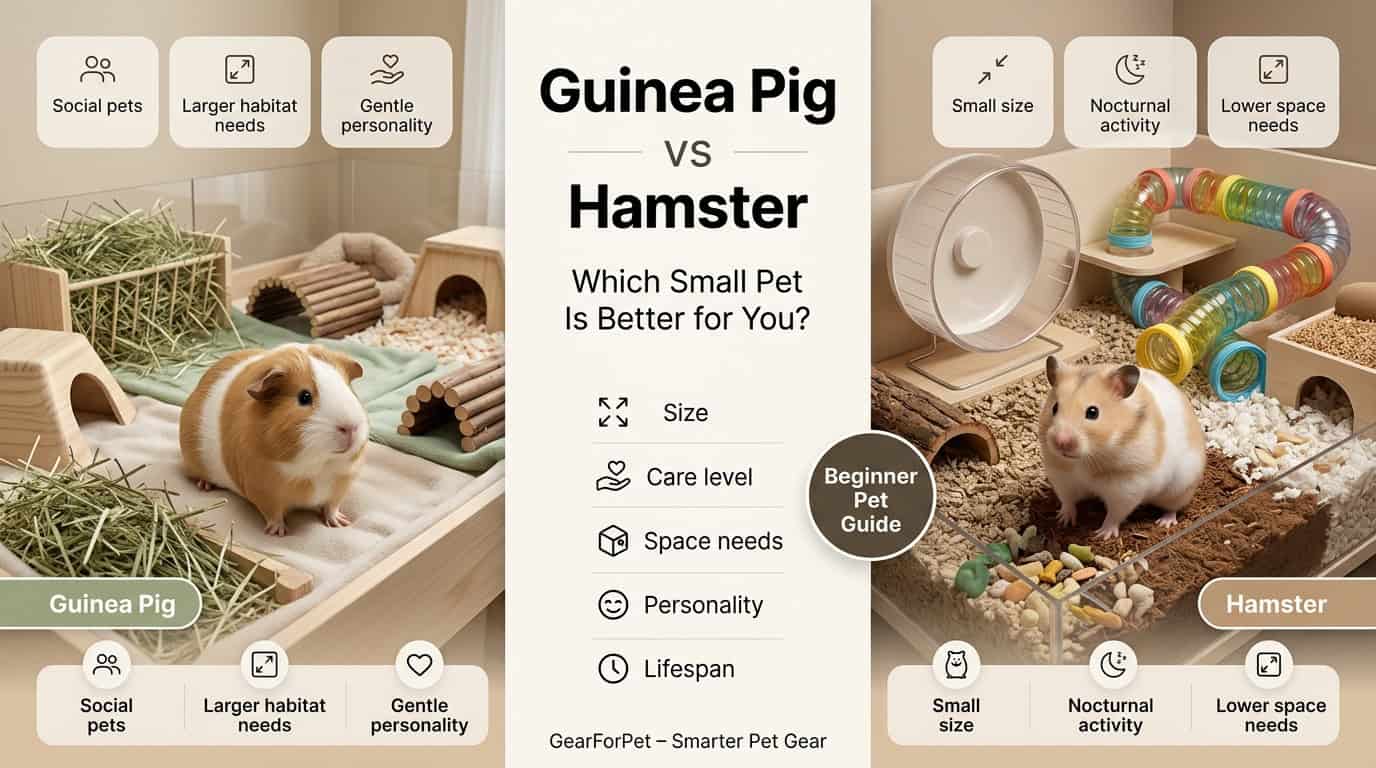
Guinea Pig vs Hamster: Which Pet Is Right for You?
Guinea pigs and hamsters are sold in the same pet store aisle, housed in similar-looking cages, and marketed to the same audience — which is why so many people assume they are interchangeable options that differ mainly in size. They are not. A guinea pig is a social, vocal, daytime animal that lives 5–8 years, must be kept with at least one companion, and will recognise your voice and call out to you when you enter the room. A hamster is a solitary, primarily nocturnal animal that lives 2–3 years, must live alone, and will be asleep for most of the hours a child wants to play with it. These are fundamentally different ownership experiences — and the right choice depends entirely on your lifestyle, schedule, living situation, and what you actually want from the relationship. This guide gives you the honest comparison that pet store staff rarely do.
Quick Answer — Guinea Pig or Hamster?
Get a guinea pig if you want an interactive, social pet you can genuinely bond with, handle during daytime hours, and watch interact with a companion — and you have the space and budget for a pair. Get a hamster if you want a lower-maintenance pet with a smaller space footprint, lower ongoing cost, and you’re home in evenings when hamsters are naturally most active.
Which Pet Fits Your Life? — The Decision Framework
Before comparing the animals themselves, match your situation to the right choice. This is the question pet store advice skips — and the reason so many first-time small pet owners end up with an animal whose lifestyle is incompatible with theirs.
| Your Situation | Better Choice | Why |
|---|---|---|
| You work 9–5 and want daytime interaction | 🐷 Guinea Pig | Active during the day — awake and interactive in mornings and evenings |
| You work 9–5 and want low-maintenance | 🐹 Hamster | Naturally active evenings — aligns perfectly with post-work schedule |
| Children under 8 years old | 🐷 Guinea Pig | Gentler, rarely bites, easier to handle, visible daytime behaviour |
| Children aged 8–14 | Either — see children’s section below | Hamsters require consistent daily handling commitment to stay tame |
| First-time small pet owner | 🐷 Guinea Pig | More forgiving of beginner mistakes; social signals easier to read |
| Limited space — apartment or small room | 🐹 Hamster | Smaller cage footprint; single animal; no pair requirement |
| Limited budget | 🐹 Hamster | No hay cost; single animal; lower bedding volume; lower monthly total |
| Want a pet that bonds closely with you | 🐷 Guinea Pig | Social species — recognises owner voices, runs to greet, vocalises |
| Lower long-term commitment preferred | 🐹 Hamster | 2–3 year lifespan vs 5–8 years — shorter commitment period |
| Hay allergies in the household | 🐹 Hamster | Guinea pigs require unlimited hay; hay dust is a common allergen trigger |
| Noise-sensitive building or thin walls | 🐹 Hamster | Guinea pig wheeking is loud and frequent — carries through walls at feeding time |
| Want to watch social animal behaviour | 🐷 Guinea Pig | Pair dynamics — grooming, popcorning, communication — are genuinely entertaining |
Guinea Pig vs Hamster — Full Comparison
| Factor | 🐷 Guinea Pig | 🐹 Hamster |
|---|---|---|
| Size | 1.5–2.5 lbs, 8–10 inches | 1–6 oz, 2–7 inches (species varies) |
| Lifespan | 5–8 years | 2–3 years |
| Social needs | Pairs or groups — should never live alone | Solitary — Syrian hamsters must live alone |
| Active hours | Daytime and crepuscular | Primarily nocturnal and crepuscular |
| Noise level | Vocal — wheeking, purring, teeth chattering | Quiet — wheel noise at night only |
| Biting risk | Rarely bite — very gentle | Will bite if not handled consistently |
| Minimum cage size | 7.5 sq ft (pair minimum) | ~5.4 sq ft / 775 sq in (solo) |
| Cleaning frequency | Spot clean daily; full clean weekly | Spot clean weekly; full clean monthly |
| Diet | Unlimited hay + pellets + fresh veg daily | Pellets + occasional fresh food + scatter foraging |
| Monthly cost (est.) | $45–70 (pair) | $15–25 (solo) |
| Vet requirements | Regular exotics vet recommended | Less frequent vet visits typically needed |
| Good for children | ✅ Yes — with supervision | 🟡 Older children with handling consistency |
| Apartment friendly | 🟡 Noise consideration | ✅ Yes |
| Bonds with owner | ✅ Strong — recognises voice and person | 🟡 Individual — varies significantly by animal |
| Taming difficulty | Moderate — social nature helps | Moderate to high — requires daily commitment |
| Handling ease | Easier — calm, less wriggly | Harder — fast, wriggly, drop risk |
What Life With Guinea Pigs Actually Looks Like
Guinea pigs are described in pet store marketing as “low-maintenance starter pets” — a description that significantly undersells the time, cost, and space commitment they require, and simultaneously undersells the reward. They are not low-maintenance. They are medium-maintenance animals with a high reward-to-effort ratio when their needs are correctly met.
The Genuine Positives
- Daytime activity — guinea pigs are active during the day, which means you will actually see, interact with, and enjoy your pet during normal waking hours. This is the most practically important difference from hamsters for most owners.
- Vocal and expressive — guinea pigs communicate constantly. The wheek (a high-pitched call) signals excitement, especially at feeding time. The purr signals contentment during handling. Teeth chattering is a warning. Popcorning — spontaneous jumping and twisting — is pure joy. Once you learn the vocabulary, reading your guinea pigs’ emotional state becomes intuitive.
- Social dynamics to watch — a bonded guinea pig pair grooms each other, chases each other, navigates dominance through non-violent posturing, and communicates in ways that are genuinely interesting to observe. Many guinea pig owners describe watching their pair as more entertaining than television.
- Rarely bite — a guinea pig that is comfortable with handling will almost never bite. Even a frightened guinea pig is more likely to freeze, struggle, or vocalise distress than to bite. This makes them significantly safer for children and handling beginners than hamsters.
- Long bond — at 5–8 years, a guinea pig is a genuine long-term companion. Many owners describe strong individual personalities that they come to know deeply over years of daily interaction.
The Honest Realities
- Must be kept in pairs — this doubles the cost, space, food, and vet bills from day one. A guinea pig kept alone is not a money-saving decision — it is a welfare failure that produces a chronically stressed animal.
- High poop volume — a guinea pig produces 100+ droppings per day. Spot cleaning is not an optional extra; it is a daily 5-minute task that is required to prevent ammonia buildup and bacterial growth in the substrate.
- Unlimited hay is non-negotiable — 80% of a guinea pig’s diet is timothy hay, available at all times, every day. This creates ongoing monthly cost and produces hay dust that is a known allergen trigger. If anyone in your household has respiratory sensitivities, test hay exposure before committing.
- Vocalisations carry — the wheek is loud. Guinea pigs wheek at feeding time, when they hear a fridge open, when they hear a bag rustle, and when they want attention. In an apartment or thin-walled home, this is audible to neighbours. It is charming to most owners and a genuine consideration for noise-sensitive living situations.
- Larger space and longer commitment — 7.5 square feet minimum for a pair, and a lifespan of up to 8 years. Before getting guinea pigs, think honestly about where you will be in 5 years and whether the commitment travels with you.
What Life With a Hamster Actually Looks Like
Hamsters are the most commonly purchased small pet in the US — and among the most commonly surrendered, for a predictable reason: buyers expect a small, handleable pet they can interact with whenever they want, and discover an animal that is asleep during their available hours and defensive when woken mid-sleep. A hamster owned with accurate expectations is a rewarding, low-cost, space-efficient pet. A hamster owned with inaccurate expectations produces frustration on both sides.
The Genuine Positives
- Solo animal — one cage, one animal, one set of costs. This is a genuine practical advantage for owners with limited budget or space.
- Smaller footprint — a correctly sized hamster cage (775 square inches) is physically smaller than a correctly sized guinea pig pair cage. For apartment dwellers or owners with limited floor space, this matters.
- Quiet during the day — a hamster in a correctly sized cage with adequate enrichment is virtually silent during daytime hours. The only regular noise is wheel running — and only at night.
- Evening activity aligns with post-work schedules — if you arrive home at 6pm, your hamster is waking up. For owners who work full days and want an animal that is active when they are home, the hamster’s crepuscular schedule is actually a feature rather than a limitation.
- Lower ongoing cost — no hay, lower food volume, lower bedding volume. The monthly cost of a hamster is roughly a third of a guinea pig pair. Over a 2–3 year lifespan, this is a meaningful financial difference.
The Honest Realities
- Asleep when children want to play — a hamster purchased for a child who wants afternoon interaction will be sleeping. Waking a hamster from deep sleep causes significant stress and dramatically increases bite risk. This is the most common source of hamster disappointment in family households.
- Short lifespan — at 2–3 years, hamster ownership ends relatively quickly. For adults this is a manageable grief experience. For children, particularly those under 8, the death of a pet at 2–3 years can be a distressing first encounter with loss before they have the emotional tools to process it.
- Biting requires management — hamsters that are not handled consistently every day revert to defensive biting within weeks. A hamster that is tamed by a child during a school holiday and then neglected during the school term is a biting hamster by October. This is not the hamster’s fault — it is the predictable result of inconsistent handling.
- Wheel noise at night — a hamster cage in a bedroom means wheel running from 10pm to 4am. This is not a minor consideration. A correctly sized hamster with an adequate wheel needs to run, and will run regardless of the hour. The cage must be in a room where night noise does not disturb sleep.
- Escape risk — a hamster that gets loose in a home is extremely difficult to recapture. They move fast, hide in small spaces, and can remain hidden for days. Cage security — secure latches, no bar gaps — is essential.
Guinea Pig vs Hamster for Children — The Honest Guide
The “which is better for a child” question is the most searched aspect of this comparison — and the one most commonly answered with a vague “both are great with supervision.” Here is the honest guidance.
Children Under 8 — Guinea Pigs Are the Better Choice
Guinea pigs are significantly safer and more rewarding for young children for three specific reasons. First, they rarely bite — even a stressed guinea pig is unlikely to break skin, whereas a startled hamster bite from a child’s mishandling can draw blood and cause fear that ends the ownership experience. Second, they are active during the day — a child who wants to watch their pet, call to it, and see it respond can do so during normal daytime hours with a guinea pig; a hamster purchased for a 6-year-old will be asleep at 3pm when the child comes home from school. Third, their size and calm temperament makes them physically easier for small hands to hold safely — a hamster’s speed and wriggling creates drop risk that is proportionally higher with young children.
Children Aged 8–14 — Either Can Work With Commitment
Older children who understand the handling commitment can successfully keep and tame hamsters — but the commitment must be genuine and consistent. A hamster requires daily handling, every day, to remain tame. This is a responsibility level appropriate for children who have demonstrated follow-through on daily tasks. Before getting a hamster for a child in this age group, test the commitment with a lower-stakes daily task for 3–4 weeks. If they maintain it consistently, the hamster taming commitment is realistic. If they don’t, a guinea pig — whose social nature and daytime activity produces more natural interaction without requiring the same structured daily taming protocol — is the more resilient choice.
The Lifespan Conversation With Children
A hamster’s 2–3 year lifespan means that a child who receives one at age 7 will experience its death at age 9 or 10. A guinea pig received at the same age will still be alive at 12–15. Both experiences have value — learning to care for a shorter-lived animal and process its death is a legitimate part of childhood development — but the timing and the child’s emotional readiness should be considered honestly rather than ignored.
True Cost Comparison — Guinea Pig vs Hamster
The cost difference between these two pets is significant and consistently underestimated. Here is the realistic breakdown:
| Cost Category | 🐷 Guinea Pig (pair) | 🐹 Hamster (solo) |
|---|---|---|
| Initial cage + setup | $150–350 | $100–200 |
| The animals (or adoption) | $40–80 (pair) | $10–30 |
| Monthly hay | $20–35 | $0 |
| Monthly pellets | $10–15 | $6–10 |
| Monthly bedding | $15–25 | $8–15 |
| Monthly fresh vegetables | $15–25 | $2–5 |
| Annual vet (healthy animals) | $100–250 | $50–100 |
| Monthly total (est.) | $45–70 | $15–25 |
| Full lifespan total (est.) | $3,500–5,500 (6 years) | $700–1,000 (2.5 years) |
The hay cost is the number most people miss. Guinea pigs require unlimited timothy hay every day of their lives — not as a supplement, but as the primary component of their diet. A good quality timothy hay for a pair runs $20–35 per month. Over a 6-year guinea pig lifespan, hay alone costs $1,500–2,500. This is not optional or reducible — it is a biological requirement. Budget for it before committing.
Space Requirements — What Each Animal Actually Needs
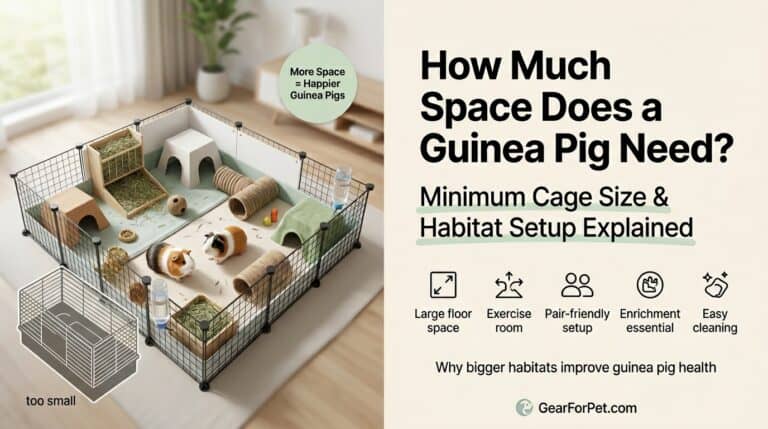
Both guinea pigs and hamsters are routinely sold in cages that are too small for their welfare needs. Here is what correct housing actually looks like in physical terms:
| Animal | Minimum Floor Space | Approximate Dimensions | Number of Animals |
|---|---|---|---|
| Guinea Pig | 7.5 sq ft (Humane Society minimum) | ~30″ x 36″ footprint | Pair (minimum recommended herd) |
| Guinea Pig (recommended) | 10+ sq ft | ~40″ x 36″ footprint | Pair |
| Hamster (Syrian) | 775 sq in / ~5.4 sq ft (TVT standard) | ~25″ x 31″ footprint | Solo only |
| Hamster (recommended) | 900+ sq in / ~6.25 sq ft | ~30″ x 30″ footprint | Solo only |
The floor space difference between a correctly sized guinea pig pair cage and a correctly sized hamster cage is smaller than most people expect — the bigger practical difference is that the guinea pig cage must accommodate two animals and the daily hay, hideout, and enrichment setup that a pair requires. For more detail on specific cage recommendations, see our Best Guinea Pig Cages 2026 and Best Hamster Cages 2026 guides.
Frequently Asked Questions — Guinea Pig vs Hamster
Are guinea pigs or hamsters better for beginners?
Guinea pigs are generally the better choice for first-time small pet owners. Their social nature makes their body language and emotional states easier to read — a stressed guinea pig vocalises clearly, a happy one purrs and popcorns, and a frightened one freezes rather than biting. Hamsters require a more structured daily taming commitment to remain handleable, and their nocturnal schedule means beginners often interact with them at the wrong time of day, creating stress and biting risk. The guinea pig’s daytime activity and vocal communication gives beginners more feedback and more natural interaction opportunities.
Are guinea pigs or hamsters better for children?
For children under 8, guinea pigs are the better choice — they rarely bite, are active during the day, and are physically calm and large enough for small hands to hold safely. For children aged 8–14 with genuine commitment to daily handling, hamsters are a viable option — but require an adult-supervised daily handling routine to maintain tameness. The hamster’s 2–3 year lifespan means grief comes sooner, which is a real consideration for younger children. The guinea pig’s longer lifespan and daytime activity makes it a more forgiving and more rewarding first pet in most family situations.
Which is easier to care for — guinea pig or hamster?
On a daily time basis, hamsters require less cleaning and less fresh food preparation than guinea pigs. On a complexity basis, guinea pig care is more straightforward — their diet, social signals, and health indicators are easier for beginners to monitor and interpret. Guinea pigs require more total daily time (fresh vegetable preparation, daily spot cleaning, hay replenishment). Hamsters require less daily time but more attentive handling consistency to maintain tameness. Neither is dramatically harder than the other — the right answer depends on whether time or attention is your more constrained resource.
Do guinea pigs or hamsters smell more?
Neither smells significantly when properly maintained. Guinea pigs produce more waste volume — 100+ droppings per day for a pair — which requires daily spot cleaning to prevent odour buildup. A guinea pig cage that is spot cleaned daily and fully cleaned weekly has no noticeable smell. A hamster cage that is cleaned on the correct schedule is similarly odourless. The hamster’s urine is more concentrated and more pungent than guinea pig urine, which means a neglected hamster cage smells more intensely than a neglected guinea pig cage. The honest answer: both smell fine when maintained, both smell bad when not.
Can guinea pigs and hamsters live together?
No — never house guinea pigs and hamsters together. They are different species with different social structures, different communication signals, and different physical sizes. A guinea pig and hamster together will cause stress to both animals and risk physical injury — guinea pigs are significantly larger and may inadvertently injure a hamster through normal movement and social behaviour. Each species requires housing with its own kind or in species-appropriate social arrangements: guinea pigs in same-sex pairs or groups, Syrian hamsters in solitary housing.
Which lives longer — guinea pig or hamster?
Guinea pigs live significantly longer — 5–8 years on average with good care, compared to 2–3 years for most hamster species. Roborovski dwarf hamsters have the longest hamster lifespan at up to 3.5 years; Syrian hamsters average 2–2.5 years. This lifespan difference is a genuine practical factor: a guinea pig is a 5–8 year commitment that will be present through significant life changes, while a hamster’s shorter lifespan means a lower total commitment period. Neither is better or worse — the right lifespan depends on what you are looking for in a pet ownership experience.
Final Verdict — Which Should You Get?
Get guinea pigs if: you want a social, interactive pet that is awake when you are, bonds with you over years, is safe for children, and you have the space, budget, and willingness to commit to daily care for up to 8 years. Accept from the start that you need two, their cage is larger than a pet store starter cage, and fresh hay is a permanent monthly expense.
Get a hamster if: you want a lower-cost, smaller-footprint, lower-maintenance solo pet that fits an apartment, aligns with an evening-active schedule, and you understand that it will be asleep in the afternoon and requires consistent daily handling to stay tame. Accept from the start that the cage sold alongside it in most pet stores is probably too small, and that the 2–3 year lifespan means this relationship — as rewarding as it is — ends sooner than you might expect.
The decision in one sentence: If you want a pet that feels like a companion, get guinea pigs. If you want a pet that fits into a busy, small-space life with minimal disruption, get a hamster. Both are excellent animals when their real needs are understood and met from the start.
Affiliate Disclosure: GearForPet.com participates in affiliate programs. We may earn a small commission if you purchase through our links at no extra cost to you. Read our full disclosure.