
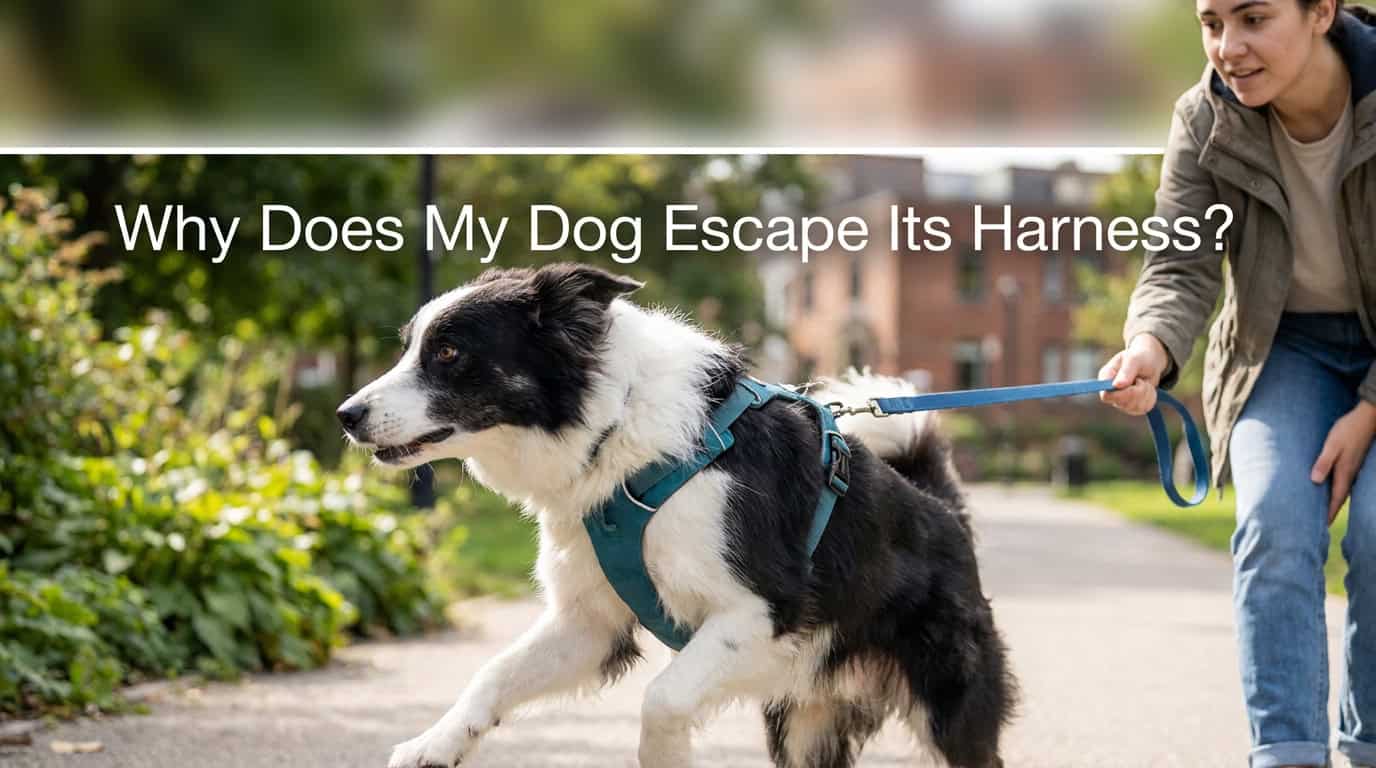
Why Does My Dog Escape Its Harness?
One second your dog is on leash. The next, the harness is dangling in your hand and your dog is three houses away. Harness escapes feel random – but they almost never are. There are three specific reasons dogs escape harnesses, they happen predictably in the same situations every time, and every one of them has a direct fix. This guide covers all three — plus the harness designs that make escape physically impossible for even the most determined dogs.
Why Does My Dog Escape Its Harness?
Dogs escape harnesses for three reasons: the harness is fitted too loosely, the harness design relies on a single contact point that the dog has learned to defeat, or the dog’s body proportions (narrow head, deep chest, or long torso) make standard harness sizing unreliable. Most escapes are fit problems — not behavior problems — and can be resolved without buying a new harness.
- Reason 1 — Wrong fit: The harness is too loose, allowing the dog to back out or slip through
- Reason 2 — Wrong design: Single-loop designs fail on narrow-headed or escape-prone breeds
- Reason 3 — Learned behavior: The dog has discovered the backwards shimmy works and repeats it deliberately
Reason 1 — The Harness Fits Too Loosely
This is the cause of the majority of harness escapes. Most owners size harnesses by weight — and weight-based sizing is unreliable. A 12 lb Dachshund and a 12 lb French Bulldog have completely different chest circumferences, neck widths, and torso lengths. If you sized by the weight label on the packaging rather than by measuring chest girth, there’s a high probability the harness is one size too large.
How to test if fit is the problem:
- Put the harness on your dog and adjust all straps to what feels snug
- Slide two fingers under the chest strap — you should be able to fit exactly two fingers, no more
- Apply gentle backwards pressure to the harness — does the chest strap shift toward the front legs? If it moves more than 1–2 cm, it’s too loose
- Check the neck opening — with the harness on, can you fit your dog’s head back through the neck loop? If yes, it will escape in exactly that way
If any of these tests fail, adjust the straps before concluding you need a new harness. Many escapes are resolved with a single strap tightening — no purchase required.
The Two-Finger Rule
Two fingers under any strap — no more, no less. This applies to the neck loop, chest strap, and belly band. Looser than two fingers and the dog can create enough slack to escape. Tighter and you’re restricting movement and causing discomfort. This single rule fixes most harness fit problems instantly. For the full step-by-step fitting protocol, see our guide on how to fit a dog harness correctly.
Reason 2 — The Harness Design Is Wrong for Your Dog’s Body
Some dogs escape harnesses not because the fit is wrong — but because their body proportions defeat the design entirely. Standard harnesses are built around a proportional dog: head width roughly equal to neck circumference, moderate chest depth, square body shape. A significant number of breeds don’t match this template at all.
Breeds Most Likely to Escape Standard Harnesses
| Breed / Type | Why They Escape | Design Fix |
|---|---|---|
| Chihuahua | Head same width as neck — slides through neck loop | Chest-wrap or figure-8 design |
| Dachshund | Long torso, shallow chest — standard harness sits wrong and shifts | Harness with independent chest + belly adjustment |
| Italian Greyhound / Whippet | Extremely narrow head and neck — defeats virtually all standard harnesses | Escape-free multi-point wrap design only |
| Greyhound | Deep chest but narrow neck — proportions make standard sizing impossible | Breed-specific harness or figure-8 design |
| Pug / French Bulldog | Wide chest relative to weight — standard sizing runs too narrow | Vest-style harness sized by chest girth measurement |
If your dog’s breed appears above and they’ve escaped a correctly fitted standard harness, the design is the problem — not the fit. A single-loop neck harness will never be reliably secure on a Whippet regardless of how tightly it’s adjusted. These breeds require a multi-point contact design that creates two independent escape barriers.
The Single-Loop Problem
Most standard harnesses work on a single security principle: a neck loop that must be wider than the dog’s head to go on, which means it’s theoretically possible for the dog to get their head back through it. For proportional breeds this rarely happens because the head is significantly wider than the neck. For sighthounds, Chihuahuas, and Dachshunds — where the head-to-neck ratio is narrow — the neck loop becomes an escape route the dog learns to use deliberately.
The solution is a harness that wraps the torso in two contact points simultaneously — like the Gooby Escape Free Easy Fit Harness, which uses a figure-8 chest wrap that must be defeated at two independent points simultaneously. In practice, this design simply doesn’t allow escape — the geometry doesn’t permit it regardless of how hard the dog tries.
Reason 3 — Your Dog Has Learned the Backwards Shimmy
Dogs are problem-solvers. Once a dog discovers that planting their feet, dropping their head, and walking backwards while rotating their shoulders simultaneously causes the harness to slide off — they file that information away and repeat it. What starts as an accidental escape becomes a deliberate behavior within two or three repetitions.
You’ll recognize this as the problem if:
- The escape happens in the same situations every time (approaching the car, near other dogs, at the end of a walk)
- Your dog looks calm and deliberate — not panicked — during the escape attempt
- The escape succeeds even when the harness feels snug at the start of the walk
- The dog immediately stops and looks at you once free — they wanted out of the situation, not a full escape
Learned escape behavior has two components to address: the harness design (make escape physically impossible) and the trigger (understand what the dog is trying to get away from). A dog that escapes every time another dog approaches is communicating anxiety about that encounter — a more escape-proof harness solves the immediate safety problem, but the underlying trigger deserves attention too.
Situational Escape Patterns — What They Mean
| When Escape Happens | Likely Cause | Fix |
|---|---|---|
| Approaching the car or vet | Anticipatory anxiety about destination | Escape-proof harness + counter-conditioning the trigger |
| Seeing another dog or person | Reactivity or fear — wants to flee or approach | Escape-proof harness + reactivity training |
| End of walk when approaching home | Doesn’t want the walk to end — learned behavior | Tighter fit + ignore the behavior; reward calm return |
| Loud noises or sudden frights | Fear response — pure flight instinct | Escape-proof harness is non-negotiable here; fear response is fast and powerful |
| Any time, apparently random | Fit problem — harness is consistently too loose | Re-measure and adjust; apply two-finger rule to all straps |
The Three Physical Escape Points on Any Harness
Understanding where harnesses fail mechanically helps you assess any harness — including your current one — before an escape happens.
Escape Point 1 — The Neck Loop
On an overhead harness, the neck loop must be large enough to fit over the dog’s head during normal use. This means it is theoretically wide enough for the head to exit if the dog applies the right combination of downward head pressure and backwards body movement. Fix: The neck loop should be snug enough that two fingers fit underneath, no more. If the loop sits loosely at the base of the neck with visible slack, it will fail on a determined dog.
Escape Point 2 — The Chest Strap Migration
The chest strap on most harnesses is designed to sit just behind the front legs. During backwards escape attempts, this strap migrates forward — toward the front legs — reducing its circumference relative to the dog’s chest and creating enough slack for the dog to slide out. Fix: Check whether the chest strap has a dedicated stop point or if it slides freely along the side straps. Harnesses with fixed attachment points hold position under backwards pressure; harnesses where the strap slides freely along a rail do not.
Escape Point 3 — The Belly Band Gap
On harnesses with a belly band (a strap running under the abdomen), a loose belly band creates a wide loop the dog can step out of sideways rather than backwards. This escape method is slower and less common but is the primary failure mode on step-in harnesses that aren’t adjusted correctly. Fix: The belly band should sit flush against the abdomen — no visible gap between the strap and the body when the dog is standing normally.
The Permanent Fix — For Dogs That Always Escape
If you’ve corrected the fit, chosen the right design for your dog’s breed, and the escapes continue — you need a harness built specifically around the escape problem rather than one that treats it as an afterthought.
The characteristics of a genuinely escape-proof harness:
- Multi-point torso contact — two independent straps around the body, not one loop
- No single point of failure — escape requires defeating two contact points simultaneously, not one
- Fixed strap positions — chest strap doesn’t migrate under backwards pressure
- Chest girth sizing — sized by measurement, not weight; fits the actual body, not an average
For small breeds and escape artists specifically, the Gooby Escape Free Easy Fit Harness (reviewed fully in our best harnesses for small dogs guide) uses a figure-8 wrap that meets all four criteria above. For larger escape-prone breeds, our complete dog harness guide includes escape-resistant picks across all size ranges.
Frequently Asked Questions
Why does my dog keep slipping out of their harness?
The most common cause is a harness that’s fitted too loosely — sized by weight rather than chest girth measurement. Apply the two-finger rule to all straps: exactly two fingers should fit under the chest strap, neck loop, and belly band when the dog is standing. If the fit is correct and escapes continue, the harness design may not suit your dog’s body proportions — breeds with narrow heads or long torsos frequently defeat standard single-loop harness designs.
How do I stop my dog from backing out of their harness?
First, tighten the neck loop — the backwards shimmy escape works by sliding the neck loop over the head, and a snug neck loop physically prevents this. Second, ensure the chest strap has a fixed position and doesn’t migrate forward under backwards pressure. If both are addressed and escape continues, switch to a multi-point design like a figure-8 or chest-wrap harness that doesn’t rely on a neck loop as a security point at all.
What harness is truly escape-proof for dogs?
No harness is escape-proof if it’s fitted incorrectly. However, multi-point chest-wrap designs — like the Gooby Escape Free — are significantly harder to defeat than standard single-loop harnesses because they require the dog to simultaneously defeat two independent contact points. For confirmed escape artists, a figure-8 or dual-strap wrap design with chest girth sizing is the most reliable option available.
Is harness escaping a behavior problem or a fit problem?
Usually both — in sequence. It starts as a fit problem (the harness is loose enough that escape is physically possible), becomes a discovery (the dog accidentally escapes once), and then turns into a learned behavior (the dog repeats it deliberately). Fix the fit first. If the behavior persists after correct fitting, address the design, then the underlying trigger driving the escape attempt.
Can a dog escape a correctly fitted harness?
A correctly fitted standard harness is hard to escape for most breeds. However, sighthounds (Greyhounds, Whippets, Italian Greyhounds) and narrow-headed small breeds (Chihuahuas, some Dachshunds) can defeat even correctly fitted standard harnesses due to body proportions. These breeds require a purpose-built escape-proof design regardless of how well the standard harness is fitted.
Final Verdict
Harness escapes are almost always predictable and preventable. Start with fit — measure chest girth, apply the two-finger rule, check for strap migration under backwards pressure. If fit is correct and escapes continue, the design is wrong for your dog’s body type. And if the escapes happen in specific situations, understand the trigger — the harness is the safety net, but the reason the dog wants out is worth addressing too.
A dog that has never escaped is a dog whose owner got the fit right from day one. It’s worth ten minutes of measuring to never have that moment of an empty leash in your hand again.
Affiliate Disclosure: GearForPet.com participates in affiliate programs. We may earn a small commission if you purchase through our links at no extra cost to you. Read our full disclosure.