
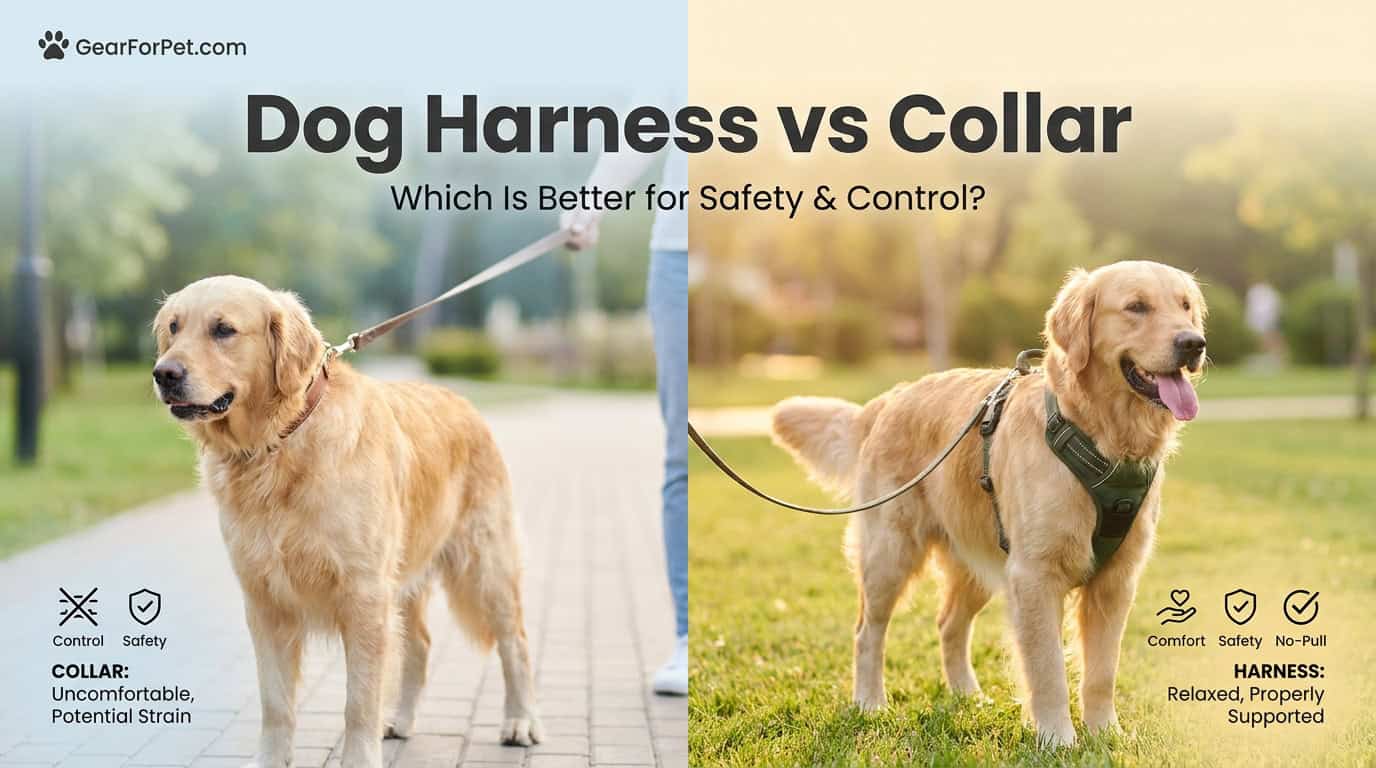
Dog Harness vs Collar: Which Is Safer for Daily Walks?
Most dog owners start with a collar because that’s what comes with the dog. It holds the ID tag, it’s easy to grab, and it’s what everyone else uses. But collars and harnesses apply force to completely different parts of a dog’s body — and for a significant number of breeds, daily collar use during walks causes cumulative damage that shows up years later as tracheal collapse, cervical spine problems, or thyroid issues. This isn’t alarmist — it’s anatomy. This guide gives you a clear, honest answer on which to use, when, and why.
Dog Harness vs Collar – Quick Answer
For daily walks, a harness is safer than a collar for most dogs – especially small breeds, puppies, dogs that pull, and brachycephalic (flat-faced) breeds. Collars are appropriate for ID tags and casual off-leash use, but attaching a leash to a collar on a dog that pulls places direct pressure on the trachea and cervical spine with every lunge. A harness distributes that same pressure across the chest and shoulders, where no critical structures are at risk.
- Use a harness if your dog pulls, is a small or toy breed, has a flat face, is a puppy, or has any history of neck or back issues
- A collar is fine for leash walking only if your dog walks calmly with zero pulling and is a medium-to-large breed with a proportional neck
- Use both – harness for leash attachment during walks, collar for ID tags at all times
Harness vs Collar – Head-to-Head
| Factor | Harness | Collar |
|---|---|---|
| Pressure distribution | Chest and shoulders — no critical structures | Concentrated on throat and neck |
| Trachea safety | ✅ No tracheal contact | ❌ Direct pressure on trachea when dog pulls |
| Pulling control | ✅ Front-clip harnesses actively reduce pulling | ❌ Back-clip collar provides zero pulling correction |
| Escape risk | Low — if correctly fitted | Higher — dogs can back out of collars |
| ID tag placement | ❌ Not ideal — harnesses come on and off | ✅ Standard and permanent ID tag location |
| Ease of use | Slightly more complex to put on | Faster on/off |
| Best for | Daily walks, training, small breeds, pullers | ID tags, off-leash areas, calm large breeds |
Why Vets Recommend Harnesses for Most Dogs
The trachea is a cartilage-ringed tube that sits directly under the skin at the front of a dog’s neck. When a dog pulls against a collar — even moderately — that collar compresses the trachea. Do it once and nothing happens. Do it for three walks a day for three years and the cartilage rings weaken progressively. This is the mechanism behind tracheal collapse, a condition disproportionately common in small breeds like Yorkies, Pomeranians, Chihuahuas, and Toy Poodles.
Beyond the trachea, collar pressure during pulling also affects:
- Thyroid gland — sits alongside the trachea; chronic collar pressure is associated with thyroid disruption in small breeds
- Cervical vertebrae — sudden lunges on a collar can cause micro-trauma to the neck vertebrae, particularly in dogs with long necks (Dachshunds, Greyhounds)
- Vagus nerve — located in the neck; compression affects heart rate regulation in sensitive dogs
- Ocular pressure — studies have shown collar pressure can temporarily elevate intraocular pressure, a concern for breeds prone to glaucoma
A harness eliminates every one of these risks by rerouting all leash force to the chest and shoulder area — where the only thing absorbing pressure is muscle and bone built to handle it.
When a Collar Is Fine — And When It Isn’t
Collars aren’t inherently dangerous. The risk is specifically about leash attachment during walks with a dog that pulls. A collar worn loosely around the neck for ID tag purposes — without a leash attached — causes no harm. The problem is using the collar as the leash attachment point on an active, pulling dog.
Collars are appropriate for:
- ID tag wearing at all times — even dogs that use harnesses for walks should wear a flat collar with tags
- Calm, loose-leash walkers that are fully trained and never pull
- Off-leash areas where the collar is purely for identification
- Large, proportional breeds (Labrador, Golden Retriever, German Shepherd) in the hands of experienced handlers who have eliminated pulling
Collars are not appropriate for:
- Any dog that pulls — regardless of size or breed
- Small and toy breeds on daily leash walks
- Brachycephalic breeds (Pugs, French Bulldogs, Bulldogs, Shih Tzus) — even light collar pressure compounds airway compromise
- Puppies — their tracheal cartilage is still developing and far more vulnerable to compression damage
- Dogs with any diagnosed neck, spine, or trachea condition
- Sighthounds (Greyhounds, Whippets) — their narrow heads mean they can back out of collars easily
The Pulling Question — This Is What Decides It
The single most important variable in the harness vs collar decision is whether your dog pulls on leash. If your dog walks calmly at your side with a loose leash, collar risk is low and the debate is mostly academic. If your dog pulls — even occasionally — a collar is the wrong leash attachment point.
Here’s why a back-clip collar makes pulling worse: when a dog feels collar resistance at the throat, the natural reflex is to pull harder against it — the same opposition reflex that makes sled dogs effective. The collar doesn’t discourage pulling. It trains into it.
A front-clip harness, by contrast, works with physics rather than against it. When the dog pulls forward, the leash attachment at the chest redirects the dog’s momentum sideways — breaking the forward drive without any pain or pressure on sensitive structures. This is the same reason front-clip harnesses are the standard recommendation in professional leash-training programs. For our full breakdown of no-pull harness options, see the complete dog harness guide — and specifically the best no-pull harnesses for large dogs if you have a strong, heavy puller.
Breed-Specific Guidance — Harness or Collar?
| Breed / Type | Recommended | Reason |
|---|---|---|
| Chihuahua, Yorkie, Pomeranian | ✅ Harness always | High tracheal collapse risk; fragile neck anatomy |
| Pug, French Bulldog, Shih Tzu | ✅ Harness always | Compromised airway; any throat pressure is dangerous |
| Dachshund | ✅ Harness always | Long spine, IVDD risk — collar pulls transfer to spine |
| Greyhound, Whippet, Italian Greyhound | ✅ Harness always | Narrow head — can back out of collars; escape risk |
| Labrador, Golden Retriever | ⚠️ Harness if pulling; collar if calm | Sturdy anatomy tolerates collar — but pulling still harmful |
| German Shepherd, Border Collie | ⚠️ Harness for walks; collar for ID | High-energy; pulling risk high without consistent training |
| All puppies | ✅ Harness always | Tracheal cartilage still developing; collar pressure causes lasting damage |
The Setup Most Dog Owners Should Use
The harness vs collar debate has a practical resolution that most experienced dog owners land on independently: use both, for different purposes.
- Flat collar (always on) — for ID tags, microchip registration backup, and emergency grab point. Never attach a leash here unless your dog is fully trained and never pulls.
- Harness (walks and outings) — the leash always clips to the harness. Front clip for active training, back clip for casual walks once training is solid.
This isn’t overcomplicated — it’s just the right tool for each job. The collar keeps your dog identified 24/7. The harness keeps your dog safe on leash. They serve different functions and don’t compete with each other.
For small dogs specifically, getting the harness fit right is critical — a poorly fitted harness can itself become an escape or chafing risk. See our guide to how to fit a dog harness correctly for the exact two-finger rule and breed-specific fitting notes. And if your dog has already slipped out of their harness, this guide explains exactly why it happens and how to stop it.
Frequently Asked Questions — Harness vs Collar
Is it better to walk a dog with a harness or collar?
For the vast majority of dogs, a harness is the safer choice for leash walking. It removes all pressure from the trachea, cervical spine, and thyroid — structures that are directly compressed when a dog pulls against a collar. The only exception is a fully trained, calm large-breed dog that never pulls and has a proportional neck build.
Can a harness be harmful to a dog?
A poorly fitted harness can cause chafing, restrict shoulder movement, or create pressure points at the armpits — but a correctly fitted harness causes none of these issues. The two-finger rule (two fingers should slide under any strap) and measuring chest girth rather than relying on weight sizing will prevent the vast majority of fit problems. See our harness fitting guide for the full protocol.
Should I use a collar or harness for a puppy?
Always a harness for leash walking. Puppies’ tracheal cartilage is still developing and is significantly more vulnerable to compression damage than adult dogs. Use a flat collar for ID tags, but never attach the leash to it during the puppy phase — or after, if the dog pulls.
Do vets recommend harnesses over collars?
Yes — most veterinary guidance recommends harnesses for daily leash walking, particularly for small breeds, brachycephalic breeds, and any dog that pulls. The American Veterinary Medical Association does not endorse choke chains or prong collars, and the general clinical consensus is that front-clip harnesses are the safest and most effective training tool for pulling dogs.
What type of collar is safest if I don’t use a harness?
If you choose to walk on a collar, a flat buckle collar — properly fitted, not too loose — is the safest option. Choke chains and prong collars apply intentional pressure to the trachea as a correction mechanism and carry significant injury risk. Martingale collars (a limited-slip design) are a safer middle ground for dogs that tend to slip out of flat collars, but still aren’t recommended as a leash attachment point for dogs that pull hard.
Final Verdict
The collar vs harness debate isn’t really a debate — it’s a question of anatomy. Collars place leash force on structures that aren’t designed to handle it. Harnesses don’t. For small breeds, flat-faced breeds, puppies, and any dog that pulls, the answer is unambiguously a harness for walks. For larger, fully trained calm dogs, a collar can work — but a harness is still the safer default.
Keep the collar for ID. Walk on a harness. That’s the setup that protects your dog long-term — and it costs nothing extra if you already have both.
Ready to find the right harness? Our best dog harnesses guide for 2026 covers every size, breed, and use case — with verified picks at every price point.
Affiliate Disclosure: GearForPet.com participates in affiliate programs. We may earn a small commission if you purchase through our links at no extra cost to you. Read our full disclosure.