Do Cats Need a Water Fountain? What Vets Actually Say
You have seen the claims: fountains prevent kidney disease, fountains triple your cat’s water intake, every vet recommends them. You may have already bought one, watched your cat ignore it for a week, and quietly moved it to the back of a cupboard. Or you are considering buying one and wondering whether the evidence actually holds up before spending the money.
The honest answer is more nuanced than most pet sites will tell you. Vets do lean toward recommending fountains — but the published science is less dramatic than the marketing suggests, and whether a fountain makes a meaningful difference depends entirely on three identifiable factors specific to your cat. This guide gives you the evidence, the vet perspective, and a clear answer for your situation.
What Most Articles Get Wrong About Cat Water Fountains
The majority of content on this topic is written by fountain brands or affiliate sites with a financial interest in you buying one. That does not make their recommendations wrong, but it does mean the inconvenient evidence tends to disappear.
Here is what the research actually shows. A published crossover study of 9 cats found that average daily water intake from a flowing fountain (115.44 mL) was only marginally higher than from a still bowl (109.83 mL) — a difference that did not reach statistical significance. A separate 16-cat randomised study found no consistent population-level increase in water consumption from fountain use. Walkerville Vet, an Australian veterinary practice with 25 years of clinical experience, publicly described these findings as “very inconvenient evidence” after having recommended fountains to clients for years.
This matters. It means the claim that “cats drink dramatically more from a fountain” is not supported at the population level. But it does not mean fountains are useless — it means the benefit is individual rather than universal, and the cats who benefit most are identifiable in advance.
What Vets Actually Recommend — and Why
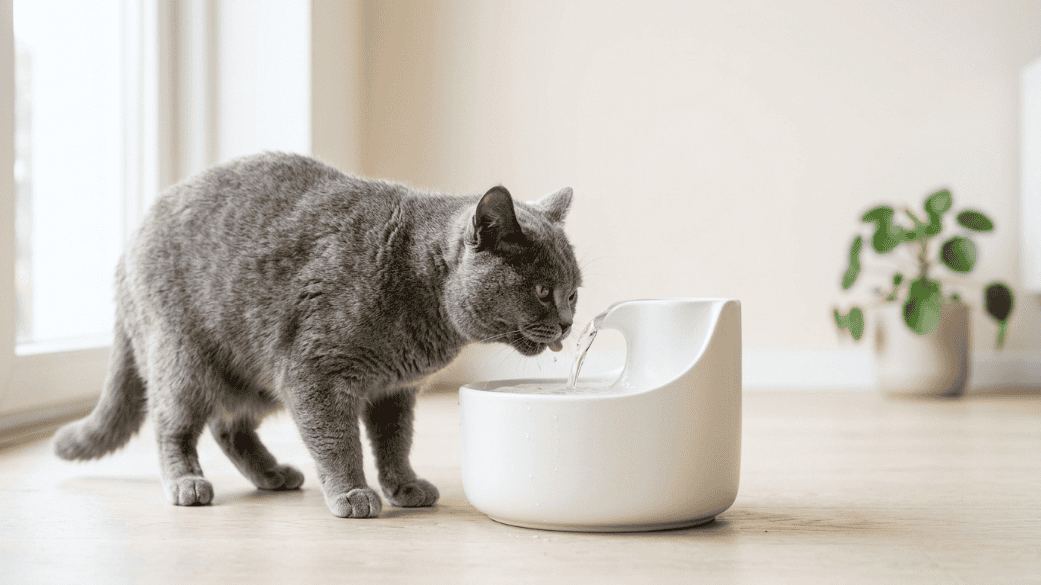
Despite the mixed population-level evidence, most vets do recommend fountains in clinical practice. The reasoning is not “fountains always increase intake” — it is more specific than that.
Cats have a weak thirst drive by design. Cats evolved as desert predators who obtained most of their moisture from prey rather than drinking. Their thirst sensation is genuinely less acute than in dogs or humans, which means they can become mildly dehydrated before their body registers significant thirst. This is not a fountain problem — it is a species-level biology problem. Fountains lower the barrier to drinking, which is a low-friction way to work with that biology rather than against it.
Individual preference is strong and real, even if population averages are flat. The same studies that found modest average increases also found significant individual variation — some cats drank substantially more from a fountain while others showed no change. If your cat is a strong individual responder, the benefit is meaningful. The only way to know which type your cat is: try it.
For cats with specific health conditions, increased water intake is clinically significant. This is where vet recommendations become most consistent and most evidence-backed:
- Chronic kidney disease (CKD) — PDSA clinical guidance specifically lists water fountains as a recommendation for cats with CKD, where higher fluid intake slows disease progression and reduces the concentration of waste products the damaged kidneys must filter
- Urinary tract disease and crystals — dilute urine reduces crystal formation and recurrence risk; anything that reliably increases intake has a direct clinical benefit
- Diabetes mellitus — increased thirst is a symptom, but ensuring consistent access to preferred water sources supports management
- Constipation and megacolon — hydration directly affects stool consistency; chronically under-hydrated cats are at higher risk for recurrence
The Purina Institute’s clinical nutrition guidance on maintaining hydration in cats with CKD identifies palatability of water — which includes temperature, freshness, and movement — as one of the key intervention points for increasing voluntary intake in cats that are resistant drinkers.
Does Your Cat Actually Need a Water Fountain? The 3-Factor Test
A fountain is most likely to make a meaningful difference for your cat if at least one of the following applies. Check your cat against each factor before deciding.
- Your cat shows water avoidance behaviours. Ignoring a full, clean water bowl. Seeking running water from taps or sinks. Batting at the bowl surface before or instead of drinking. Drinking only when you run the tap nearby. These behaviours are your cat communicating a preference for moving water — a fountain directly addresses the signal your cat is already sending.
- Your cat has a diagnosed health condition. CKD, urinary crystals or recurrent UTIs, diabetes, or chronic constipation all have a clinically meaningful relationship with water intake. For these cats, a fountain is not a lifestyle upgrade — it is a low-cost, low-friction medical intervention worth trying before more invasive options.
- Your cat eats exclusively or primarily dry food. Wet food is approximately 70–80% moisture by weight. Dry kibble is approximately 10%. Cats fed exclusively dry food must get nearly all their daily moisture from drinking alone — a task their weak thirst drive makes them poorly equipped for. Fountains significantly reduce the friction of voluntary drinking for dry-food-only cats and represent the highest-value use case in the category.
A fountain is less likely to make a significant difference if: your cat drinks reliably and consistently from a bowl without prompting, eats wet food as their primary or sole diet, and has clean annual blood panels with no urinary or kidney concerns. In this case, a fountain may offer marginal benefits but is not urgent — and the money is better spent elsewhere in your cat’s care budget.
The One Thing That Matters More Than Buying a Fountain
Before you buy anything, move your cat’s water bowl.
Most cats are mildly underhydrated not because of fountain absence but because of placement. Water positioned next to or near the food bowl triggers an instinctive contamination avoidance response — in the wild, water near a carcass signals bacterial contamination and is avoided. Most cat owners set up food and water side by side because it is tidy and convenient. Their cat’s biology treats this arrangement as a warning signal.
Move the water bowl to a completely separate location from the food — different side of the room at minimum, different room entirely if possible. Do this before buying any fountain. If your cat’s drinking improves noticeably within a week, placement was the problem and you have solved it for free. If drinking does not improve and your cat still shows avoidance behaviours, that is your signal that a fountain is the right next step.
If you do buy a fountain, the cordless format has a specific advantage here: it lets you place the fountain anywhere in the home rather than within cable reach of a wall outlet, which is often directly in the kitchen where the food already is. This is one of the underrated practical arguments for cordless designs like the PETLIBRO Dockstream 2 — placement flexibility is a functional feature, not just a convenience.
For a full breakdown of the signs that your cat is not drinking enough and what is causing it, see our guide to why cats don’t drink enough water and how to fix it.
Is a Cat Water Fountain Worth Buying? The Honest Answer by Cat Type
There is no universal answer. Here is the honest breakdown by situation:
| Your cat’s situation | Fountain verdict | Recommended action |
|---|---|---|
| Shows water avoidance behaviours (seeks taps, ignores bowl) | ✅ Clear yes | Buy a stainless or ceramic fountain. Start with a budget option to confirm behaviour change. |
| Diagnosed with CKD, urinary crystals, or UTIs | ✅ Vet-recommended | Prioritise this. Talk to your vet about fluid intake targets alongside fountain use. |
| Eats exclusively dry food, no health issues | ✅ Strongly recommended | Dry food cats have the highest need for voluntary drinking support. |
| Unsure whether cat will use a fountain | 🟡 Worth testing cheaply | Start with the Catit LED Flower Fountain (~$20). Treat it as a proof-of-concept purchase. |
| Drinks reliably from a bowl, eats wet food, healthy bloodwork | ⬜ Not urgent | Move the bowl away from food first. Reassess at next vet visit. |
| Previously bought a fountain that was ignored | 🟡 Diagnose before replacing | Check placement, filter condition, and flow setting before buying a replacement. |
If You Do Buy One: What to Look For
This is not the place for a full fountain review — that breakdown lives in our complete guide to the best cat water fountains in 2026. But three factors determine whether a fountain gets used long-term or ends up in a cupboard: material (stainless steel or ceramic, never plastic long-term), noise level (a loud pump gets unplugged, then the whole thing gets abandoned), and placement flexibility (corded fountains end up next to food bowls because that is where the outlet is).
The PETLIBRO Dockstream 2 is the clearest overall recommendation for owners who have confirmed their cat responds to moving water — cordless, stainless steel, near-silent. For owners testing the concept before committing, the Catit LED Flower Fountain at ~$20 is the right proof-of-concept purchase. Full picks, honest trade-offs, and who each fountain is actually for: Best Cat Water Fountains 2026.
FAQ
Do vets recommend cat water fountains?
Most vets do recommend them, particularly for cats with CKD, urinary disease, or dry-food-only diets. The recommendation is less about fountains universally increasing water intake — population-level studies show modest, sometimes non-significant differences — and more about individual cat preference, reduced drinking friction, and clinical benefit for cats with specific health conditions.
- Strongest vet recommendation: cats with CKD, urinary crystals, or recurrent UTIs
- Consistent recommendation: cats fed exclusively dry food
- Conditional recommendation: cats showing water avoidance behaviours
- Less urgent: cats already drinking consistently with clean bloodwork on a wet food diet
Do cats drink more water from a fountain than a bowl?
At the population level, the difference is smaller than most fountain marketing suggests. Published crossover studies found modest average increases that did not reach statistical significance. However, individual variation is significant — some cats drink substantially more from a fountain while others show little change. The cats most likely to show a meaningful individual response are those who already display water avoidance behaviours with a still bowl or who eat exclusively dry food.
Is a cat water fountain necessary?
Not for every cat. It is most necessary — and most clearly evidence-backed — for cats with CKD or urinary disease, cats fed exclusively dry food, and cats that show consistent avoidance of still water. For cats already drinking reliably on a wet food diet with no health concerns, a fountain is a marginal upgrade rather than a necessity. The higher-priority intervention for most cats is moving the water bowl away from the food bowl, which costs nothing.
What is the best cat water fountain vets recommend?
Vets do not endorse specific brands in clinical settings, but the consistent recommendation is for stainless steel or ceramic over plastic due to bacterial resistance and long-term hygiene. For a full ranked breakdown of the top fountains by use case, noise level, and ease of cleaning, see our best cat water fountains guide.
Can a dirty fountain make my cat sick?
Yes — a poorly maintained fountain is worse than a clean bowl. Biofilm and bacterial buildup in a plastic fountain that is not cleaned weekly will deter cats from drinking and can cause gastrointestinal upset. The fountain that never gets cleaned is worse than the bowl it replaced. If maintenance is a genuine barrier, stainless steel or ceramic fountains are significantly easier to keep genuinely clean, and weekly cleaning should be non-negotiable regardless of material.
My cat ignored the fountain I bought. Does that mean fountains don’t work for them?
Not necessarily. Before concluding fountains do not work for your cat, check four things: the fountain’s placement relative to the food bowl (the most common cause of rejection), the flow setting (some cats prefer a gentle bubbler over a cascade), the filter condition (overdue filters make the water taste worse), and the material (some cats reject plastic due to smell). A cat that ignores one fountain design may drink consistently from a different material or flow style. See our full guide on why cats don’t drink enough water for a full diagnostic checklist.
Affiliate Disclosure: GearForPet.com participates in affiliate programs. We may earn a small commission if you purchase through our links at no extra cost to you. Read our full disclosure.