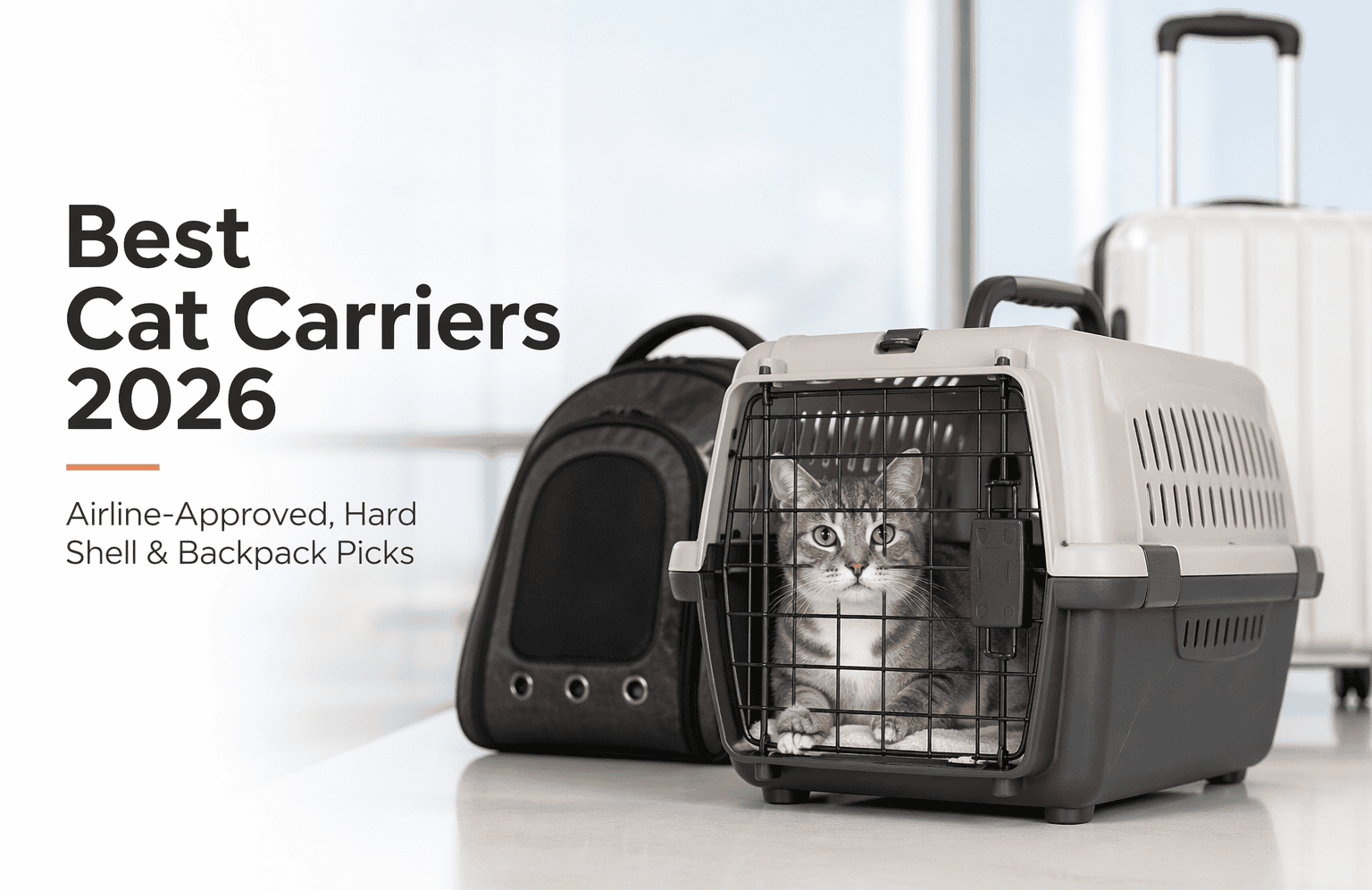
Best Cat Carriers 2026: Airline-Approved, Hard Shell & Backpack Picks
Two things go wrong with cat carriers more than anything else. The first: you arrive at the airport, the gate agent pulls out a tape measure, and your carrier is half an inch too wide for the under-seat space on that specific airline. The second: your cat associates the carrier so strongly with vet visits and stress that getting them inside it becomes a ten-minute ordeal every single time. This guide covers the seven carriers that solve both problems — ranked by genuine airline compliance, stress-reducing design, and whether they hold up over years of real use.
Quick Comparison: Best Cat Carriers 2026
| Product | Best For | Type | Airline Approved | Price Tier | Link |
|---|---|---|---|---|---|
| Sleepypod Air | 🏆 Best Overall | Soft-sided / convertible | ✅ Yes | Premium (~$160) | Check current price on Amazon |
| Sherpa Original Deluxe | ✈️ Best Airline Budget | Soft-sided | ✅ Yes | Mid (~$50) | See latest price on Amazon |
| Frisco Premium Quilted Bag | 💰 Best Budget Overall | Soft-sided | ✅ Yes | Budget (~$30) | Compare prices on Amazon |
| Catit Cabrio | 🔝 Best Top-Loading | Hard shell / convertible | ⚠️ Check dimensions | Mid (~$55) | Check sizing on Amazon |
| Mr. Peanut’s Gold Series | 🎒 Best Backpack | Backpack | ⚠️ Check dimensions | Mid (~$55) | View current deal on Amazon |
| Sleepypod Mobile Pet Bed | 🚗 Best for Car Trips | Soft-sided / convertible | ✅ Yes | Premium (~$130) | See current pricing on Amazon |
| Petluv Happy Cat Premium | 😺 Best for Large Cats | Soft-sided | ✅ Yes | Mid (~$65) | Check availability on Amazon |
The Airline Dimension Problem Nobody Talks About Honestly
The phrase “airline approved” on a carrier label means almost nothing on its own. Airlines set their own under-seat dimensions independently, and a carrier that fits perfectly under a Delta seat can be half an inch too tall for a JetBlue flight. No carrier manufacturer can guarantee approval on every airline — they can only guarantee their carrier fits the most common configurations. Before any flight, verify your carrier dimensions against your specific airline’s current policy.
| Airline | Max carrier dimensions (L × W × H) | Notes |
|---|---|---|
| Delta | 18″ × 11″ × 11″ | Soft-sided only under seat |
| American Airlines | 19″ × 13″ × 9″ | Soft-sided required |
| United Airlines | 17.5″ × 12″ × 7.5″ | One of the stricter size limits |
| Southwest | 18.5″ × 13.5″ × 9.5″ | Soft-sided only |
| JetBlue | 17″ × 12.5″ × 8.5″ | Verify before booking |
| Lufthansa | 55cm × 40cm × 23cm | Approx. 21.6″ × 15.7″ × 9″ |
Important: airline policies change without notice. Always verify dimensions directly with your airline before travel — not with the carrier manufacturer.
Best Overall: Sleepypod Air In-Cabin Carrier
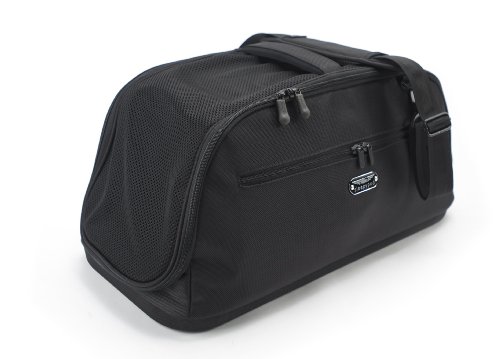
The Sleepypod Air is the most thoughtfully engineered carrier in the category and the one that holds up against the hardest scrutiny. It is crash-tested and certified by the Center for Pet Safety — one of the very few carriers that has gone through actual structural safety testing rather than just claiming it. The patented compressible design allows it to flex into tighter under-seat spaces than its stated dimensions suggest, which is why it has maintained a genuine reputation among frequent flyers with cats for over a decade. The interior is padded, the ventilation mesh is on multiple sides, and the top-loading option means cats can be settled in without the extraction struggle that front-only carriers create.

What most reviews miss about the Sleepypod Air: the convertible design means it functions as a cat bed at home between trips. This is not a minor convenience feature — it is the most effective way to reduce carrier-related stress. Cats that sleep in their carrier regularly stop associating it exclusively with vet visits and travel. The Sleepypod’s plush interior makes it genuinely comfortable as an everyday sleeping spot, which is something a hard plastic or bare-mesh carrier cannot replicate. Owners who introduce the Sleepypod as a bed first consistently report smoother travel experiences than those who only bring it out at trip time.
Honest trade-off: the price is significant. At ~$160, it is the most expensive carrier on this list by a wide margin. It is the right investment if you fly with your cat regularly or want a carrier that will last years without replacement. For occasional or one-time travel, the Sherpa below delivers solid performance at a third of the cost.
Who it’s for: frequent flyers; owners who want crash-tested safety certification; anyone who has struggled with carrier stress and wants to solve it properly from the start.
Who should skip it: occasional travellers who fly once a year or less; owners on a tight budget testing whether their cat will tolerate travel at all.
Best Airline Budget Pick: Sherpa Original Deluxe Airline-Approved Carrier
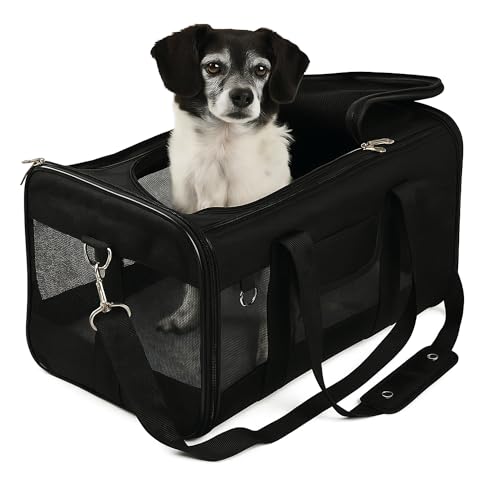
The Sherpa Original Deluxe has been the default airline carrier recommendation for over fifteen years for a straightforward reason: it works, it fits most under-seat configurations, and it has a long enough review history to trust. The patented spring wire frame allows it to compress slightly for the tightest fits while snapping back to full shape outside the seat. Multiple mesh panels provide ventilation from three sides. The locking zippers address one of the most common owner anxieties — a stressed cat forcing the zipper during a flight.

What long-term owners consistently report: the Sherpa holds up to heavy use without the seams splitting or the frame warping that affects cheaper soft carriers after a year of regular travel. Owners who have used the same Sherpa for five or more years are not uncommon in verified reviews — that durability track record at this price point is genuinely rare in the category.

Honest trade-off: the interior padding is minimal compared to the Sleepypod. For short flights or vet visits it is adequate. For long-haul travel or cats that need extra comfort reassurance, adding a small familiar-scented blanket inside makes a significant difference. The washable liner helps here — pull it out, wash it, replace it with your cat’s regular bedding for a few days before travel to transfer familiar scent.
Who it’s for: owners who fly occasionally and need reliable airline compliance without the premium price; anyone replacing a carrier that failed at the gate.
Who should skip it: owners whose cats need maximum comfort padding for anxiety; very large cats over 15 lbs.
Best Budget Overall: Frisco Premium Airline Compliant Quilted Bag
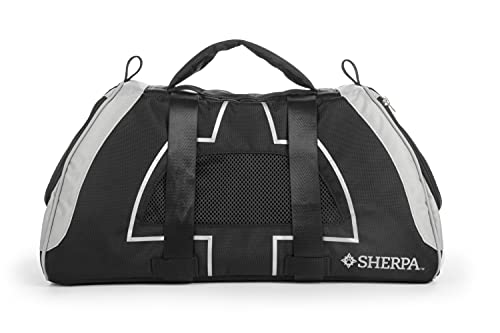
The Frisco Premium Quilted Bag is the right answer when budget is the genuine constraint and you need a carrier that is airline compliant, well-ventilated, and not going to fall apart on the first trip. It is not the most feature-rich carrier on this list, but it does the job it is built for reliably. The quilted exterior gives it a cleaner look than most budget options, the mesh panels ventilate adequately, and the dimensions sit comfortably within most major airline under-seat allowances.

Where it earns its price: for a first carrier purchase — confirming whether your cat will tolerate carrier travel before investing in a premium option — the Frisco delivers everything that matters. Ventilation, compliance, secure closure, comfortable interior lining. The features you pay extra for in premium carriers (crash-tested frames, convertible bed design, multiple-decade durability) are genuine upgrades, but they are not reasons to spend $160 before you have established that your cat travels calmly.

Honest trade-off: the frame is lighter than the Sherpa and will not hold its shape as well under repeated compression. Fine for occasional travel; less suitable as a permanent high-frequency travel carrier.
Who it’s for: first-time carrier buyers; owners confirming travel tolerance before upgrading; genuinely budget-constrained households.
Who should skip it: frequent travellers who need a carrier to last five or more years; cats over 12 lbs.
Best Top-Loading Carrier: Catit Cabrio
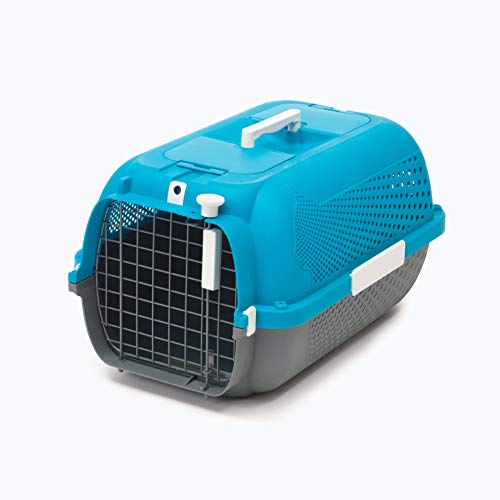
Top-loading is not a preference feature — it is a practical one. Vets strongly prefer top-loading carriers because they allow examination without requiring the cat to exit the carrier entirely, which reduces stress significantly in clinical settings. For owners whose cats resist entering a front-loading carrier, top-loading removes the physical wrestling match: you lower the cat in from above rather than coaxing them through a door they associate with confinement. The Catit Cabrio does this well, with a wide top opening, solid hard-shell construction that protects against accidental compression on a seat or overhead surface, and ventilation panels on multiple sides.

The vet visit case for top-loading: a cat that has retreated to the back of a front-loading carrier during a stressful vet visit requires the carrier to be fully disassembled or the cat to be tipped out — both of which increase anxiety. A top-loading carrier lets the vet reach in, complete parts of the examination with the cat still partially enclosed, and reduce the total time the cat spends fully exposed in an unfamiliar environment. If your cat has vet-visit anxiety specifically, the loading style of the carrier is the highest-impact design change you can make.

Honest trade-off: the hard shell adds weight and the dimensions may not fit under some airline seats. Verify before flying. For ground transport — vet visits, car trips, moving house — it is an excellent choice. For air travel specifically, the Sleepypod or Sherpa are more reliable fits.
Who it’s for: owners whose cats resist front-loading carriers; anyone who visits the vet frequently; car-travel households.
Who should skip it: owners who primarily need an under-seat airline carrier; owners who want a lightweight travel option.
Best Backpack Carrier: Mr. Peanut’s Gold Series Expandable Backpack

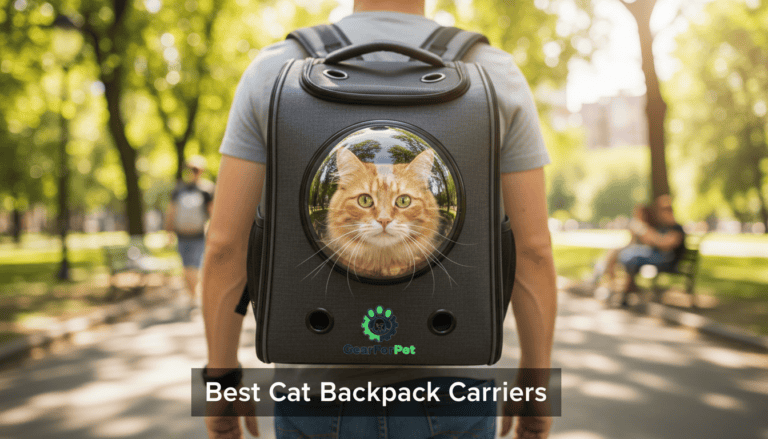
Backpack carriers have earned a genuine place in the category over the last few years — not as a gimmick, but because they solve a specific real problem: hands-free transport for owners who use public transport, cycle, or need both hands free while managing an anxious cat in a busy environment. Mr. Peanut’s Gold Series is the most consistently recommended backpack carrier at a non-premium price, with a bubble window that gives cats a wide sightline without exposure, padded shoulder straps that distribute weight properly for heavier cats, and an expandable mesh panel that gives the cat more space once you reach your destination.

What backpack carrier owners learn quickly: cats respond very differently to backpack transport than to traditional carriers. The upright position, the movement of walking, and the ability to see out of the bubble window without direct exposure to the environment produces a calmer response in many cats that are stressed in standard carriers. It is not universal — some cats dislike the movement — but for cats that are stressed in still carriers on stationary surfaces, a backpack is genuinely worth trying as an alternative format.

Honest trade-off: the dimensions will not fit under most airline seats. This is a ground-transport carrier. For air travel, use the Sleepypod or Sherpa. The bubble window also needs regular cleaning — it fogs and scratches if neglected, which reduces the sightline benefit your cat is relying on.
Who it’s for: owners who use public transport, cycle, or need hands-free carrying; cats that are curious rather than anxious about their environment; short urban trips.
Who should skip it: owners who need airline compliance; cats that are highly stressed by movement or new environments.
Best for Car Trips: Sleepypod Mobile Pet Bed
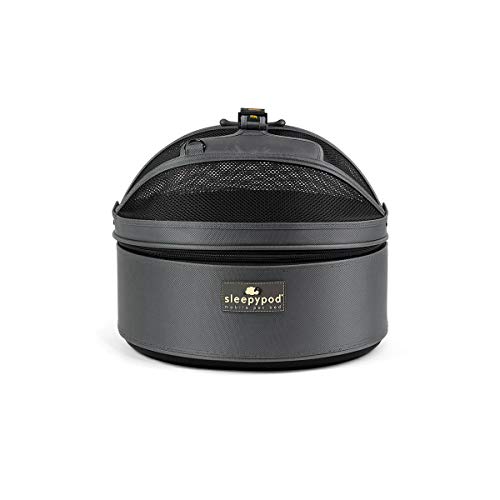
The Sleepypod Mobile Pet Bed is the only carrier on this list that is also a crash-tested car safety product. It attaches to a seatbelt, has been through independent safety testing, and is endorsed by the Center for Pet Safety — the same organisation that tested the Sleepypod Air. For regular car travel, this matters more than most owners realise. In a sudden stop or collision, an unsecured carrier becomes a projectile. The Sleepypod Mobile absorbs that force through the seatbelt attachment rather than transferring it through your cat.
The real reason to choose this over a standard carrier for car travel: it also functions as a daily cat bed at home, which means your cat can sleep in it between car trips and build a positive association with the carrier as a comfort space rather than a stress signal. The same logic applies as with the Sleepypod Air — a carrier that lives in your home as a sleeping spot produces a dramatically calmer cat when travel time comes. The plush interior of the Mobile Pet Bed is genuinely comfortable for everyday use, not just functional padding.

Honest trade-off: it is a premium price for what is essentially a soft-sided carrier. The safety certification and the bed-use versatility justify the cost for owners who travel by car regularly. For occasional car trips to the vet, the Sherpa or Frisco are adequate and far cheaper.
Who it’s for: owners who drive with their cat regularly; anyone who has worried about carrier safety in a car; households that want a carrier that doubles as a cat bed.
Who should skip it: owners who rarely travel by car; anyone whose primary need is airline travel.
Best for Large Cats: Petluv Happy Cat Premium Carrier
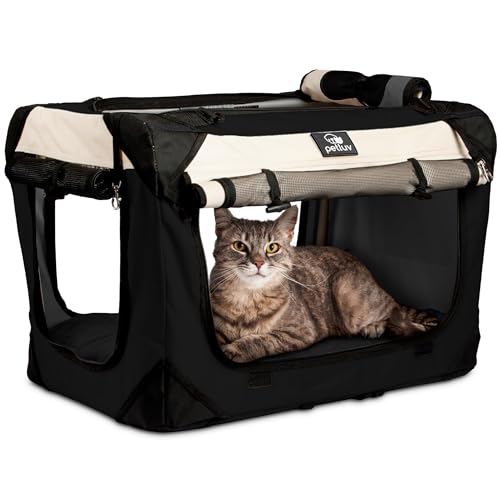
Most carriers labelled “large” are built for cats up to 12 lbs. If your cat is a Maine Coon, a Ragdoll, a large male domestic, or simply on the bigger end of average, that “large” label is misleading — and discovering this on the way to the vet or at an airport check-in is not when you want to find out. The Petluv Happy Cat is built specifically for genuinely large cats, with interior dimensions that allow a 15–20 lb cat to stand, turn, and lie down comfortably. Multiple mesh panels provide ventilation on three sides, and the top-and-front dual loading options give you flexibility for vet visits and everyday use.

The ASPCA standard every carrier should meet: your cat should be able to stand at full height, turn around completely, and lie down in a natural position inside the carrier. If any of these three movements are restricted, the carrier is too small — and a stressed, cramped cat in a too-small space is more likely to panic than a cat with adequate room. For large breed owners, this standard eliminates most mainstream carriers immediately. The Petluv is one of the few that genuinely clears it for 15+ lb cats.
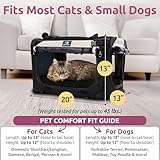
Honest trade-off: the larger dimensions mean it will not fit under all airline seats. Verify your airline’s policy before flying. For ground transport — vet visits, car trips — it is the clearest recommendation for large cats available at this price point.
Who it’s for: large breed cats (Maine Coon, Ragdoll, large domestic shorthair over 12 lbs); owners who have bought “large” carriers that still felt cramped.
Who should skip it: owners of average-sized cats who do not need the extra space; owners whose primary use case is under-seat airline travel.
What to Look for in a Cat Carrier
Type: Soft-Sided vs Hard-Sided vs Backpack
Soft-sided carriers are the right default for most owners. They compress to fit tighter spaces, are lighter to carry, and are more comfortable for cats on soft surfaces. Hard-sided carriers offer more structural protection and are preferred by vets for examination — they can be partially disassembled to allow treatment without full cat removal. Backpack carriers solve the hands-free transport problem specifically and suit cats that are curious rather than anxious about their environment. There is no universally superior type — the right choice depends on your primary use case.
Loading Style: Front vs Top
This is one of the most under-discussed decisions in carrier buying and one of the highest-impact ones. Front-loading requires coaxing or pushing a resistant cat through a horizontal door — the direction cats most instinctively resist when stressed. Top-loading allows you to lower the cat in from above, which most cats accept with significantly less resistance. For vet visits specifically, a top-loading carrier allows partial examination inside the carrier, which keeps stress lower than a full exposure on a table. If your cat has ever planted all four paws at the entrance of a front-loading carrier, a top-loading design will change your experience immediately.
Size: The ASPCA Stand-Turn-Lie Rule
Your cat should be able to stand at full height without their head touching the ceiling, turn around completely without their body pressing the sides, and lie down in a natural stretched position. If any of these movements are restricted, size up. Cats in cramped carriers are more likely to panic — the sense of physical confinement compounds the stress of the travel experience. When sizing, measure your cat from nose to base of tail (length) and from floor to top of head (height), then add 2–3 inches in each dimension for the carrier interior.
Ventilation
Mesh panels on at least two sides are the minimum. Three or more sides is preferable, particularly for anxious cats where airflow reduces the claustrophobic effect of a fully enclosed space. Mesh also allows your cat to see out without being directly exposed to the environment — which maintains a sense of connection and awareness that fully opaque carriers remove. For flat-faced breeds (Persians, Exotic Shorthairs), ventilation is a safety issue, not just a comfort preference — their restricted airways mean they are more vulnerable to overheating in inadequately ventilated carriers.
Stress Reduction Features
The single most effective stress reduction technique costs nothing and requires no special carrier: leave the carrier out as a piece of furniture at home between trips. A carrier that lives in a cupboard and only appears on vet visit day becomes a reliable stress trigger. A carrier that sits in the living room with a familiar blanket inside, that your cat has slept in voluntarily, is a neutral or positive space. Carriers with comfortable interior padding that functions as a genuine bed — the Sleepypod designs specifically — make this strategy easier to execute. Covers or blanket draping for carriers during travel also help by reducing visual stimulation from a stressful environment.
Common Carrier Mistakes That Make Things Harder
Only bringing the carrier out at vet or travel time. This is the fastest way to create a carrier-phobic cat. The carrier becomes a reliable predictor of stress and your cat will hide the moment it appears. Fix: leave it out permanently with a familiar blanket inside. Feed treats near it. Let your cat choose to sleep in it. This is the highest-impact change you can make and it costs nothing.
Buying based on “airline approved” without checking your actual airline. See the dimension table above. Approved for one airline does not mean approved for all airlines. Check dimensions against your specific carrier before every flight.
Choosing front-loading only. For cats that already resist carriers, front-loading is the hardest option. A top-loading carrier removes the horizontal resistance response entirely. If your current carrier is front-loading and your cat resists it, a top-loader is the simplest fix before trying anything else.
Sizing for current weight without considering interior dimensions. Two carriers labelled “up to 15 lbs” can have very different interior dimensions. Weight capacity refers to structural load, not comfortable interior space. Always check the interior dimensions against your cat’s measurements, not the weight limit on the label.
Using a shared carrier for multiple cats. Cats transfer scent to their carrier and that scent signals territory. Placing one cat into a carrier saturated with another cat’s stress scent increases anxiety before travel has even begun. Separate carriers per cat, washed regularly, is the cleaner solution.
Edge Cases
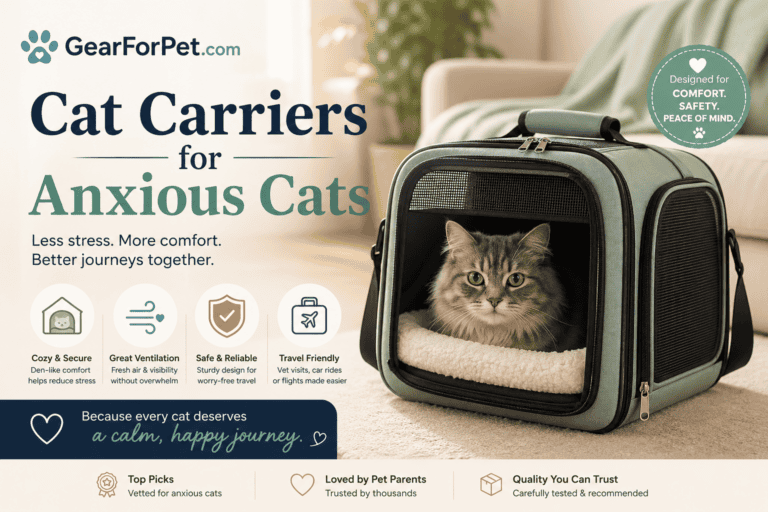
Anxious or reactive cats: carrier design is only one part of the anxiety equation. For cats with significant travel anxiety, the introduction method, familiar scenting, and whether the carrier is a familiar space at home all matter more than which specific model you buy. See our complete guide to best cat carriers for anxious cats for a full breakdown of stress-reduction strategies alongside carrier selection.
Large breeds (Maine Coon, Ragdoll, Norwegian Forest Cat): most mainstream carriers will not meet the ASPCA stand-turn-lie standard for cats over 12–13 lbs. The Petluv Happy Cat is the clearest recommendation at a non-premium price. Avoid buying any carrier for a large cat based on weight limit alone — always check interior dimensions.
Flat-faced breeds (Persian, Exotic Shorthair, British Shorthair): ventilation is a safety issue for brachycephalic breeds, not just comfort. Their restricted airways mean they are significantly more vulnerable to heat stress in poorly ventilated carriers or warm environments. Choose a carrier with mesh on three or more sides and never leave a flat-faced cat in a carrier in a warm car or direct sun.
Multi-cat households: separate carriers per cat, transported in the same vehicle, produce less inter-cat stress than sharing. Cats in the same carrier during a stressful journey can redirect anxiety onto each other, and the stress scent transferred in a shared carrier affects subsequent solo travel. Budget for one carrier per cat.
FAQ
What is the best cat carrier for air travel?
The Sleepypod Air is the best overall airline carrier for owners who fly regularly — crash-tested, compressible for tight under-seat fits, and genuinely comfortable as a home bed between trips. For occasional flyers, the Sherpa Original Deluxe delivers solid airline compliance at a third of the price.
- Frequent flyers: Sleepypod Air — crash-tested, compressible, long-term durable
- Occasional flyers: Sherpa Original Deluxe — reliable compliance, proven track record, mid-range price
- Budget flyers: Frisco Premium Quilted — confirm fit with your specific airline before flying
What cat carriers are airline approved?
No carrier can be approved by every airline simultaneously because each airline sets its own under-seat dimensions. The Sleepypod Air and Sherpa Original Deluxe fit the widest range of major airline configurations. Always verify your carrier’s dimensions against your specific airline’s current policy before travel — see the dimension table above for the major carriers.
Should I get a soft or hard cat carrier?
For most owners, soft-sided is the better default: lighter, compressible for airline travel, and more comfortable for cats on soft surfaces during transport. Hard-sided carriers are preferred for vet visits where the carrier may need to be partially disassembled for examination, and they offer more structural protection if the carrier is placed on uneven surfaces or in cargo. For a full comparison of when each type is appropriate, see our soft vs hard cat carrier guide.
How do I get my cat used to their carrier?
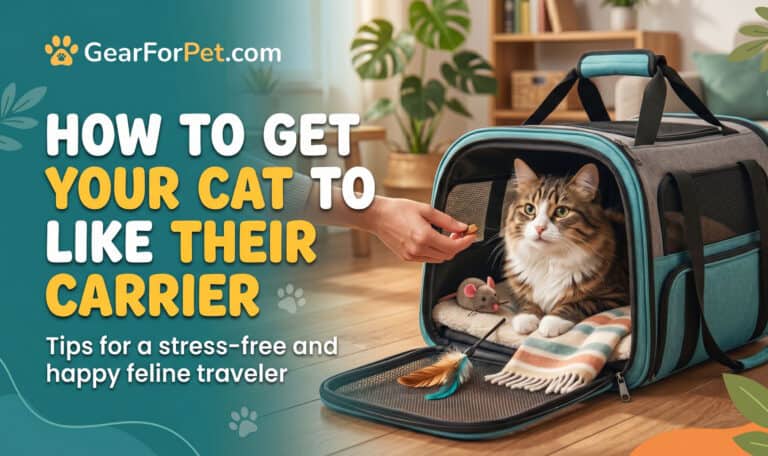
Leave the carrier out permanently as a piece of furniture — not just on travel days. Place a familiar blanket inside. Feed treats near it, then inside it. Let your cat choose to rest in it. This process takes 2–4 weeks to produce a neutral carrier association in most cats. For a complete step-by-step carrier introduction process, see our guide to getting your cat to like their carrier.
What size cat carrier do I need?
Your cat should be able to stand at full height, turn around completely, and lie down in a natural position inside the carrier — this is the ASPCA standard. To find the right size: measure your cat nose to tail base (length) and floor to top of head (height), then add 2–3 inches to each measurement. Weight limits on carrier labels refer to structural load, not comfortable interior space — always check interior dimensions, not the weight rating.
Final Verdict
For most owners buying a carrier for air travel: the Sleepypod Air is the clearest overall recommendation — crash-tested, genuinely compressible, and designed to function as a home bed between trips to reduce stress long-term. If the premium price is the barrier, the Sherpa Original Deluxe has earned its reputation over fifteen years of real use and delivers solid compliance at a mid-range price.
For specific situations: vet visits go to the Catit Cabrio for its top-loading design; large cats are best served by the Petluv Happy Cat; hands-free urban transport goes to Mr. Peanut’s Gold Series backpack; regular car travel gets the Sleepypod Mobile Pet Bed for its crash-tested seatbelt attachment; and first-time buyers who need to confirm their cat’s travel tolerance before spending more should start with the Frisco Premium Quilted Bag.
The carrier your cat tolerates is better than the carrier with the most features. Start with the right use case, the right size, and a proper introduction period — and most cats will travel far more calmly than their owners expect.
- 🏆 Best Overall: Sleepypod Air on Amazon
- ✈️ Best Airline Budget: Sherpa Original Deluxe on Amazon
- 💰 Best Budget: Frisco Premium Quilted Bag on Amazon
- 🔝 Best Top-Loading: Catit Cabrio on Amazon
- 🎒 Best Backpack: Mr. Peanut’s Gold Series on Amazon
- 🚗 Best for Car Trips: Sleepypod Mobile Pet Bed on Amazon
- 😺 Best for Large Cats: Petluv Happy Cat on Amazon
Affiliate Disclosure: GearForPet.com participates in affiliate programs. We may earn a small commission if you purchase through our links at no extra cost to you. Read our full disclosure.