Best Cat Carriers for Anxious Cats 2026: Vet-Tested Picks
If your cat hides the moment the carrier comes out, fights every attempt to load them, or spends the entire journey vocalising and panting, the carrier itself is usually a significant part of the problem. Most carriers are designed around containment. The carriers that actually work for anxious cats are designed around what causes the anxiety in the first place — and those are different design priorities entirely. This guide covers the four carriers that vets and feline behaviour specialists consistently recommend for cats with genuine travel anxiety, and exactly why each design feature matters for a stressed cat.
Why Most Carriers Make Anxious Cats Worse
Carrier anxiety in cats is almost always learned behaviour. A cat that has only experienced their carrier on vet visit days has made a reliable association: carrier appearance predicts a stressful event. This association strengthens with every repetition. By the time most owners seek help, the cat is not anxious about travel — they are anxious about the carrier itself, before a single journey has begun.
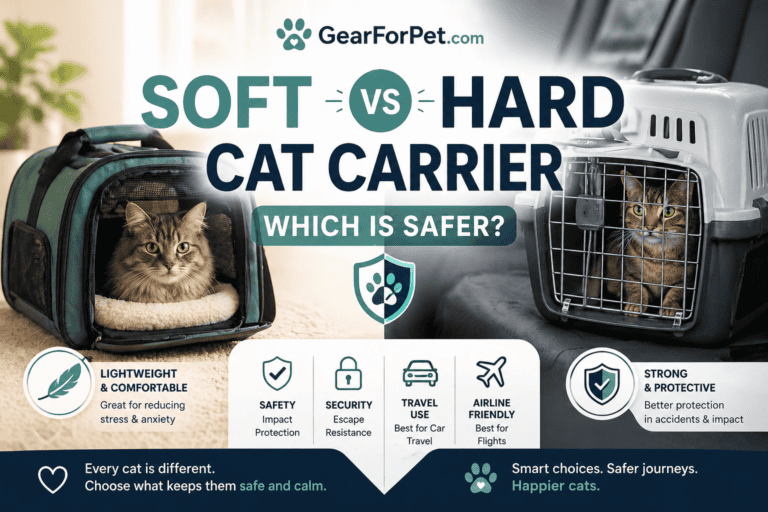
The design features that make this worse in standard carriers:
- Front-loading only — requires pushing or coaxing a resistant cat through a horizontal door, which triggers the exact avoidance response the cat has learned
- Hard plastic interiors — cold, unfamiliar, impossible to make smell like home, and impossible to use as an everyday comfort space between trips
- Stored out of sight — a carrier that only appears on travel days is a reliable stress trigger the moment it is seen; a carrier that lives in the home as furniture becomes neutral
- No privacy or cover option — anxious cats feel more secure when they cannot see a stressful environment; a carrier with no covering option forces full visual exposure throughout the journey
- Inadequate ventilation — an overheated, poorly oxygenated environment amplifies the physiological stress response regardless of the cat’s baseline anxiety level
The carriers in this guide address each of these directly. The products themselves matter, but the introduction and use method matters equally — see the full anxiety protocol at the end of this article before deciding whether a new carrier alone will solve the problem.
Quick Comparison
| Product | Best For | Loading Style | Doubles as Home Bed | Airline Approved | Price Tier | Link |
|---|---|---|---|---|---|---|
| Sleepypod Air | 🏆 Best Overall for Anxiety | Top + front | ✅ Yes | ✅ Yes | Premium (~$160) | Check current price on Amazon |
| Catit Cabrio | 🔝 Best for Vet Visits | Top + front | ❌ No | ⚠️ Check dimensions | Mid (~$55) | See latest price on Amazon |
| Sherpa Original Deluxe | ✈️ Best Anxious + Airline | Front | ❌ No | ✅ Yes | Mid (~$50) | Compare prices on Amazon |
| Sleepypod Mobile Pet Bed | 🚗 Best for Anxious Car Travel | Top + front | ✅ Yes | ✅ Yes | Premium (~$130) | View current deal on Amazon |
Best Overall for Anxious Cats: Sleepypod Air In-Cabin Carrier
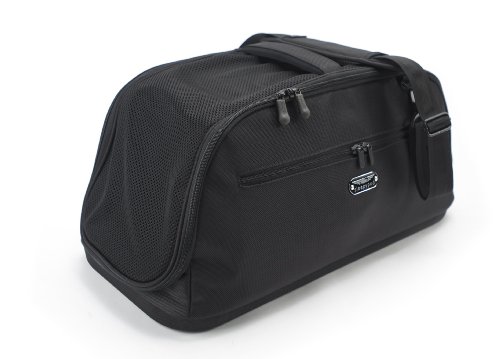
The Sleepypod Air is the most consistently recommended carrier for anxious cats by feline behaviour specialists and veterinary professionals, and the reasoning is straightforward once you understand what causes carrier anxiety. The single most effective intervention for a carrier-anxious cat is making the carrier a familiar, positive space that exists in the home permanently — not a threat that appears only on vet visit days. The Sleepypod Air is one of the very few carriers with an interior plush lining comfortable enough for a cat to genuinely choose to sleep in. Owners who leave it out as a permanent bed consistently report the fastest improvement in carrier tolerance of any product in the category.

The specific design features that reduce anxiety: the top-loading option removes the front-door resistance response entirely — lowering a cat from above meets significantly less avoidance than pushing them through a horizontal door. The compressible frame allows the carrier to flex subtly with a cat’s weight shifts rather than transmitting every vibration rigidly, which reduces the unsettled feeling anxious cats experience in hard carriers during transit. The crash-tested certification from the Center for Pet Safety means it can be seatbelted in a car, which eliminates the carrier sliding and shifting that amplifies anxiety on corners and braking. Multiple mesh ventilation panels prevent the heat buildup that compounds the physiological stress response. And the carrying strap options allow you to hold the carrier against your body during transit, which transmits your heartbeat and body warmth — a documented calming effect in cats with separation-linked anxiety.
What vets specifically recommend about the Sleepypod: the ability to drape a towel or blanket over it during travel without compromising ventilation is a significant practical advantage for anxious cats. Covering the carrier reduces visual stimulation from a stressful environment — waiting rooms, airport terminals, moving vehicles — while the mesh panels maintain full airflow underneath. This combination of privacy and ventilation is difficult to achieve with most carriers and the Sleepypod’s structure makes it straightforward.
Honest trade-off: the price is the barrier for many owners. At ~$160 it is a significant investment. It is the right investment if your cat has genuine travel anxiety and you travel with them regularly — the combination of stress reduction, crash safety, and multi-year durability justifies the cost. For a cat whose anxiety is mild or who travels rarely, the Sherpa below is the appropriate alternative.
Who it’s for: cats with significant carrier or travel anxiety; frequent travellers by air or car; owners committed to a proper carrier introduction programme. Who should skip it: occasional travellers on a tight budget; owners whose cat’s anxiety is mild and situational rather than deeply conditioned.
Best for Vet Visits: Catit Cabrio Top-Opening Carrier
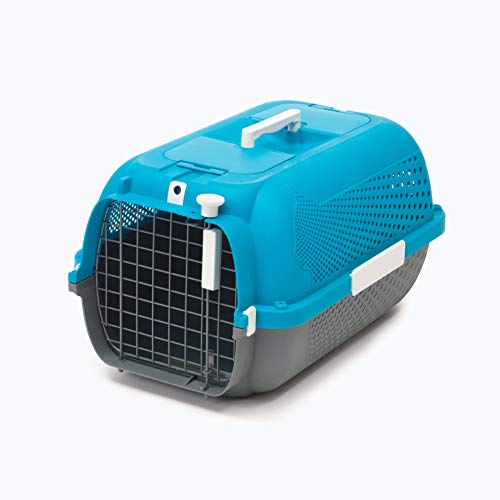
Vet visit anxiety and general travel anxiety are related but distinct problems, and the Catit Cabrio addresses the vet visit dimension more directly than any other carrier at this price. The top-loading design is the critical feature: anxious cats that have retreated to the back of a front-loading carrier during a stressful waiting room experience cannot be safely examined without disassembling the carrier entirely or tipping them out — both of which increase the stress of the visit significantly. A top-loading carrier allows the vet to reach in, begin examination without full exposure, and complete much of the assessment with the cat still partially within their familiar enclosed space.

Why feline veterinary specialists specifically recommend top-loading: the International Society of Feline Medicine (ISFM) guidelines on feline-friendly handling explicitly recommend top-loading carriers for veterinary visits as a primary stress-reduction measure. Cats that are examined partially inside their carrier show lower heart rate elevation, less defensive behaviour, and faster recovery to baseline than cats fully removed from their carrier for examination. For a cat that already has vet anxiety, keeping them in a partially enclosed familiar space throughout as much of the examination as possible is one of the highest-impact changes an owner can make — and it requires a carrier that allows this. The Catit Cabrio is the most accessible price point that delivers this functionality reliably.

Honest trade-off: the hard shell and dimensions may not fit under airline seats — verify before flying. It also does not double as a comfortable home bed in the way the Sleepypod does, which limits its effectiveness for the “leave it out permanently” desensitisation strategy. For owners whose primary anxiety problem is specifically vet visits rather than general carrier avoidance, it is the strongest recommendation at mid-range pricing. For owners dealing with both, the Sleepypod Air addresses the broader problem more completely.
Who it’s for: cats with vet visit anxiety specifically; owners who visit the vet frequently; cats that resist front-loading carriers. Who should skip it: owners whose primary need is airline travel; cats whose anxiety is home-based (carrier avoidance starting before any travel begins) where the bed-use strategy is more important.
Best for Anxious Cats Flying: Sherpa Original Deluxe Airline-Approved Carrier
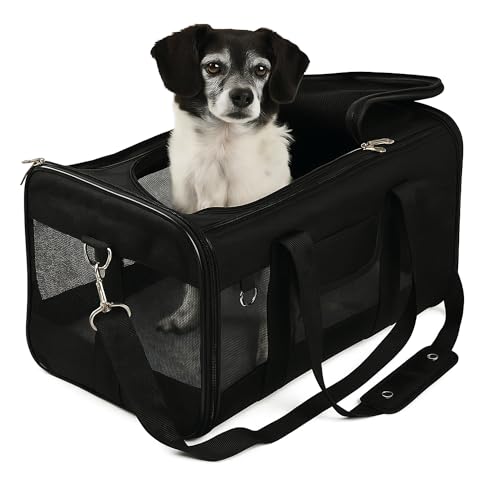
For anxious cats that must fly, the carrier choice involves a specific tension: the features most effective at reducing anxiety (rigid structure, familiar bed interior, top-loading) conflict with airline compliance requirements (soft-sided, compressible, specific maximum dimensions). The Sherpa Original Deluxe resolves this tension as well as any carrier at its price point. The spring wire frame compresses to fit tight under-seat spaces while maintaining enough structure to prevent the carrier walls collapsing onto an already-stressed cat. Locking zippers are a meaningful anxiety feature: a stressed cat that discovers the zip can be pushed open will attempt to exit, which causes a crisis mid-flight. The Sherpa’s locking zip eliminates this.

What to do before flying with an anxious cat in a Sherpa: remove the interior liner 3–5 days before travel and replace it with your cat’s regular sleeping blanket or a worn item of your clothing. The familiar scent is one of the most reliably documented calming interventions for cats in unfamiliar environments — more effective than most commercial calming sprays for cats whose anxiety is primarily scent-environment based. On travel day, spray Feliway (synthetic feline facial pheromone) inside the carrier 30 minutes before loading — not immediately before, as the alcohol carrier in the spray itself causes brief aversion that reverses the intended effect. Allow the spray to dry and the alcohol to dissipate first.

Honest trade-off: the Sherpa is front-loading only, which is its primary limitation for highly anxious cats that resist horizontal entry. If your cat’s resistance to entry is the core problem, the Catit Cabrio or Sleepypod Air’s top-loading design will produce a noticeably better experience. The Sherpa is the right choice when airline compliance is the non-negotiable requirement and the cat’s anxiety is manageable with the scent and pheromone preparation above.
Who it’s for: anxious cats that fly; owners who need proven airline compliance; cats whose anxiety is manageable with scent preparation rather than carrier redesign. Who should skip it: cats with severe carrier entry resistance; owners whose primary transport is by car rather than air.
Best for Anxious Cats in the Car: Sleepypod Mobile Pet Bed
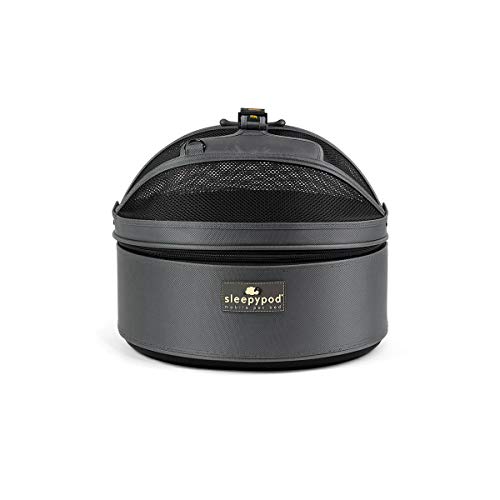
Car travel anxiety in cats has a specific physical component that most carriers ignore entirely: the carrier slides, shifts, and rotates on corners and during braking, and the cat inside cannot see or anticipate the movement. This unpredictable physical instability is one of the most consistent anxiety triggers in car-anxious cats — more significant than noise or unfamiliarity for many individuals. The Sleepypod Mobile addresses this directly with a seatbelt attachment loop that secures the carrier to the seat belt, eliminating the sliding and shifting entirely. The carrier moves with the car rather than against it, which dramatically reduces the vestibular disruption that anxious cats experience in unsecured carriers.

The crash-tested certification matters for anxious cat owners specifically: an unsecured carrier in a sudden stop or collision becomes a projectile. For an owner whose cat is already anxious in the car, the additional anxiety of worrying about carrier safety during transit is not a minor psychological factor. The Sleepypod Mobile’s Center for Pet Safety certification removes that concern entirely. Combined with the plush interior that functions as an everyday cat bed at home — building the familiar scent association that is the foundation of all effective carrier anxiety reduction — it is the most complete solution available for car-specific anxiety at any price.

Honest trade-off: premium price for what is structurally a soft-sided carrier. The safety certification and the everyday bed functionality justify it for owners who make regular car trips with an anxious cat. For rare or one-off car trips, the Sherpa secured with a seatbelt through the carrier handle is an adequate lower-cost alternative.
Who it’s for: cats with car-specific travel anxiety; owners who drive with their cat regularly; anyone who has noticed their cat’s anxiety is worse in the car than in other transport contexts. Who should skip it: owners whose primary transport is air travel; cats whose anxiety begins before loading rather than during transit.
The Anxiety Protocol: What to Do Beyond Buying a Better Carrier
No carrier, however well designed, will resolve deep carrier anxiety on its own. The carrier is the environment; the protocol is what changes the association. Use both together.
Step 1: Permanent Placement (Weeks 1–2)
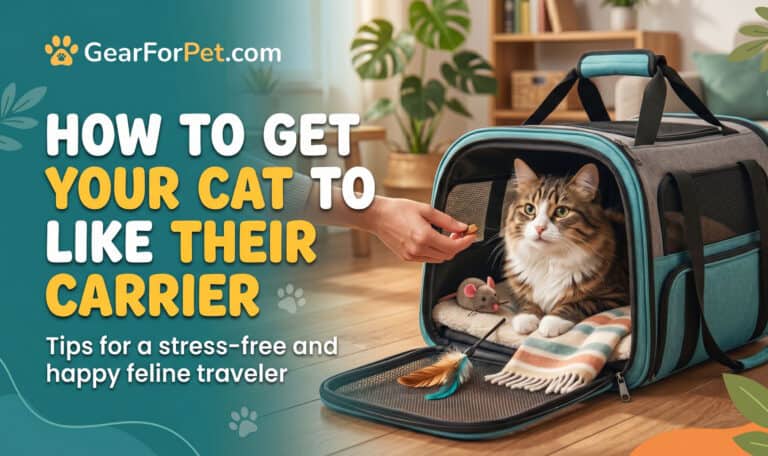
Place the carrier in your cat’s regular living space and leave it there permanently. Remove the door if possible. Place a familiar blanket or worn item of your clothing inside. Do nothing else. Do not encourage interaction, do not place your cat inside it, do not move it. The goal at this stage is solely neutralisation — the carrier stops predicting anything because it is always present.
Step 2: Positive Association (Weeks 2–4)
Feed your cat’s highest-value treats near the carrier, then just inside the entrance, then fully inside. Do this in very short sessions — 2–3 minutes maximum — and always end before your cat shows any discomfort. The goal is to end every session on a positive, calm note. If your cat will not approach the carrier even for high-value treats, you are moving too fast — go back to pure neutralisation for another week.
Step 3: Voluntary Confinement (Weeks 3–5)
Once your cat enters the carrier voluntarily for treats, begin closing the door briefly — 30 seconds, then 2 minutes, then 5 minutes — while remaining visible and calm. Reward calm behaviour through the mesh. Do not progress to the next duration until your cat is completely settled at the current one. A cat that is mildly unsettled at 2 minutes needs more time at 2 minutes, not progression to 5.
Step 4: Movement (Weeks 4–6)
Once your cat is calm with the door closed, begin carrying the carrier short distances around your home. Then to your front door. Then to your car, engine off. Then a 5-minute drive. Then a 15-minute drive. This graduated exposure to movement and the car environment is the step most owners skip — jumping from home sessions directly to a vet trip — and it is the step that determines whether the protocol actually works.
Feliway and Calming Supplements
Feliway Classic spray used inside the carrier 30 minutes before travel (allowing the alcohol to dry fully before loading) is one of the most evidence-supported interventions for short-term carrier anxiety reduction. It does not replace desensitisation work — it is most effective as a short-term support while the longer-term protocol builds. For cats with severe anxiety that does not respond to environmental management, speak to your vet about prescription anxiolytic options before major travel events. Gabapentin specifically has become a commonly used and well-tolerated pre-travel anxiolytic for cats in veterinary practice.
What to Look for in a Carrier for an Anxious Cat
Top-Loading Access
This is the single highest-impact design feature for anxious cats. Front-loading requires horizontal entry that triggers avoidance in conditioned carrier-anxious cats. Top-loading allows vertical entry that meets significantly less instinctive resistance, and crucially allows vets to examine the cat without requiring full removal from the carrier. If your cat currently has a front-loading carrier and resists entry, switching to a top-loader is the simplest first intervention before anything else.
Capacity for Familiar Bedding
A carrier that can hold a small familiar blanket or worn clothing item is more effective at reducing scent-triggered anxiety than a carrier with a fixed non-removable liner. The familiar scent is one of the most reliable environmental calming cues for cats. Carriers with removable, washable liners allow you to cycle your cat’s own bedding in and out — wash it, allow it to re-acquire your cat’s scent at home for a few days, return it to the carrier before travel.
Coverable Without Blocking Airflow
The ability to drape a towel over the carrier during transit without blocking ventilation is a practically valuable feature for anxious cats. Visual exposure to a stressful environment — a busy waiting room, airport terminal, unfamiliar vehicle interior — maintains the stress arousal state. A covered carrier reduces incoming visual stimulation while mesh panels maintain safe airflow underneath. Check that the carrier you choose allows this before buying.
Stability in Transit
A carrier that slides, tips, or shifts during transport amplifies anxiety in cats that are already stressed. For car travel, a seatbelt attachment or a non-slip base that prevents movement is meaningful. For hand-carrying, a carrier that can be held against your body rather than swinging free transmits physical steadiness that anxious cats respond to. The Sleepypod designs specifically address this with seatbelt attachments and body-carry strap options.
FAQ
What is the best cat carrier for an anxious cat?
The Sleepypod Air is the strongest overall recommendation for anxious cats: top-loading design reduces entry resistance, plush interior doubles as a home bed to build positive association between trips, crash-tested frame eliminates sliding in transit, and multiple mesh panels allow covering without blocking airflow. For owners on a tighter budget, the Catit Cabrio delivers the critical top-loading feature at a mid-range price.
How do I calm my cat in a carrier?
The most effective interventions in order of evidence strength: (1) leave the carrier out permanently as furniture so it stops predicting vet visits; (2) place familiar-scented bedding inside; (3) spray Feliway Classic inside 30 minutes before travel and allow to dry before loading; (4) cover the carrier with a light towel during transit to reduce visual stimulation; (5) hold the carrier against your body rather than swinging it. For severe anxiety that does not respond to environmental management, speak to your vet about gabapentin as a pre-travel anxiolytic.
Is a top-loading or front-loading carrier better for anxious cats?
Top-loading is consistently better for anxious cats for two reasons: it requires the cat to be lowered in from above rather than pushed through a horizontal door, which meets less instinctive avoidance resistance; and it allows vets to examine the cat without requiring full removal from the carrier, which keeps stress lower during veterinary visits. If your current carrier is front-loading and your cat resists entry, switching to top-loading is the single most impactful carrier design change you can make.
Should I use Feliway in my cat’s carrier?
Yes, with correct timing. Spray Feliway Classic inside the carrier at least 30 minutes before loading — not immediately before. The alcohol carrier in the spray causes brief aversion if the cat is loaded before it has dried and dissipated. Allow 30 minutes for the spray to dry fully before placing your cat inside. Used correctly, Feliway is one of the best-supported short-term interventions for carrier and travel anxiety in cats.
Can I sedate my cat for travel?
Speak to your vet rather than using over-the-counter products. Gabapentin has become a commonly used and well-tolerated pre-travel anxiolytic for cats — it reduces anxiety without the respiratory side effects that made older sedatives problematic for air travel especially. Your vet can advise on the correct dose for your cat’s weight and health status. Never use human sedatives or antihistamines without veterinary guidance.
Final Verdict
For most anxious cats, the Sleepypod Air is the clearest recommendation: it addresses the anxiety problem at the root by functioning as an everyday home bed, building the positive association that no amount of in-transit calming can replicate once a cat is already conditioned to fear the carrier. The top-loading design, coverable mesh panels, and seatbelt-compatible crash-tested frame resolve the major in-transit anxiety triggers simultaneously.
For vet visit anxiety specifically, the Catit Cabrio delivers the critical top-loading and partial-examination features at a fraction of the Sleepypod price. For cats that must fly and whose anxiety is manageable with scent preparation, the Sherpa Original Deluxe provides the most reliable airline compliance in the category. And for car-specific anxiety, the Sleepypod Mobile Pet Bed’s seatbelt-secured stability and everyday-bed design make it the most complete solution available.
The carrier is one part of the solution. The introduction protocol above is the other. Used together, most owners see meaningful improvement in carrier tolerance within 4–6 weeks — even in cats that have been strongly conditioned against carriers for years.
- 🏆 Best Overall for Anxiety: Sleepypod Air on Amazon
- 🔝 Best for Vet Visits: Catit Cabrio on Amazon
- ✈️ Best Anxious + Airline: Sherpa Original Deluxe on Amazon
- 🚗 Best for Car Travel Anxiety: Sleepypod Mobile on Amazon
Affiliate Disclosure: GearForPet.com participates in affiliate programs. We may earn a small commission if you purchase through our links at no extra cost to you. Read our full disclosure.