Soft vs Hard Cat Carrier: Which Is Safer? (2026)
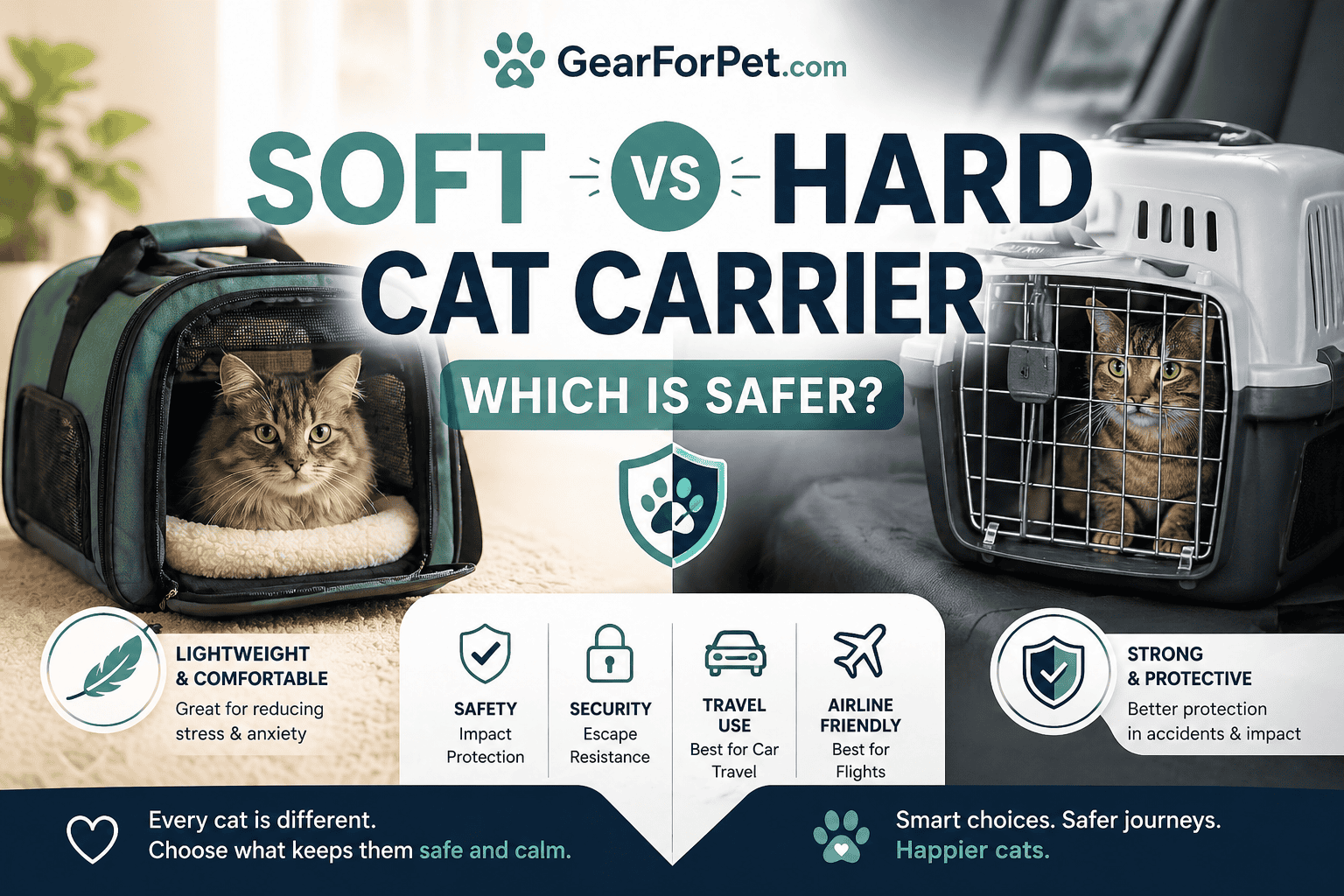
The short answer: soft-sided for air travel, hard-sided for vet visits, and soft-sided for anxious cats. The longer answer depends on which of those situations describes yours — because the same carrier design that works perfectly in one context fails in another. This guide gives you a clear decision by use case, not a vague “it depends.”
Soft vs Hard: Head-to-Head
| Factor | Soft-sided | Hard-sided |
|---|---|---|
| Airline compliance | ✅ Required by most airlines | ❌ Usually too rigid for under-seat |
| Vet visit examination | ⚠️ Harder to examine inside | ✅ Can be opened or disassembled |
| Car travel safety | ⚠️ Needs securing to be safe | ✅ More structural protection |
| Anxious cats | ✅ Softer, quieter, warmer feel | ⚠️ Colder, more clinical feel |
| Large cats | ⚠️ May lack rigidity under heavier cats | ✅ Better structural integrity |
| Storage | ✅ Collapses flat | ❌ Bulky to store |
| Long-term durability | ⚠️ Fabric wears over time | ✅ Hard shell lasts longer |
| Weight to carry | ✅ Lighter | ❌ Heavier empty |
| Doubles as home bed | ✅ Possible with right design | ❌ Not practical |
Which Type Wins by Use Case
Air Travel — Soft Wins, Always
This is the one use case where the answer is unambiguous. Every major airline — Delta, United, American, Southwest, JetBlue — requires soft-sided carriers for in-cabin travel. Hard carriers are too rigid to compress into the under-seat space and are restricted to cargo hold transport, where temperature and pressure conditions are significantly more stressful for cats. If you fly with your cat in the cabin, a soft-sided carrier is not a preference — it is a requirement.
The soft-sided carrier that most consistently passes real airline gate checks is the Sleepypod Air, which uses a compressible frame to flex into tight under-seat spaces while maintaining enough structure to prevent the walls collapsing onto your cat. The Sherpa Original Deluxe is the mid-range alternative with a fifteen-year track record of airline compliance. For a full breakdown of airline-approved options with verified dimensions by carrier, see our complete guide to the best cat carriers 2026.
Vet Visits — Hard Wins
Hard-sided carriers have a specific practical advantage in veterinary settings that soft carriers cannot match: they can be opened from the top or fully disassembled, allowing the vet to examine your cat without requiring them to exit the carrier entirely. The International Society of Feline Medicine (ISFM) guidelines on feline-friendly handling recommend carriers that allow examination inside the carrier as a primary stress-reduction measure for vet visits. A cat that has retreated to the back of a soft-sided carrier during a stressful consultation cannot be examined without tipping or coaxing them out — which increases the stress of the visit significantly.
Hard-sided carriers also hold their shape reliably on examination tables, which prevents the instability that an unstructured soft carrier on a slippery surface creates for an already-anxious cat. The Catit Cabrio is the clearest hard-sided recommendation for vet visits: top-loading, disassemblable base, adequate ventilation, and mid-range pricing. See our full review in the best cat carriers guide.
Car Trips — Hard Edges It for Safety
In a collision or sudden stop, a carrier becomes a projectile if it is not secured. Hard-sided carriers offer more structural protection in an impact than soft carriers, and their rigid base sits more stably on a car seat without a securing system. That said, a soft carrier with a seatbelt loop — the Sleepypod Mobile Pet Bed specifically — resolves the safety issue entirely and adds the anxiety-reduction benefits of a familiar home bed interior. The safety gap between hard and soft narrows considerably once you add proper securing.
For regular car travel, the deciding factor is whether your cat has car-specific anxiety. If they do, the soft Sleepypod Mobile’s seatbelt stability and plush interior is the better choice. If car anxiety is not an issue and you want maximum structural protection, a hard-sided carrier secured with a seatbelt through the handle is adequate.
Anxious Cats — Soft Wins
Hard plastic carriers have a specific sensory profile that works against anxious cats: they are cold to the touch, acoustically harsh (any movement or sound echoes differently inside a rigid shell), and impossible to use as a comfortable everyday sleeping space — which is the foundation of every effective carrier anxiety protocol. A soft carrier with a plush interior can be left out permanently as a cat bed, building the positive home association that neutralises carrier anxiety over time. A hard carrier cannot.
For cats with significant travel or carrier anxiety, soft-sided is the correct starting point regardless of other travel requirements. The Sleepypod Air addresses both the anxiety problem (plush bed design, top-loading, coverable without blocking airflow) and the airline compliance requirement simultaneously. For a complete anxiety-specific protocol and carrier breakdown, see our guide to best cat carriers for anxious cats.
Large Cats — Hard Edges It
Soft carriers under heavier cats can lose structural integrity over time — the base compresses, the sides bow, and the carrier stops holding its shape reliably. Hard-sided carriers maintain their interior dimensions regardless of the cat’s weight, which is important for the ASPCA stand-turn-lie comfort standard. For cats over 15 lbs, a hard carrier with confirmed interior dimensions is more reliable than a soft carrier whose stated weight limit may not reflect real comfortable interior space.
That said, large soft carriers with reinforced frames — the Petluv Happy Cat and Vivicreate specifically — are designed to hold their shape under heavier cats and address this gap. Check the interior dimensions, not just the weight limit, before buying either type for a large cat.
Urban Commuting and Public Transport — Soft Wins
For carrying a cat on public transport, cycling, or walking through a city, the weight difference between a hard and soft carrier is felt immediately and consistently. A hard carrier adds significant empty weight that compounds over a 30-minute commute. Soft carriers collapse for flat storage on a bus or train. For urban use where airline compliance is not required, soft-sided is the practical choice by a wide margin.
When You Need Both
Many cat owners end up with two carriers — one soft for air travel and one hard for vet visits — and this is the honest recommendation for households that do both regularly. The use cases have genuinely different optimal designs that no single carrier resolves perfectly. A hard carrier for quarterly vet visits and a soft carrier for annual or semi-annual flights is not unnecessary duplication; it is the right tool for each job.
If budget requires a single carrier that handles both, the Sleepypod Air is the closest compromise: soft-sided and airline-compliant, top-loading for vet examination access, and plush enough to function as a home bed for anxiety reduction. It does not disassemble the way a hard carrier does, which limits vet examination flexibility slightly — but the top-loading access resolves most of the practical problem. See the full review and airline dimension comparison in our best cat carriers 2026 guide.
The One Thing Both Types Need
Regardless of whether you choose soft or hard, the single most effective thing you can do for your cat’s carrier tolerance is leave the carrier out permanently as a piece of furniture with a familiar blanket inside. A carrier that only appears on vet visit or travel days becomes a reliable predictor of stress. A carrier that is always present in the home becomes neutral. This works with both types — though soft carriers with plush interiors make it easier for cats to choose to sleep in voluntarily, which is the fastest route to a genuinely positive association.
For a full step-by-step carrier introduction protocol for cats that already have strong carrier avoidance, see our guide to best cat carriers for anxious cats.
FAQ
Do airlines allow hard cat carriers in the cabin?
No. All major airlines require soft-sided carriers for in-cabin travel because hard carriers cannot compress to fit the under-seat space. Hard carriers are allowed in cargo hold transport only. If you are flying with your cat in the cabin, you need a soft-sided, airline-compliant carrier. Check your specific airline’s maximum dimensions before buying — they vary by carrier and route.
Is a soft or hard carrier better for vet visits?
Hard-sided, top-loading carriers are better for vet visits. They allow the vet to examine your cat without requiring full removal from the carrier — which the ISFM identifies as one of the highest-impact stress-reduction measures for clinical handling. Hard carriers can also be fully disassembled if needed, giving the vet complete access without tipping or coaxing a resistant cat out through a front door.
Are hard cat carriers safer in cars?
Hard carriers offer more structural protection in an impact, but the critical safety factor for either type is whether the carrier is secured — an unsecured hard carrier is more dangerous than a properly seatbelted soft carrier. Secure any carrier to the seat belt before driving. The Sleepypod Mobile Pet Bed is the only soft carrier with crash-tested certification from the Center for Pet Safety, making it the strongest safety option regardless of material type.
Can I use a soft carrier for a large cat?
Yes, if the interior dimensions are large enough to meet the ASPCA stand-turn-lie standard and the frame is reinforced to hold its shape under the cat’s weight. Always check interior dimensions rather than weight limits — two carriers with the same weight rating can have very different interior space. The Petluv Happy Cat and Vivicreate are both soft carriers specifically designed for cats over 15 lbs with reinforced frames. See our full large cat recommendations in the best cat carriers guide.
The Verdict by Situation
- Flying in cabin — soft-sided, always. Hard carriers are not permitted.
- Vet visits — hard-sided, top-loading. Allows examination inside the carrier.
- Regular car trips — either, if properly secured. Soft with seatbelt attachment edges it for anxious cats.
- Anxious cats — soft-sided. Can double as a home bed to build positive association.
- Large cats (15 lbs+) — hard or reinforced soft. Check interior dimensions, not weight limits.
- Urban commuting — soft-sided. Lighter, compressible, easier to manage on public transport.
- If you need one carrier for everything — Sleepypod Air. Soft and airline-compliant, top-loading for vet access, plush for home bed use.
For full reviews of the best soft and hard carriers across every use case, see our best cat carriers 2026 guide. For anxious cats specifically, see best cat carriers for anxious cats.
Affiliate Disclosure: GearForPet.com participates in affiliate programs. We may earn a small commission if you purchase through our links at no extra cost to you. Read our full disclosure.