
Best Dog Harnesses for Small Dogs 2026 – Safe Fits for Tiny, Escape-Prone Breeds
Small dogs have fragile tracheas – and most harnesses on the market are designed around a 50 lb Labrador, then just scaled down. The result is a harness that sits wrong, applies pressure to the wrong places, and does nothing to stop the one thing small dog owners dread most: the sudden backwards slip that sends a Chihuahua sprinting free. The right harness for a small dog isn’t a smaller version of a big-dog harness. It’s built differently — and this guide covers the five picks that actually get it right.
Quick Comparison: Best Small Dog Harnesses 2026
| Product | Best For | Clip Type | Price Tier | Link |
|---|---|---|---|---|
| Mercano Soft Mesh Harness & Leash Set | Best Overall — everyday small breeds | Back clip | Budget–Mid | Check price on Amazon |
| SlowTon No Pull Small Dog Harness | Best No-Pull — front & back dual clip | Front + Back | Mid | Check price on Amazon |
| Puppia Soft Dog Harness | Best for Trachea Safety — vest style | Back clip | Mid | Check price on Amazon |
| Gooby Escape Free Easy Fit Harness | Best Escape-Proof — narrow-chested breeds | Back clip | Mid | Check price on Amazon |
| Voyager Step-In Air Dog Harness | Best Step-In — dogs that resist overhead | Back clip | Budget | Check price on Amazon |
Best Small Dog Harnesses — Reviewed
1. Mercano Soft Mesh Dog Harness and Leash Set — Best Overall

If you own a small dog and want a single harness that handles daily walks, car rides, and light outdoor use without fuss — the Mercano Soft Mesh is the answer. The breathable mesh panel distributes pressure across the chest and torso rather than concentrating it at the neck, which is exactly the construction small breeds need. It ships as a complete set with a matching leash, so there’s nothing extra to buy on day one.

What makes it the best overall pick: The mesh is soft enough for dogs with sensitive skin and thin coats — a real issue with Yorkies, Maltese, and Italian Greyhounds where coarser materials cause friction rubs. The adjustable chest and belly straps mean you can dial in the fit for narrow or barrel-chested small breeds, not just rely on the size label. Verified owners consistently praise how quickly dogs adapt to wearing it — even those who’ve resisted other harnesses.

Honest limitation: The back-clip design means it won’t correct pulling behavior on its own — if your dog pulls hard, pair it with leash training or step up to the SlowTon dual-clip below. Also, the included leash is functional but basic; if you walk multiple dogs or need a hands-free option, you’ll replace it eventually.
Best for: Chihuahuas, Yorkies, Maltese, Pomeranians, and any small breed under 20 lbs with a calm-to-moderate walk style.
Not ideal for: Strong pullers, escape artists with narrow chests.
See current price and sizing on Amazon →
2. SlowTon No Pull Small Dog Harness and Leash Set — Best No-Pull

Small dogs pull too — and anyone who’s had their wrist yanked by a determined 10 lb Dachshund knows that size doesn’t mean polite. The SlowTon is built specifically for small breeds that pull, with both a front clip and a back clip so you can switch between training mode and casual walk mode without buying a second harness. The front clip redirects forward momentum sideways — the same physics that makes front-clip harnesses effective on large breeds, scaled correctly for small ones.
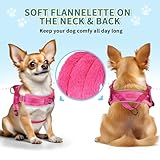
What owners consistently report: The padded chest strap stays centered and doesn’t dig into the armpit — a common complaint with poorly designed no-pull harnesses on small dogs where the chest opening is too narrow. The dual adjustment points (neck and chest) allow you to get a snug, escape-resistant fit even on narrow-bodied breeds. Multiple verified owners note visible pulling improvement within the first few walks when using the front clip attachment.

Honest limitation: The front-clip attachment point creates slight chest strap tension during hard pulls — fine for training sessions, but less comfortable for long all-day wear. For relaxed daily walks once pulling is under control, the Mercano or Puppia are better long-term wear options.
Best for: Small dogs in active leash training, dual-clip versatility, Dachshunds, Beagles, and spirited small breeds.
Not ideal for: Flat-faced breeds where any chest compression is a concern; dogs that wear a harness all day.
See current price and dual-clip options on Amazon →
3. Puppia Soft Dog Harness — Best for Trachea Safety
No products found.The Puppia is the go-to recommendation when a vet or groomer tells you to switch your small dog off a collar entirely. It’s a true vest-style harness — meaning it wraps around the torso like a soft jacket rather than applying any loop or strap near the throat. For Pugs, French Bulldogs, Shih Tzus, and other brachycephalic breeds where respiratory function is already compromised, this construction difference isn’t aesthetic — it’s medically relevant.
No products found.Why it’s been a top seller for years: The soft air-mesh material is genuinely gentle against short, fine, or no-undercoat coats. The single back-clip position keeps leash pressure distributed across the chest and shoulders, not the throat. Sizing is precise and well-documented — Puppia publishes chest girth measurements for every size, not just vague S/M/L labels, which matters enormously for breeds where a 1 cm difference changes the fit entirely.
No products found.Honest limitation: No front clip, so it won’t help with pulling correction. The vest opening is a fixed size per model — if your dog has an unusually deep or wide chest for their weight (common in French Bulldogs), check the chest girth measurement carefully before ordering; some owners size up one.
Best for: Flat-faced breeds (Pugs, Frenchies, Shih Tzus, Cavaliers), post-trachea-surgery recovery, vet-recommended harness transitions.
Not ideal for: Dogs that pull hard or need front-clip training; breeds with very narrow chest-to-neck ratios.
Check current sizing and price on Amazon →
4. Gooby Escape Free Easy Fit Harness — Best Escape-Proof
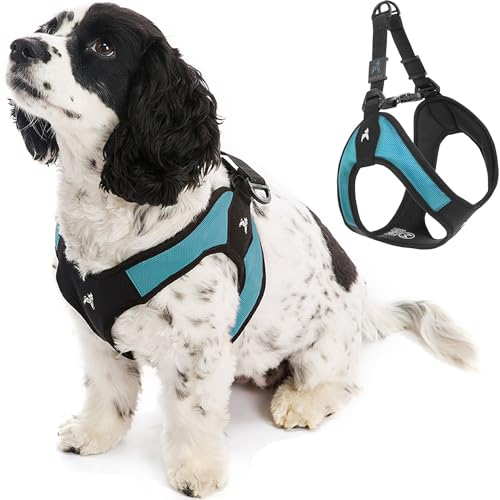
The name says it directly — and it earns it. The Gooby Escape Free is designed around the specific problem that haunts small dog owners: the backwards shimmy where a dog drops its head, rolls its shoulders, and walks out of a standard harness in under three seconds. This happens because most harnesses are designed for proportional builds. Dachshunds, Italian Greyhounds, and Whippet-mix dogs have heads that are the same width as their neck — and any harness that relies on neck circumference alone as the escape barrier will fail on them.

What makes it escape-proof: The Gooby uses a chest wrap design with a figure-8 configuration that locks around the torso rather than relying on a single neck loop. The leash attachment sits high on the back, and the chest wrap creates two points of contact that must both be compromised simultaneously for a dog to escape — which simply doesn’t happen in practice. Owners of known escape artists across Chihuahua, Dachshund, and Italian Greyhound communities specifically recommend this harness by name.

Honest limitation: The figure-8 construction means it takes slightly longer to put on than a standard step-in or overhead harness — there’s a technique to it. Most owners master it within two to three uses, but if you need something fast to grab-and-go, the Mercano or Voyager are quicker. Also not designed for hard pulling correction — purely a security and safety harness.
Best for: Confirmed escape artists, Dachshunds, Italian Greyhounds, narrow-chested small breeds, any dog that has previously slipped out of a standard harness.
Not ideal for: Dogs that need pulling correction; owners who prioritize quick on/off.
See escape-proof sizing guide on Amazon →
5. Voyager Step-In Air Dog Harness — Best Budget Step-In

If your small dog refuses to let you pull a harness over their head — and more do than owners admit — the Voyager Step-In solves the problem cleanly. Instead of lifting over the head, the dog steps their front paws into two openings and you clip the back closed. For anxious, rescue, or touch-sensitive dogs where overhead handling creates stress, this isn’t a minor convenience — it’s the difference between a harness they’ll tolerate and one they’ll fight every single time.

Best value on this list: The Voyager punches above its price point with a lightweight air-mesh construction that doesn’t overheat small dogs in warm weather — a real issue with heavier padded harnesses in summer. The back-clip position is well-centered, and the buckle closure is sturdy enough for daily use without the clipping difficulty some budget harnesses have. Available in an unusually wide range of sizes including XXS — genuinely useful for teacup breeds that most harnesses don’t fit at all.

Honest limitation: The step-in design means the straps sit around the front legs — over time, active dogs can experience minor chafing at the leg openings if the fit isn’t exact. Check the leg opening measurement against your dog’s chest girth, not just weight. Also, the mesh is lighter and less durable than the Gooby or Puppia — plan to replace after 12–18 months of daily use.
Best for: Anxious dogs, rescue dogs with overhead sensitivity, teacup and toy breeds, budget-conscious owners, warm weather walking.
Not ideal for: Escape artists with narrow chests; high-activity trail dogs who need maximum durability.
See current price and size chart on Amazon →
How to Choose a Harness for a Small Dog — What Actually Matters
Measure Chest Girth, Not Just Weight
Weight-based sizing fails small dogs constantly. A 10 lb Chihuahua and a 10 lb French Bulldog have completely different chest proportions — the Frenchie’s barrel chest can be 4–5 cm wider at the same weight. Always measure your dog’s chest girth (the widest point just behind the front legs) before buying any harness. Most quality brands publish chest girth ranges per size — if they don’t, that’s a red flag.
Step-In vs Overhead — Which Design Is Right?
This is the most common buying decision small dog owners face and most guides skip it entirely.
| Design Type | How It Works | Best For | Avoid If |
|---|---|---|---|
| Step-In | Dog steps front paws into leg openings, clip over back | Anxious dogs, overhead-sensitive rescues | Escape artists with narrow chests |
| Overhead (Vest) | Slips over the head, clips under belly | Calm dogs, brachycephalic breeds, trachea safety | Dogs who resist head handling |
| Figure-8 / Wrap | Wraps chest in two loops, no head or leg entry | Escape artists, narrow-chested breeds | Owners who need fast on/off |
Front Clip vs Back Clip — Does It Matter for Small Dogs?
Yes — and most guides ignore this for small breeds. A back-clip harness is fine for dogs that don’t pull and are past the training phase. A front-clip harness redirects pulling by turning the dog sideways when tension is applied — this works on small dogs exactly as it does on large ones. If your dog is still in active leash training, choose a harness with at least one front-clip option. If pulling is resolved, a soft back-clip vest is more comfortable for long daily wear. For more on this distinction, see our complete dog harness buying guide.
Hardware: Plastic vs Metal at Small Dog Weights
At under 20 lbs, plastic buckles are generally sufficient — the load they’re bearing is low, and quality plastic hardware on a well-made harness won’t fail in normal use. Metal hardware becomes more important for dogs that lunge, are reactive, or where the harness doubles as a car restraint attachment point. If you’re attaching a seatbelt clip to the harness, choose one with metal D-ring hardware at the leash attachment point.
Breed-Specific Fit Notes — Small Dogs Are Not All the Same
One of the most consistent failures in small dog harness buying guides is treating all small breeds as a single category. They’re not. These are the four most distinct anatomical profiles to know:
Chihuahua
Fragile neck, proportionally large head relative to neck circumference. Any harness that relies purely on neck sizing as a security point is an escape risk on a Chihuahua. Prioritize chest-wrap designs (Gooby) or well-fitted vest styles (Puppia) over standard loop harnesses. Soft mesh is essential — rough materials chafe their thin coat and delicate skin quickly.
Dachshund
Long torso, low clearance, narrow chest relative to body length. Standard harnesses designed for square-bodied breeds sit incorrectly on Dachshunds — the belly strap either digs in or sits too far back. Look for harnesses with independent chest and belly adjustment points. The Gooby Escape Free is specifically well-reviewed in Dachshund owner communities for its torso-wrap fit.
French Bulldog / Pug (Brachycephalic)
Wide, barrel-shaped chest, flat face, compromised airway. No collar, ever. The harness must be a full vest or chest-wrap design with zero throat contact. The Puppia Soft Harness is the veterinary standard recommendation for this group — its vest construction fully eliminates tracheal pressure. Size up if your Frenchie has a deeper-than-average chest; the breed varies significantly in chest girth even within the same weight class.
Yorkshire Terrier / Maltese
Fine, silky coat that can slip through poorly fitting harnesses and develop friction rubs from coarse materials. Soft mesh or air-mesh construction is non-negotiable. The coat also tends to catch on velcro closures — avoid any harness with hook-and-loop (velcro) adjustment panels. Buckle-only closures are the right choice for this group.
Why Small Dogs Escape Their Harness — And How to Stop It
Small dog escape incidents almost always happen the same way: the dog stops, plants their feet, and backs up — dropping their head and rolling their shoulders forward simultaneously. In under three seconds, a standard harness with a single neck loop slides straight over the head.
The three escape points to check on any harness before you buy:
- Neck opening diameter — if the neck loop is wider than your dog’s head circumference when tightened to fit, it’s an escape risk. Measure your dog’s head width, not just neck circumference.
- Chest strap tension under backwards pressure — put the harness on, apply gentle backwards pressure, and watch whether the chest strap shifts toward the front legs. If it moves more than 2 cm, the fit is too loose.
- Single-point vs multi-point contact — harnesses that rely on one strap loop around the body are fundamentally less secure than designs that create two independent contact points (chest + belly, or figure-8 wrap). For confirmed escape artists, only a multi-point design is reliable.
If your dog has already escaped their current harness once, assume they’ll do it again — dogs learn this behavior quickly and repeat it. For more on diagnosing and solving harness escapes, see our full guide on why dogs escape their harness and how to prevent it.
Which Small Dog Harness Should You Actually Buy?
Not every reader needs the same answer. Here’s how to decide fast:
- Best value for most small dog owners: Mercano Soft Mesh — soft, well-fitted, complete set, no complications.
- Dog still in leash training: SlowTon No Pull — dual-clip versatility you’ll use every walk.
- Flat-faced breed or trachea concern: Puppia Soft — the vet-recommended vest construction that eliminates throat pressure entirely.
- Confirmed escape artist: Gooby Escape Free — built specifically for this problem; nothing on this list beats it for security.
- Tight budget or overhead-resistant dog: Voyager Step-In — step-in convenience, good value, wide size range.
If you have a large dog instead, our best no-pull harnesses for large dogs guide covers entirely different sizing and load requirements. And if you’re still deciding between a harness and a collar altogether, the complete dog harness guide breaks down every scenario where a harness is the safer choice.
Frequently Asked Questions — Small Dog Harnesses
What is the best harness for a small dog?
For most small dog owners, the Mercano Soft Mesh Harness is the best overall choice — it fits correctly, doesn’t irritate sensitive skin, and ships with a matching leash. For escape-prone dogs, the Gooby Escape Free is the more secure option. For flat-faced breeds with trachea concerns, the Puppia Soft Harness is the veterinary standard recommendation.
Are harnesses better than collars for small dogs?
Yes — for daily walks, harnesses are significantly safer for small dogs. Small breeds are disproportionately prone to tracheal collapse, and any collar that applies neck pressure during pulling increases that risk over time. A well-fitted harness distributes leash pressure across the chest and shoulders, eliminating throat contact entirely.
How do I stop my small dog from escaping their harness?
First, check the fit — the most common cause is a harness that’s sized too loosely. Measure chest girth (not just weight) and ensure the chest strap doesn’t shift under backwards pressure. If the fit is correct and escape still happens, switch to a multi-point design like the Gooby Escape Free, which creates two independent contact points that must both fail simultaneously for an escape to occur. See our full guide on why dogs escape harnesses and how to fix it.
What size harness does a small dog need?
Never size by weight alone. Measure the chest girth — the widest point around the rib cage just behind the front legs. Compare that measurement against the brand’s published size chart. A 10 lb French Bulldog and a 10 lb Chihuahua can easily be two different sizes. When in doubt between two sizes, size down for escape-prone breeds and size up for brachycephalic breeds with wide chests.
Is a step-in harness or overhead harness better for small dogs?
It depends on the dog. Step-in harnesses (like the Voyager) work best for anxious dogs or those who resist overhead handling. Overhead vest harnesses (like the Puppia) offer better trachea protection and are harder to escape. If your dog is calm and easy to handle, an overhead vest is generally the more secure and trachea-safe choice. If handling the head causes stress, step-in is the practical solution.
How do I fit a harness correctly on a small dog?
Apply the two-finger rule: once the harness is on and all straps are adjusted, you should be able to slide exactly two fingers under any strap — no more, no less. Looser than two fingers and the dog can slip out; tighter and you’re restricting movement and causing discomfort. Check both the neck opening and the belly/chest strap. For a full step-by-step fitting guide, see how to fit a dog harness correctly.
Final Verdict
The single biggest mistake small dog owners make when buying a harness is treating it like a scaled-down version of a large-dog product. Small breeds have distinct anatomy, real escape risks, and in many cases genuine trachea vulnerabilities that make harness selection a safety decision — not just a comfort one.
Best Overall: Mercano Soft Mesh Harness — the right construction for most small breeds, at a price that doesn’t require justification.
Best for Safety-First / Trachea Concerns: Puppia Soft Dog Harness — if your vet has ever mentioned tracheal collapse, this is the only choice on this list.
Best for Escape Artists: Gooby Escape Free — built specifically for the backwards-shimmy problem that catches most harnesses off guard.
Get the fit right, measure before you buy, and your small dog will walk more comfortably — and stay exactly where they’re supposed to be.
Affiliate Disclosure: GearForPet.com participates in affiliate programs. We may earn a small commission if you purchase through our links at no extra cost to you. Read our full disclosure.