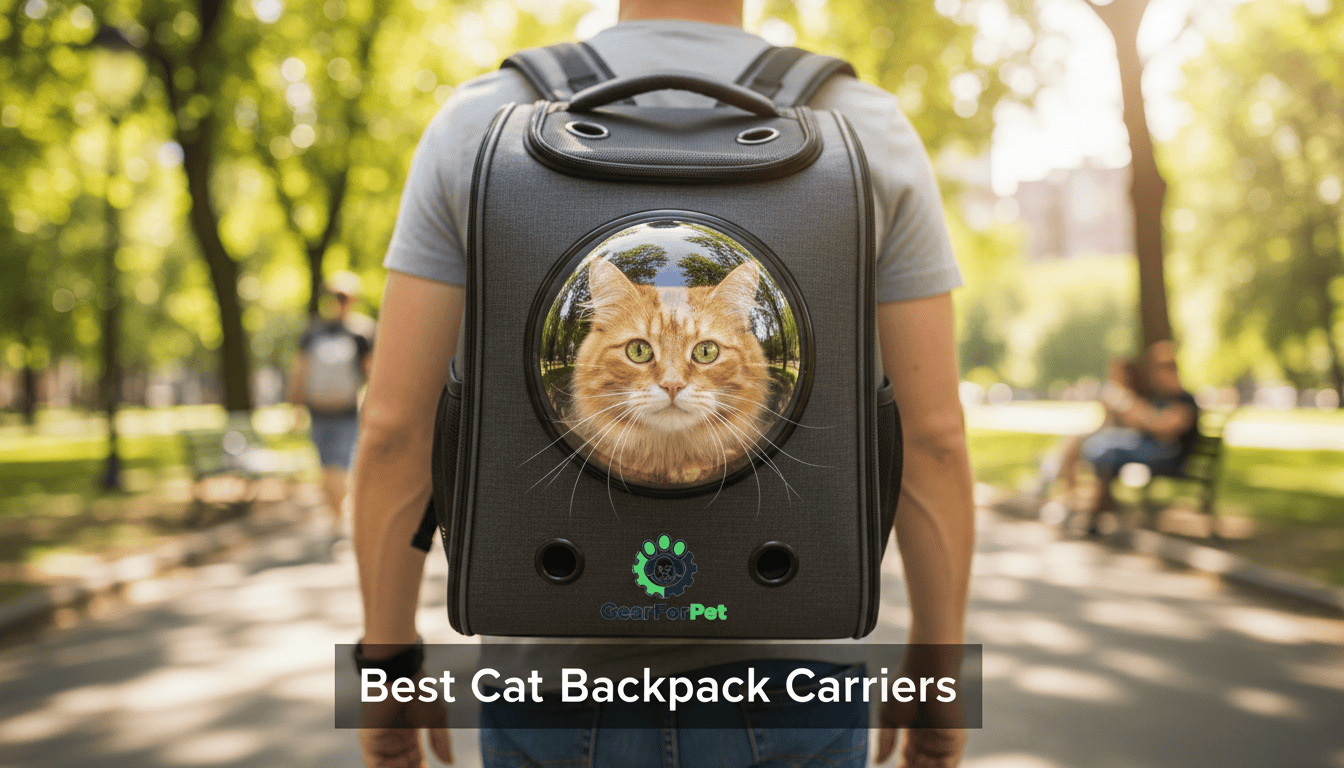
Best Cat Backpack Carriers 2026: Bubble, Hiking & More
Cat backpack carriers look impressive in product photos. In real use, most of them have the same three problems: poor ventilation that turns the interior into a heat trap within twenty minutes, bubble windows that fog and scratch within a month, and shoulder straps that dig in badly once a 12 lb cat is inside. The backpacks that actually get used long-term – that cats tolerate calmly and owners carry comfortably – solve all three before anything else. This guide covers the six that do.
Quick Comparison: Best Cat Backpack Carriers 2026
| Product | Best For | Ventilation | Bubble Window | Max Weight | Price Tier | Link |
|---|---|---|---|---|---|---|
| Mr. Peanut’s Gold Series | 🏆 Best Overall | Mesh panels | ✅ Yes | 20 lbs | Mid (~$55) | Check current price on Amazon |
| Vivicreate Large Cat Backpack | 😺 Best for Large Cats | Wide mesh panels | ✅ Yes | 25 lbs | Mid (~$50) | See latest price on Amazon |
| PETKIT Breezy Dome 2 | 🌬️ Best Ventilation | Built-in fan + mesh | ✅ Dome | 15 lbs | Mid-Premium (~$65) | Compare prices on Amazon |
| Travel Cat The Navigator | 🥾 Best for Hiking | Mesh + ventilation channels | ❌ No bubble | 18 lbs | Premium (~$80) | Check sizing on Amazon |
| Pecute Expandable Backpack | 💰 Best Budget | Mesh panels | ✅ Yes | 15 lbs | Budget (~$35) | View current deal on Amazon |
| Vceoa Large Soft-Sided Backpack | 🐱 Best Budget Large Cat | Wide mesh panels | ❌ No bubble | 22 lbs | Budget (~$40) | See current pricing on Amazon |
Are Cat Backpack Carriers Actually Good for Cats?
The honest answer: it depends entirely on the individual cat. Cats that are curious, confident, and comfortable with new environments often take to backpack carriers faster than to traditional carriers — the upright position, the movement of walking, and the ability to observe through a mesh or bubble window without direct exposure to the environment produces a calmer response in these cats than sitting stationary in a soft carrier on the floor. Cats that are anxious, easily overstimulated, or sensitive to motion will not enjoy a backpack regardless of how good it is.
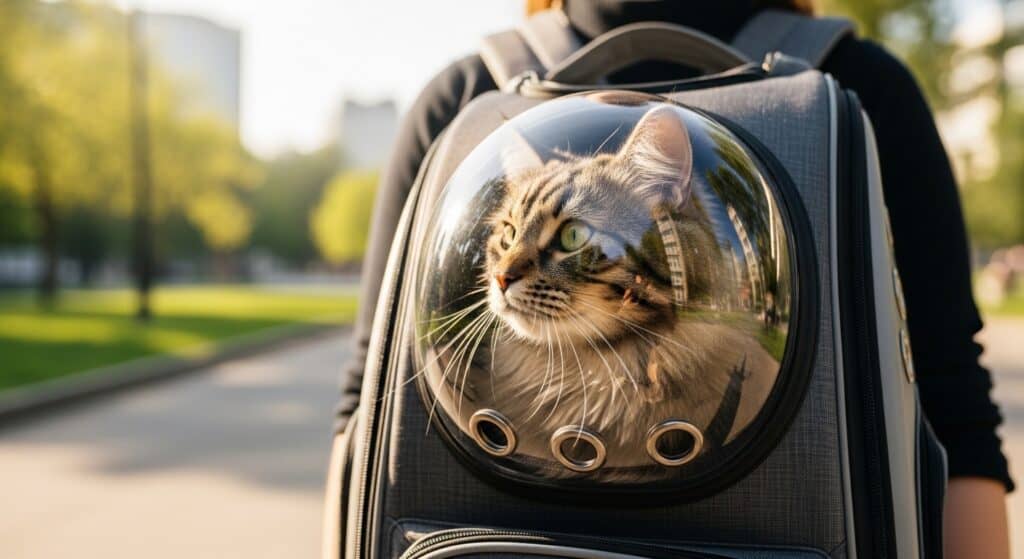
The three things that determine whether your cat will tolerate a backpack carrier:
- Ventilation — a poorly ventilated backpack gets warm fast; an overheated cat is a stressed cat regardless of personality type
- Introduction method — cats introduced to a backpack gradually at home, with familiar scent inside and positive associations built before the first outing, tolerate it significantly better than cats placed inside it cold on trip day
- Visibility vs exposure balance — most cats want to see their environment without being fully exposed to it; mesh panels and bubble windows provide this; fully opaque sides do not
A backpack is not a substitute for a carrier for all situations. For airline travel, vet visits requiring examination, and car trips where crash safety matters, a traditional carrier remains the better choice. The backpack excels for urban commuting, hiking, public transport, and extended walking where hands-free carrying is genuinely useful.
Best Overall: Mr. Peanut’s Gold Series Expandable Cat Backpack

Mr. Peanut’s Gold Series has held its position as the most consistently recommended cat backpack at this price point for several years, which in a category full of short-lived products is a meaningful signal. The bubble window gives cats a wide, undistorted sightline without direct exposure to the environment. The expandable mesh panel at the bottom can be opened at the destination to give the cat more space to stretch. Padded shoulder straps and a chest strap distribute the load properly for cats up to 20 lbs, which most backpack carriers at this price do not handle without shoulder strain after twenty minutes.

What long-term owners report consistently: the bubble window on the Gold Series is notably more scratch-resistant than cheaper alternatives. Budget bubble backpacks typically develop visible surface scratches within 4–6 weeks of regular use that reduce the sightline cats rely on. Owners who have used the Gold Series for 12+ months report the bubble remaining clear with basic cleaning — this is not a minor point when the window is the primary reason your cat tolerates the backpack at all.

Honest trade-off: the bubble window is fixed and does not open, which means ventilation relies entirely on the mesh panels. In warm weather or on strenuous walks, monitor your cat’s comfort closely. The expandable mesh panel helps significantly on arrival — open it as soon as you reach your destination to increase airflow and give your cat more space.
Who it’s for: owners who want a proven, long-lasting backpack for regular urban use; cats that are curious and engaged by their environment; anyone who has bought a cheaper bubble backpack and watched the window scratch into opacity. Who should skip it: owners of cats over 20 lbs; anyone hiking steep terrain with a heavier cat where a dedicated hiking pack is needed.
Best for Large Cats: Vivicreate Large Cat Backpack Carrier
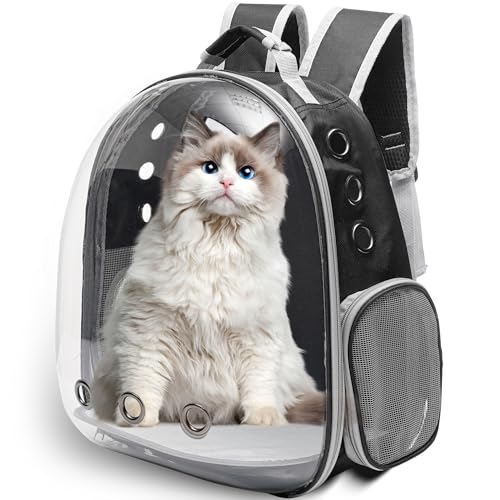
Large cat owners face the same problem with backpack carriers as with traditional carriers: most products labelled “large” are sized for cats up to 12–13 lbs, which excludes a significant portion of male domestic cats and virtually all Maine Coons, Ragdolls, and Norwegian Forest Cats. The Vivicreate is genuinely built for larger cats up to 25 lbs, with interior dimensions that allow a bigger cat to sit upright and turn without pressing the sides. Wide mesh panels on multiple sides provide the ventilation that a larger cat — generating more body heat — specifically needs.

What large cat owners consistently flag: the structural integrity of backpacks under heavier cats is a genuine concern. Cheap backpacks with light frames buckle or compress when a 15+ lb cat shifts their weight, which creates instability and stress for the cat. The Vivicreate’s reinforced frame handles the load distribution of heavier cats without deformation — owners of 18–22 lb cats report the structure remaining solid on multi-hour outings.

Honest trade-off: the larger dimensions mean a heavier pack overall, and carrying 20+ lbs of cat plus backpack frame for extended periods requires good shoulder strap padding. The Vivicreate’s straps are adequately padded for shorter outings but may cause fatigue on hikes longer than an hour with a heavier cat.
Who it’s for: owners of genuinely large cats (15 lbs+); anyone who has found standard backpack carriers too small for their cat’s comfort. Who should skip it: owners of average-sized cats who do not need the extra bulk; owners planning extended hikes where a lighter, more ergonomic hiking pack is preferable.
Best Ventilation: PETKIT Breezy Dome 2
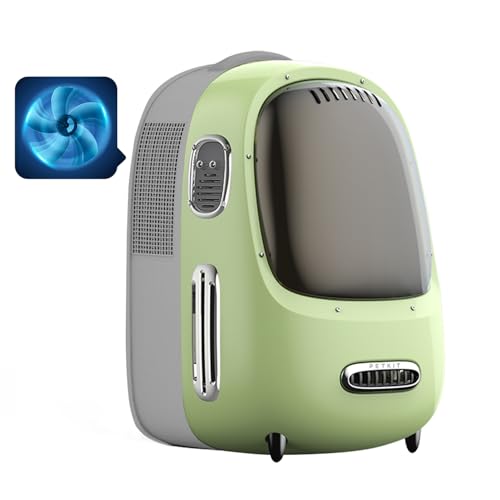
The PETKIT Breezy Dome 2 is the only backpack on this list with a built-in USB-powered fan, and for cats that run warm, cats in hot climates, or any owner who has watched a cat pant with stress inside a standard backpack during summer, that single feature changes the entire experience. The fan draws fresh air through the mesh panels and circulates it inside the dome, keeping the interior temperature noticeably lower than passive ventilation alone. The dome window gives cats a wide, panoramic sightline — wider than a standard bubble window — with no distortion.

The ventilation case in numbers: standard bubble backpacks with passive mesh ventilation can see interior temperatures rise 8–12°F above ambient on warm days during active walking. Cats are susceptible to heat stress above 100°F body temperature — a stressed cat in a poorly ventilated backpack in summer heat reaches that threshold faster than most owners realise. The Breezy Dome 2’s active airflow measurably reduces this risk. For summer outings specifically, the fan is not a luxury feature — it is a safety one.

Honest trade-off: the fan requires USB charging. Battery life runs 4–6 hours on standard mode — adequate for most day outings but worth monitoring on longer trips. The dome shape also makes the backpack bulkier than flat-bubble alternatives, which can be awkward on crowded public transport. Maximum weight capacity of 15 lbs limits this to average-sized cats.
Who it’s for: owners in warm or hot climates; cats that show any signs of heat sensitivity; anyone who has used a standard backpack in summer and noticed their cat panting or distressed. Who should skip it: owners of cats over 15 lbs; owners who want a more compact, flat-profile backpack for crowded urban commuting.
Best for Hiking: Travel Cat “The Navigator”
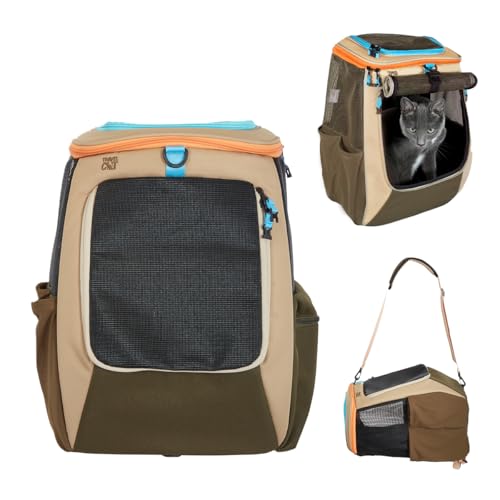
The Navigator is built specifically for active outdoor use in a way that most cat backpacks — which are designed for urban commuting and photographed on hiking trails — are not. The frame is rigid enough to maintain its shape on uneven terrain without the structural flex that unsettles cats in cheaper packs. Multiple ventilation channels prevent heat buildup during sustained physical activity. The opening system allows quick access for water breaks or brief rest stops without full unloading. And the shoulder and hip strap system is designed for actual load distribution over several hours, not just for a fifteen-minute walk to a coffee shop.

What distinguishes a hiking backpack from an urban backpack: on flat urban terrain, frame rigidity and load distribution matter less because trips are short and pace is steady. On a hiking trail, the pack shifts with every uneven step, slope, and scramble. A cat inside a flexing, poorly distributed pack on a 3-hour trail hike will be significantly more stressed than a cat in a rigid, well-distributed one — because instability triggers vigilance and vigilance is exhausting. The Navigator’s construction directly addresses this. It is the reason adventure cat owners consistently recommend it over the more photographed urban-focused alternatives.

Honest trade-off: no bubble window. Cats that specifically enjoy watching their environment through a bubble may be less engaged in the Navigator than in bubble-window alternatives. The mesh panels provide ventilation and partial visibility but a different experience than a panoramic dome or bubble. At ~$80 it is also the most expensive backpack on this list — justified for regular hikers, less so for occasional urban outings where the Mr. Peanut’s Gold Series covers the need at two-thirds of the price.
Who it’s for: adventure cat owners; owners who hike regularly and want a pack built for the activity; anyone whose cat is comfortable outdoors and has already been acclimated to carrier travel. Who should skip it: owners whose primary use is urban commuting; owners whose cats have not yet been introduced to outdoor environments; anyone who specifically wants a bubble window.
Best Budget: Pecute Expandable Cat Carrier Backpack
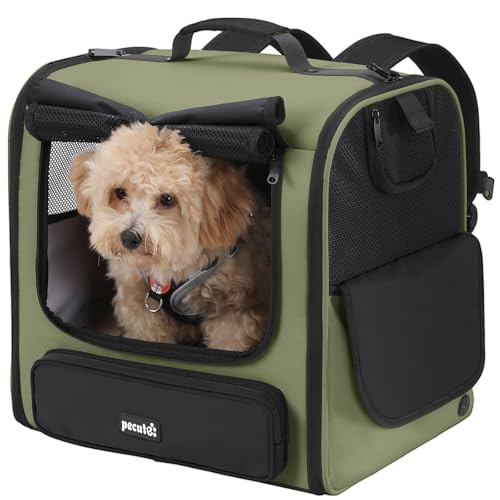
The Pecute Expandable is the right answer for owners testing whether their cat will tolerate a backpack at all before committing to a premium option. It does the fundamentals correctly: adequate mesh ventilation, a bubble window that provides sightline without full exposure, an expandable section that increases interior space at the destination, and a front opening that makes cat loading reasonably straightforward. At ~$35 it is the lowest price on this list that still meets the minimum standard for mesh coverage and structural integrity.
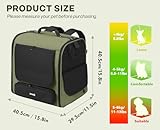
Where it earns the recommendation: many owners are not certain their cat will tolerate a backpack before buying one. The Pecute is the proof-of-concept purchase — it confirms whether your cat is a backpack carrier cat without the risk of the Mr. Peanut’s or Navigator price point. If your cat uses it calmly on three or four outings, that is your confirmation to upgrade to a longer-lasting option. If your cat never settles in it, you have spent $35 rather than $80 on the lesson.

Honest trade-off: the bubble window will scratch more visibly over time than the Gold Series. The shoulder straps are adequate for short outings but lack the padding for 90-minute+ walks with a heavier cat. Treat it as a starter backpack, not a permanent solution.
Who it’s for: first-time backpack carrier buyers testing cat tolerance; genuinely budget-constrained owners; short urban trips where premium durability is not the priority. Who should skip it: owners who hike; owners of cats over 13–14 lbs; anyone who wants a long-term backpack that will last several years of regular use.
Best Budget for Large Cats: Vceoa Large Soft-Sided Backpack Carrier
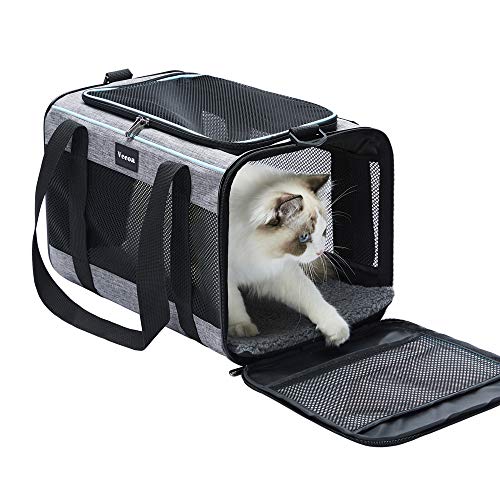
The Vceoa is currently the top-selling cat carrier backpack on Amazon by unit volume, and for large cat owners on a budget it earns that position. Interior dimensions accommodate cats up to 22 lbs with enough space to meet the ASPCA stand-turn-lie standard — rare at this price point. The wide mesh panels on the front and sides provide better passive ventilation than most compact bubble designs, and the soft-sided construction collapses for flat storage when not in use. For owners of larger cats who want to try backpack transport without spending $65–$80 on a first attempt, it is the most accessible entry point available.

What the sales rank reflects: the Vceoa’s 4.7★ rating across 500+ verified reviews is notably higher than many longer-established competitors. The review pattern shows consistent praise for interior space, ventilation, and build quality relative to price — and notably few complaints about structural failure or strap discomfort, which are the two most common failure modes in budget backpack carriers. For a recently launched product, the review quality is a stronger signal than the volume.

Honest trade-off: no bubble window. Cats that are specifically motivated by the panoramic viewing experience of a bubble design will have a less engaging experience in a mesh-only carrier. The soft-sided construction also provides less structural stability than a rigid-frame backpack on uneven terrain. Best for flat urban use, not hiking.
Who it’s for: large cat owners (15–22 lbs) who want backpack transport at a budget price; owners testing whether their large cat will tolerate a backpack before investing in the Vivicreate. Who should skip it: cats that specifically respond well to bubble windows; owners who hike; owners who want a long-term rigid-frame backpack.
What to Look for in a Cat Backpack Carrier
Ventilation: Mesh Panels vs Active Airflow
This is the most critical safety factor in any backpack carrier and the one most product photos obscure. Bubble windows look impressive but provide no airflow — ventilation must come from mesh panels, and the placement, size, and coverage of those panels determines whether the interior stays safe in warm conditions. Look for mesh on a minimum of two sides, with the front panel openable for maximum airflow at rest. If you live in a warm climate or plan summer outings, the PETKIT Breezy Dome 2’s active fan is the only reliable solution to the heat problem passive mesh cannot fully solve.
Bubble Window: What to Look for Beyond the Photo
Not all bubble windows are equal. The key differences are scratch resistance (polycarbonate holds up; cheap acrylic scratches within weeks), size (a larger window gives your cat a wider sightline with less distortion at the edges), and whether the window opens or is fixed. A fixed bubble provides no additional ventilation — check that mesh panels are providing airflow independently. Clean the bubble with a microfibre cloth only — paper towels and standard cleaning cloths introduce surface scratches that accumulate into opacity over time.
Shoulder Straps and Weight Distribution
A cat backpack carrier is only comfortable to carry if the straps are designed for the actual weight being carried. Most cat backpacks are designed for cats under 12 lbs. For larger cats, thin or unpadded straps cause shoulder fatigue within twenty minutes. Look for padded shoulder straps of at least 2 inches width, a chest strap to prevent the pack swinging, and ideally a waist or hip strap for hikes over an hour. Test the straps loaded — many owners only discover strap inadequacy on the first real outing.
Interior Size
Apply the same ASPCA standard as for traditional carriers: your cat should be able to stand at full height, turn completely, and lie in a natural position. Backpack carriers are often more compact than traditional carriers for the same weight rating — measure your cat before buying rather than relying on the weight limit. An expandable base panel, present on several models in this list, is the most practical solution to the interior space problem: compact for carrying, expandable at the destination for resting.
Loading Style
Most backpack carriers load from the top or front. Top-loading is generally easier for cats that resist entering horizontally — lowering from above meets less resistance than pushing through a front door. Front-loading is more accessible for the owner while wearing the pack. The best backpacks offer both options. Check specifically which opening is the primary loading point before buying — some backpacks are marketed as dual-opening but the secondary opening is too small for practical loading.
How to Introduce a Cat to a Backpack Carrier
Week 1 — Familiarisation at home. Leave the backpack open on the floor in your cat’s regular space. Do not force interaction. Place a familiar blanket inside. Feed treats near it, then just inside the opening. The goal is for your cat to investigate it voluntarily rather than associating it with being placed inside.
Week 2 — Voluntary entry. Once your cat is entering voluntarily to investigate or take treats, let them spend short periods inside with the door open. Do not close it yet. A cat that retreats inside a backpack of their own choice is a cat building a positive association with the space.
Week 3 — Brief closures at home. Close the backpack for 5–10 minutes with your cat inside while you remain visible. Reward calm behaviour with treats through the mesh. Keep the fan running if your backpack has one.
Week 4 — First short outing. A 10–15 minute walk in a quiet environment, not a busy street or crowded area. Observe your cat’s body language throughout: ears forward and alert is curiosity; ears flat and pupils dilated is stress. End the outing before your cat reaches the stress threshold, not after. Build duration gradually over subsequent outings.
For cats with significant travel anxiety, the carrier introduction process needs more time and a more structured approach. See our complete guide to best cat carriers for anxious cats for a full anxiety-specific introduction protocol.
Edge Cases
Senior cats: older cats with joint pain or reduced mobility may find the posture required in a backpack — particularly sitting upright for extended periods — uncomfortable. A well-padded interior and the ability to lie down fully are more important for senior cats than for younger ones. If your cat is over 10 years old, prioritise interior padding and a wider base over viewing features.
Flat-faced breeds (Persian, Exotic Shorthair, British Shorthair): ventilation is a safety issue, not a comfort preference, for brachycephalic cats. The PETKIT Breezy Dome 2 with its active fan is the safest backpack option for flat-faced breeds in warm conditions. Never use a bubble-window-only backpack with a flat-faced cat in temperatures above 70°F without confirming active airflow through additional mesh panels.
First outdoor exposure: cats that have never been outside should not have their first outdoor experience in a backpack at a busy location. Introduce outdoor sounds and smells gradually — an open window or a quiet garden — before the first backpack outing. Sensory overload on a first outdoor trip produces a stressed, avoidant cat, not a confident one.
FAQ
Are cat backpack carriers safe?
Yes, when used correctly — with adequate ventilation, a properly sized interior, and a gradual introduction process. The primary safety risks are overheating (inadequate ventilation in warm conditions), stress overload (placing a cat in a backpack in a busy environment before they are acclimated), and structural failure (cheap frames that compress under heavier cats). All three are avoidable by choosing the right backpack for your cat’s size and climate, and introducing it properly at home first.
How long can a cat stay in a backpack carrier?
For most cats, 1–2 hours is a reasonable maximum for regular outings. Some cats tolerate longer periods comfortably; others show stress signals within 30 minutes. Monitor your cat’s body language throughout — ears forward is curiosity, ears flat and pupils dilated is stress. Build duration gradually based on your individual cat’s response, not on a fixed time rule. Ensure water access on any outing over 45 minutes.
Do cats like backpack carriers?
Curious, confident cats with proper introduction often do — the upright position, movement, and ability to observe without full exposure suits their instinct to watch their environment safely. Anxious, easily overstimulated, or motion-sensitive cats typically do not. The only reliable way to know which type your cat is: introduce the backpack gradually at home over 2–3 weeks and observe their response to voluntary entry before attempting any outdoor use.
Can I use a cat backpack carrier for airline travel?
Most cat backpack carriers do not fit under airline seats due to their rigid bubble or dome structure and wider dimensions. For airline travel, a dedicated soft-sided carrier like the Sherpa Original Deluxe or Sleepypod Air is the correct choice. See our full best cat carriers guide for airline-compliant options with verified dimensions by airline.
What size cat backpack do I need?
Your cat should be able to stand at full height, turn around completely, and lie in a natural position inside the backpack — the ASPCA standard. Measure your cat nose to tail and floor to top of head, add 2 inches to each dimension, and compare against the interior dimensions of the backpack — not the weight limit. Two backpacks with the same weight rating can have very different interior dimensions.
Final Verdict
For most owners buying their first cat backpack or upgrading from a budget option that scratched into opacity: Mr. Peanut’s Gold Series is the clearest overall recommendation — proven durability, scratch-resistant bubble window, and adequate ventilation for most conditions at a fair price. For large cats, the Vivicreate fills the size gap that most backpacks leave. For warm climates or summer outings, the PETKIT Breezy Dome 2’s active fan solves the heat problem that passive mesh cannot.
For hikers, Travel Cat The Navigator is the only backpack on this list genuinely built for trail conditions. For first-time buyers confirming cat tolerance before committing to a premium price, the Pecute Expandable is the right proof-of-concept purchase. And for large cat owners on a budget, the Vceoa offers the most interior space per pound spent currently available in the category.
The backpack your cat tolerates on the third outing is better than the backpack with the best product photos. Introduce it slowly, watch your cat’s body language honestly, and build duration gradually — most cats surprise their owners by how quickly they settle when the introduction is done right.
- 🏆 Best Overall: Mr. Peanut’s Gold Series on Amazon
- 😺 Best for Large Cats: Vivicreate Large Cat Backpack on Amazon
- 🌬️ Best Ventilation: PETKIT Breezy Dome 2 on Amazon
- 🥾 Best for Hiking: Travel Cat The Navigator on Amazon
- 💰 Best Budget: Pecute Expandable Backpack on Amazon
- 🐱 Best Budget Large Cat: Vceoa Large Backpack on Amazon
Affiliate Disclosure: GearForPet.com participates in affiliate programs. We may earn a small commission if you purchase through our links at no extra cost to you. Read our full disclosure.