How Much Space Does a Guinea Pig Need?
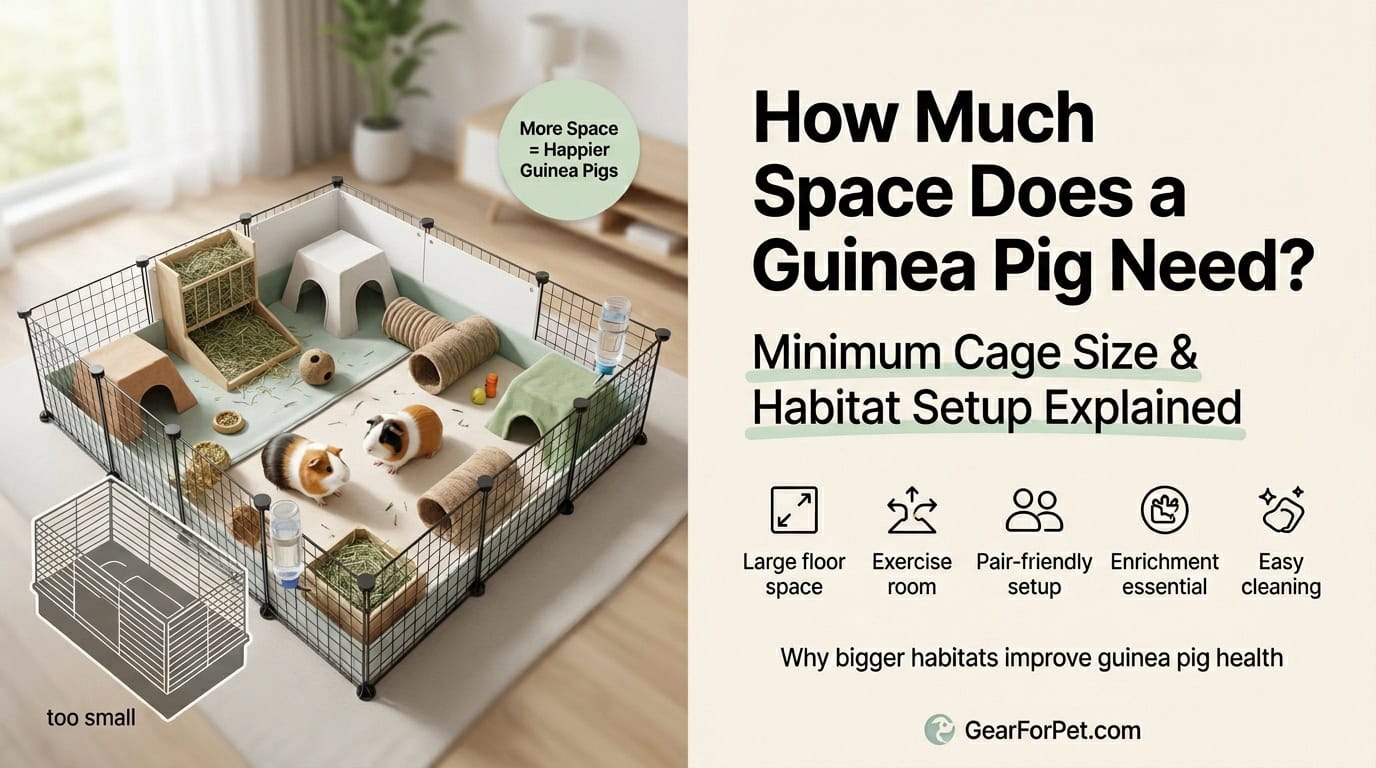
The cage that comes in a guinea pig starter kit from a pet store typically provides 2–4 square feet of floor space. The minimum floor space that guinea pig welfare organisations, exotic animal veterinarians, and the Humane Society recommend for a single guinea pig is 7.5 square feet. For a pair — and guinea pigs must be kept in pairs — that number rises to at least 7.5 square feet minimum, with 10+ square feet recommended. The average pet store starter cage provides roughly one quarter of the space a guinea pig pair actually needs. This is not a minor welfare shortfall — it is the leading cause of the stress behaviours, aggression, and chronic health problems that bring guinea pigs to exotic vets. This guide explains exactly how much space guinea pigs need, why they need it, and what that space looks like in practical cage dimensions.
Quick Answer — How Much Space Does a Guinea Pig Need?
A single guinea pig needs a minimum of 7.5 square feet of unobstructed floor space. A pair of guinea pigs — the minimum recommended group size — needs a minimum of 7.5 square feet with 10+ square feet recommended. Three guinea pigs need a minimum of 10.5 square feet. These are the figures cited by the Humane Society of the United States, major guinea pig welfare organisations, and most exotic animal veterinarians — not the figures used in pet store cage marketing.
Why Space Is the Most Important Factor in Guinea Pig Health
Guinea pigs are not sedentary animals that sit in a corner waiting to be picked up. In the wild, they are prey animals that range continuously across open grassland, grazing, exploring, and maintaining social hierarchies across territory. Their bodies are built for continuous low-intensity movement — short sprints, constant grazing, social interaction across distance. When confined to inadequate space, this biological drive for movement does not disappear. It redirects into the stress behaviours that owners observe and often misattribute to personality or illness.
What Inadequate Space Looks Like Behaviourally
- Repetitive circuits — a guinea pig that runs the same loop around its cage perimeter repeatedly is not exercising. It is expressing the locomotion drive that has no other outlet. This is a stereotypy — a repetitive behaviour caused by chronic environmental deprivation.
- Barbering — a dominant guinea pig chewing the fur of a subordinate cage mate is often a space problem. When subordinate animals cannot escape a dominant’s attention in a large enough space, stress-driven barbering escalates.
- Persistent hiding — a guinea pig that spends most of its time in a hideout and cannot be drawn out is often in a cage too small to feel safe. Inadequate space removes the flight distance that prey animals require to feel secure.
- Aggression between cage mates — guinea pig pairs that fought constantly in a small cage frequently become peaceful when moved to an adequately sized enclosure. Many “incompatible” guinea pig pairs are actually cage-size problems.
- Muscle weakness and obesity — insufficient space for movement causes the same physical consequences in guinea pigs that it causes in any animal: muscle atrophy and weight gain, which compounds into joint problems and shortened lifespan.
Guinea Pig Space Standards — What Each Organisation Actually Recommends
| Organisation / Standard | 1 Guinea Pig | 2 Guinea Pigs | 3 Guinea Pigs | Notes |
|---|---|---|---|---|
| Typical pet store starter cage | 2–4 sq ft | 4–5 sq ft | Not addressed | Commercial standard — not a welfare guideline |
| ASPCA | 4 sq ft | 6 sq ft | 8 sq ft | Basic US minimum — considered outdated by welfare organisations |
| Humane Society of the United States | 7.5 sq ft | 7.5 sq ft | 10.5 sq ft | Current US welfare recommendation |
| Guinea Pig welfare community standard | 7.5 sq ft | 10.5 sq ft | 13 sq ft | Active welfare community — most widely cited by experienced keepers |
| RSPCA UK | Not recommended alone | ~10 sq ft minimum | 13+ sq ft | UK welfare law guidance — among the strictest internationally |
| Swiss Animal Welfare Act | Not permitted alone | ~10.8 sq ft minimum | 13+ sq ft | Legally enforceable — solitary housing is illegal in Switzerland |
The standard that matters most for US owners: Use the Humane Society’s 7.5 square feet as your absolute minimum and the guinea pig welfare community’s 10.5 square feet for a pair as your genuine target. The ASPCA’s 6 sq ft for a pair is the bare legal floor in a US context — not a welfare benchmark worth targeting.
What These Dimensions Look Like in Practice
Square footage figures are abstract until translated into physical cage dimensions. Here is what each space standard looks like as cage floor dimensions:
| Floor Space | Example Dimensions (W x D) | Standard | Suitable For |
|---|---|---|---|
| 2–4 sq ft | 24″ x 12″ — 24″ x 24″ | Typical pet store starter cage | ❌ No guinea pig — inadequate for any herd size |
| 4–6 sq ft | 24″ x 24″ — 30″ x 29″ | ASPCA single-pig minimum | 🟡 Temporary housing only — below Humane Society minimum |
| 7.5 sq ft | 30″ x 36″ — 27″ x 40″ | Humane Society minimum | ✅ 1 guinea pig minimum / pair absolute minimum |
| 8 sq ft | 47″ x 24″ (MidWest Guinea Habitat) | Above Humane Society minimum | ✅ Pair — meets welfare standard |
| 10+ sq ft | 50″ x 29″ — 60″ x 24″ | Welfare community recommendation for pairs | ✅ Pair — genuinely comfortable; recommended target |
| 10.5–13 sq ft | 60″ x 25″ — 48″ x 39″ | 3 guinea pig minimum | ✅ 3 guinea pigs |
| 13–16 sq ft | 60″ x 31″ — 48″ x 48″ | 4+ guinea pig recommendation | ✅ 4 guinea pigs — C&C cage territory |
The Visual Test That Matters Most
Place both guinea pigs in the cage and watch for 10 minutes. Each guinea pig should be able to move freely to a separate area of the cage without entering the other’s personal space. They should be able to access food, water, and a hideout independently without navigating past the other animal. If one guinea pig cannot move without the other being in its path, the cage is too small — regardless of what the square footage calculation suggests.
Space Guide by Herd Size
Solo Guinea Pig — 7.5 sq ft Minimum
A single guinea pig should only be housed alone in a rescue, medical isolation, or post-bonding introduction context — not as a permanent arrangement. Guinea pigs are social animals whose psychological health requires the company of at least one companion. Switzerland has legally prohibited solitary guinea pig housing since 2008. If you have a single guinea pig due to the loss of a companion, introduce a new companion as soon as the remaining guinea pig’s health allows — the distress of social isolation is a genuine health concern, not anthropomorphism.
A Pair — 7.5 to 10+ sq ft
Two guinea pigs is the minimum recommended herd size and the most common ownership configuration. The Humane Society cites 7.5 sq ft as the minimum for a pair — the MidWest Guinea Habitat Plus at 8 sq ft is the most widely available commercial cage that meets this standard. For genuine comfort and to minimise dominance-related stress, 10+ sq ft is the target for a pair. At 10+ sq ft, guinea pigs can establish separate activity zones — sleeping, eating, and exercising in distinct areas — which dramatically reduces the frequency of dominance interactions.
Three Guinea Pigs — 10.5 sq ft Minimum
Three guinea pigs require 10.5 sq ft at minimum — and in practice, three animals adds social complexity (trios can create two-against-one dynamics) that is better managed with more space rather than less. C&C cage configurations beginning at 2×4 grid panels (~10.5 sq ft) are the standard approach for three-animal herds. No commercially available standard cage on the market adequately houses three guinea pigs — custom or modular C&C builds are the practical solution at this herd size.
Four or More Guinea Pigs — 13+ sq ft
Four or more guinea pigs require a C&C cage build of at least 2×5 grid panels (~13 sq ft) or larger. At this herd size, commercial cage products are not appropriate — the GuineaDad Piggy Condo and similar modular products can be expanded, but a fully custom DIY C&C build from storage cube grids and coroplast provides maximum flexibility at minimum cost for large herds. Add approximately 2–3 sq ft per additional guinea pig beyond four as a practical planning guideline.
Floor Time — Does It Count Toward Space Requirements?
Daily floor time — supervised free-roaming time outside the cage in a safe, guinea pig-proofed area — is an important welfare supplement but does not replace adequate cage size. Here is why:
- Guinea pigs are active 24 hours a day — they do not sleep in extended blocks the way humans or cats do. They have multiple short rest periods throughout the day and night interspersed with continuous activity. The cage is their primary living space for the vast majority of their waking hours, not just overnight storage.
- Floor time requires active supervision — a guinea pig in a room unsupervised chews cables, squeezes under furniture, and is at risk from other pets. Genuine floor time requires a present adult. For families where daily supervised floor time is realistic, it meaningfully supplements cage space. For families where it happens once or twice a week, it does not compensate for chronic space deprivation.
- The welfare minimum is for the cage itself — the 7.5 sq ft figure is the minimum for the cage, assuming no floor time. Floor time adds welfare value above and beyond the minimum but does not arithmetically compensate for a cage below it.
Practical guidance: Aim for a correctly sized cage first. Add daily floor time as enrichment above and beyond correct cage sizing — not as a substitute for it. A guinea pig in a correctly sized cage with daily floor time is the welfare ideal. A guinea pig in an undersized cage with occasional floor time is still experiencing chronic space deprivation for the majority of its waking hours.
Which Cage Type Provides the Most Usable Space?
| Cage Type | Space Efficiency | Expandable? | Best For |
|---|---|---|---|
| C&C cage (grid panels + coroplast) | ⭐⭐⭐⭐⭐ Maximum | ✅ Fully expandable | Any herd size — the most space-efficient format at any budget |
| MidWest Guinea Habitat Plus | ⭐⭐⭐⭐ Good | ✅ Connectable units | Pairs — meets welfare minimum in a ready-made product |
| Standard commercial wire cage | ⭐⭐ Poor–Fair | ❌ Fixed size | Solo guinea pig at 7.5+ sq ft models only |
| Hybrid wire/plastic base cage | ⭐⭐ Poor–Fair | ❌ Fixed size | Solo — bedding containment priority over space |
| Pet store starter cage | ⭐ Inadequate | ❌ No | ❌ Not suitable for any permanent guinea pig housing |
Does Cage Height Matter for Guinea Pigs?
Unlike birds or chinchillas, guinea pigs do not climb — they are ground-dwelling animals whose natural environment is open grassland, not trees or rocky terrain. Cage height is not a meaningful welfare factor for guinea pigs beyond a minimum of 12–14 inches to prevent escape. Floor space is the only dimension that matters for guinea pig welfare. A cage that is 18 inches tall and 10 square feet is significantly better than a cage that is 36 inches tall and 4 square feet — the vertical space is wasted on an animal that will never use it, while the floor space directly determines quality of life.
This means multi-level cages with platforms and ramps are not a substitute for floor space. A platform adds a second level that guinea pigs can use, but most guinea pigs are reluctant to use steep ramps and the platform footprint reduces the unobstructed floor space below. Count only the main unobstructed floor area when calculating whether a cage meets the space minimum — do not include platform areas in the total.
Frequently Asked Questions — Guinea Pig Space Requirements
How much space does a single guinea pig need?
A single guinea pig needs a minimum of 7.5 square feet — but a single guinea pig should only be housed alone in rescue, medical, or introduction contexts. Guinea pigs must be kept with at least one companion for psychological health. If you are planning a single guinea pig long-term, reconsider: a same-sex pair in 10 square feet is a better welfare outcome than a single animal in 7.5 square feet.
How much space do 2 guinea pigs need?
Two guinea pigs need a minimum of 7.5 square feet (Humane Society standard) with 10+ square feet recommended by most guinea pig welfare organisations for genuine comfort. The MidWest Guinea Habitat Plus at 8 square feet is the most widely available commercial cage that meets the pair minimum. For 10+ square feet, C&C cage configurations are the practical solution.
Is a 4 sq ft cage big enough for a guinea pig?
No — 4 square feet is below every meaningful guinea pig welfare standard except the outdated ASPCA single-pig guideline. A 4 sq ft cage produces the chronic stress behaviours (repetitive circuits, barbering, persistent hiding) that signal inadequate housing. If your current cage is 4 square feet, expand to a minimum of 7.5 square feet as soon as possible and supplement with daily supervised floor time in the interim.
Do guinea pigs need a two-storey cage?
No — guinea pigs are ground-dwelling animals that do not climb and do not benefit from vertical space the way birds or arboreal small animals do. A two-storey cage is not a welfare improvement for guinea pigs and does not substitute for floor space. Count only unobstructed ground-level floor area when assessing cage adequacy. A single-level cage with correct floor dimensions is superior to a multi-level cage with insufficient ground floor area.
Can guinea pigs live in a large plastic bin?
A large plastic storage bin — the basis of DIY bin cage setups — can provide adequate floor space for guinea pigs if it is large enough (110-litre / 30-gallon bins provide approximately 5–6 sq ft, which is below minimum for a pair). The primary concern with solid plastic bins is ventilation — guinea pigs require good airflow to prevent respiratory problems, and a solid plastic bin with a screened lid provides significantly less ventilation than a wire cage. If using a bin, cut large ventilation panels in the lid and sides and line with mesh. For welfare-minimum space at low cost, C&C cage construction is the better DIY approach.
What is a C&C cage and is it worth it?
A C&C (Cubes and Coroplast) cage is built from wire storage cube grid panels and a corrugated plastic (coroplast) base — the most space-efficient, lowest-cost, and most customisable guinea pig housing format available. A 2×4 grid C&C cage provides approximately 10.5 square feet — enough for a pair — for $40–60 in materials. A 2×5 provides 13 square feet for a trio at similar cost. The GuineaDad Piggy Condo is the premium ready-made C&C option for owners who want the format without the DIY build. C&C cages are worth it for any owner whose herd size exceeds what commercial cages adequately house — which is most guinea pig households with two or more animals.
The Bottom Line on Guinea Pig Space
The single most impactful decision you will make for your guinea pig’s health and quality of life is cage size — more than bedding choice, food brand, or enrichment accessories. A guinea pig in a correctly sized cage with basic enrichment is healthier and happier than a guinea pig in an undersized cage with every premium accessory available. Start with the right size and everything else follows.
- 1 guinea pig (medical/rescue isolation): 7.5 sq ft minimum
- 2 guinea pigs: 7.5 sq ft minimum — 10+ sq ft recommended
- 3 guinea pigs: 10.5 sq ft minimum — C&C cage required
- 4+ guinea pigs: 13+ sq ft — custom C&C build
For cage recommendations matched to these space requirements, see our Best Guinea Pig Cages 2026 guide — every pick is assessed against the Humane Society minimum, not the pet store standard.
Affiliate Disclosure: GearForPet.com participates in affiliate programs. We may earn a small commission if you purchase through our links at no extra cost to you. Read our full disclosure.