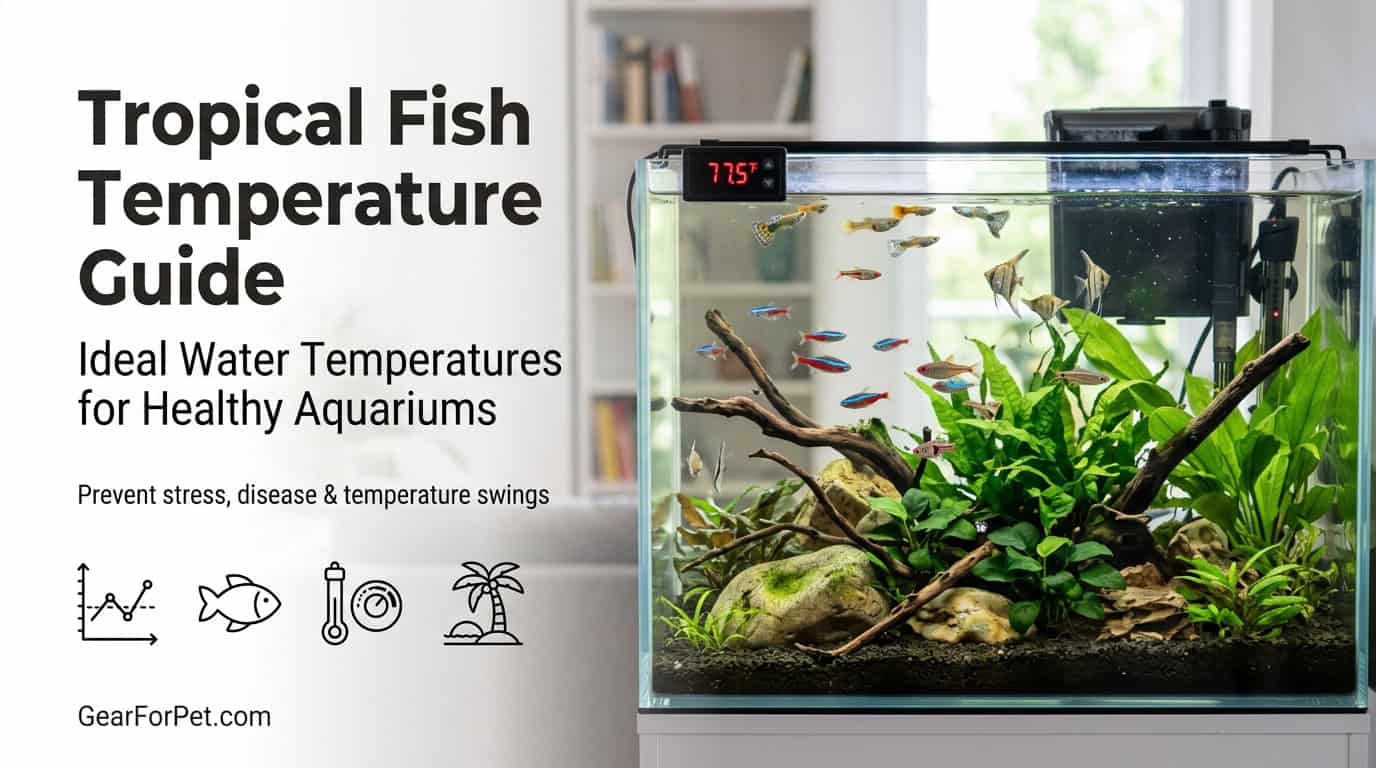
Tropical Fish Temperature Guide: Ideal Ranges for 40+ Species (2026)
Temperature is the most important environmental parameter in a tropical fish tank — and the one most consistently mismanaged. Not because fishkeepers don’t care, but because the default advice (“keep your tropical tank at 78°F”) is too blunt to be genuinely useful. A neon tetra is comfortable at 72°F. A discus below 82°F is a stressed discus — immune-suppressed, prone to disease, and losing colour. A betta at 72°F is not dying, but it is significantly more lethargic, disease-susceptible, and short-lived than one kept at 78–80°F. The right temperature is not a single universal number — it is a species-specific range that, when hit consistently, is one of the most powerful things you can do for your fish’s health, colour, immune function, and lifespan. This guide gives you exact ranges for over 40 common tropical species, explains the biology behind why temperature matters, and tells you how to actually achieve stable temperatures in a home aquarium.
Quick Answer — What Temperature for a Tropical Fish Tank?
Most tropical community fish thrive between 75–80°F (24–27°C). This range covers the majority of commonly kept species — tetras, livebearers, corydoras, rasboras, and most beginner-friendly fish. However, species outside the community tank norm — discus, altum angelfish, some cichlids, and cold-water tropicals — have specific requirements that fall outside this window. Always check species-specific requirements before setting tank temperature, especially in mixed-species community tanks.
Why Temperature Matters More Than Most Fishkeepers Realise
Fish are ectotherms — their body temperature matches the surrounding water, and virtually every biological process they perform is directly governed by water temperature. This is not a minor background variable. Temperature controls metabolic rate, immune response, digestion speed, oxygen consumption, reproductive behaviour, and lifespan. A fish kept at the wrong temperature is not merely uncomfortable — it is operating outside its biological design parameters, and the consequences accumulate over time.
What Incorrect Temperature Actually Does to Fish
- Immune suppression — cold stress is the most common trigger for white spot (Ich), velvet, and bacterial infections in tropical tanks. Ich parasites (Ichthyophthirius multifiliis) become significantly more virulent below the lower end of a species’ preferred range, while the fish’s immune response simultaneously weakens. A fish that has never shown Ich in a stable tank will develop it within days of a significant temperature drop.
- Metabolic stress — too warm accelerates metabolism beyond sustainable levels: increased oxygen demand, faster aging, shortened lifespan, and elevated stress hormone production. Fish kept 5°F above their upper preferred limit consistently show shortened lifespans and reduced disease resistance.
- Digestive disruption — digestion in fish is enzyme-driven, and digestive enzymes are temperature-sensitive. Cold water slows enzyme activity, causing food to remain in the gut longer than normal — producing internal fermentation, bloating, and the rotting food in the gut that leads to bacterial infections.
- Reproductive failure — most tropical fish require temperature within a specific narrow window to trigger spawning behaviour. Discus, for example, will not spawn reliably below 84°F regardless of all other conditions being perfect.
- Colour loss — chromatic cells (chromatophores) in tropical fish are temperature-sensitive. Cold-stressed fish consistently show faded, washed-out colouration — the same fish moved to its correct temperature window will show noticeably deeper colour within days.
- Oxygen depletion — warmer water holds less dissolved oxygen. At temperatures above 86°F, dissolved oxygen drops significantly enough to cause respiratory stress in fish — visible as gasping at the surface, increased gill rate, and lethargy that looks like disease but is actually hypoxia.
Tropical Fish Temperature Chart — 40+ Species
Use this chart as your reference for species-specific temperature requirements. The “Ideal Range” column reflects the range where each species demonstrates best health, colour, and behaviour — not merely survival range. The “Minimum Safe” and “Maximum Safe” columns are the outer limits beyond which health consequences begin.
Tetras & Small Schooling Fish
| Species | Minimum Safe | Ideal Range | Maximum Safe | Notes |
|---|---|---|---|---|
| Neon Tetra | 68°F / 20°C | 72–78°F / 22–26°C | 82°F / 28°C | Tolerates cooler water better than most tropicals |
| Cardinal Tetra | 73°F / 23°C | 75–82°F / 24–28°C | 86°F / 30°C | Warmer than neons — often confused for the same requirement |
| Rummy Nose Tetra | 72°F / 22°C | 75–81°F / 24–27°C | 84°F / 29°C | Red nose colour intensifies at upper ideal range |
| Black Skirt Tetra | 70°F / 21°C | 70–80°F / 21–27°C | 83°F / 28°C | Wide tolerance — excellent community fish |
| Ember Tetra | 73°F / 23°C | 76–82°F / 24–28°C | 84°F / 29°C | Colour deepens at mid-upper range |
| Serpae Tetra | 72°F / 22°C | 72–79°F / 22–26°C | 82°F / 28°C | Fin-nipping increases at temperature extremes |
| Glowlight Tetra | 72°F / 22°C | 74–80°F / 23–27°C | 83°F / 28°C | Standard community tetra range |
| Congo Tetra | 73°F / 23°C | 75–81°F / 24–27°C | 84°F / 29°C | Larger tetra — needs more swim space than small species |
Bettas & Gouramis
| Species | Minimum Safe | Ideal Range | Maximum Safe | Notes |
|---|---|---|---|---|
| Betta (Siamese Fighting Fish) | 72°F / 22°C | 78–80°F / 25–27°C | 86°F / 30°C | Often kept too cool — 72°F bettas are lethargic, not “calm” |
| Dwarf Gourami | 72°F / 22°C | 77–82°F / 25–28°C | 84°F / 29°C | Sensitive to temperature swings — stability critical |
| Pearl Gourami | 72°F / 22°C | 77–82°F / 25–28°C | 84°F / 29°C | Hardy within range — good community species |
| Honey Gourami | 72°F / 22°C | 74–82°F / 23–28°C | 84°F / 29°C | Wide tolerance; colour best at upper ideal range |
| Three-Spot Gourami | 72°F / 22°C | 72–82°F / 22–28°C | 84°F / 29°C | Very adaptable — wide practical range |
| Sparkling Gourami | 72°F / 22°C | 76–82°F / 24–28°C | 84°F / 29°C | Nano species — 5–10 gallon minimum |
Livebearers
| Species | Minimum Safe | Ideal Range | Maximum Safe | Notes |
|---|---|---|---|---|
| Guppy | 64°F / 18°C | 74–82°F / 23–28°C | 86°F / 30°C | Highly adaptable — one of the widest thermal ranges |
| Platy | 65°F / 18°C | 70–78°F / 21–26°C | 82°F / 28°C | Cooler preference than most livebearers — avoid discus pairing |
| Swordtail | 64°F / 18°C | 72–79°F / 22–26°C | 82°F / 28°C | Cool tolerant; livelier at mid-range than at warmth |
| Molly | 70°F / 21°C | 75–82°F / 24–28°C | 86°F / 30°C | Saltwater tolerance makes them uniquely flexible |
| Endler’s Livebearer | 64°F / 18°C | 72–80°F / 22–27°C | 84°F / 29°C | Very hardy — similar range to guppy |
Corydoras & Bottom Dwellers
| Species | Minimum Safe | Ideal Range | Maximum Safe | Notes |
|---|---|---|---|---|
| Corydoras (most species) | 68°F / 20°C | 72–79°F / 22–26°C | 82°F / 28°C | Cooler preference — incompatible with discus tanks |
| Sterbai Corydoras | 73°F / 23°C | 78–86°F / 26–30°C | 88°F / 31°C | Only cory species suitable for discus tank temperatures |
| Otocinclus | 68°F / 20°C | 72–79°F / 22–26°C | 82°F / 28°C | Very sensitive to temperature swings — stability essential |
| Bristlenose Pleco | 60°F / 16°C | 73–81°F / 23–27°C | 86°F / 30°C | Wide tolerance; cold-hardier than most tropicals |
| Kuhli Loach | 73°F / 23°C | 75–86°F / 24–30°C | 90°F / 32°C | Warmer preference — often understated in beginner guides |
| Yoyo Loach | 72°F / 22°C | 75–82°F / 24–28°C | 86°F / 30°C | Active and social; temperature stable preferred |
Cichlids
| Species | Minimum Safe | Ideal Range | Maximum Safe | Notes |
|---|---|---|---|---|
| Discus | 80°F / 27°C | 82–88°F / 28–31°C | 90°F / 32°C | Highest temperature requirement of common tropicals — tank mates must match |
| Angelfish | 75°F / 24°C | 78–84°F / 26–29°C | 86°F / 30°C | Warmer than typical community — check tank mate compatibility |
| German Blue Ram | 78°F / 26°C | 80–86°F / 27–30°C | 88°F / 31°C | High temperature requirement — beginners often keep too cool |
| Bolivian Ram | 72°F / 22°C | 74–80°F / 23–27°C | 82°F / 28°C | Cooler than German Blue — often a better community option |
| Keyhole Cichlid | 72°F / 22°C | 74–80°F / 23–27°C | 82°F / 28°C | Peaceful; community compatible at standard range |
| African Cichlids (most) | 74°F / 23°C | 76–82°F / 24–28°C | 84°F / 29°C | Malawi / Tanganyika species — never mix with South American cichlids |
Rasboras & Danios
| Species | Minimum Safe | Ideal Range | Maximum Safe | Notes |
|---|---|---|---|---|
| Harlequin Rasbora | 72°F / 22°C | 74–81°F / 23–27°C | 84°F / 29°C | Classic community species — standard range |
| Chili Rasbora | 68°F / 20°C | 75–82°F / 24–28°C | 84°F / 29°C | Nano species; colour intensifies at upper ideal range |
| Lambchop Rasbora | 72°F / 22°C | 74–82°F / 23–28°C | 84°F / 29°C | Similar to harlequin — excellent community schooler |
| Zebra Danio | 60°F / 16°C | 65–77°F / 18–25°C | 82°F / 28°C | Coldwater tolerant — often too cool a preference for standard tropical communities |
| Pearl Danio | 64°F / 18°C | 68–77°F / 20–25°C | 82°F / 28°C | Cool preference — better in species tanks than warm tropical communities |
| Giant Danio | 68°F / 20°C | 72–81°F / 22–27°C | 84°F / 29°C | More compatible with tropical community range than zebra danio |
Shrimp & Invertebrates
| Species | Minimum Safe | Ideal Range | Maximum Safe | Notes |
|---|---|---|---|---|
| Cherry Shrimp (Neocaridina) | 65°F / 18°C | 70–78°F / 21–26°C | 82°F / 28°C | Above 82°F causes moulting failure and death within days |
| Crystal Red / Bee Shrimp (Caridina) | 62°F / 17°C | 66–76°F / 19–24°C | 78°F / 26°C | Coolest temperature requirement of commonly kept invertebrates |
| Amano Shrimp | 65°F / 18°C | 70–80°F / 21–27°C | 82°F / 28°C | Hardiest of the common shrimp species — similar range to cherry |
| Nerite Snail | 65°F / 18°C | 72–80°F / 22–27°C | 84°F / 29°C | Wide tolerance; suitable for most tropical community tanks |
| Mystery Snail | 68°F / 20°C | 74–80°F / 23–27°C | 84°F / 29°C | Standard community range; lifespan improves at cooler end of range |
Temperature Compatibility in Mixed-Species Community Tanks
The most common temperature-related mistake in community fishkeeping is selecting species with incompatible temperature requirements and splitting the difference — setting the tank at 78°F when one species prefers 72°F and another needs 84°F. Neither animal is comfortable, both are experiencing chronic stress, and disease will appear sooner than in a single-species setup. Always check temperature requirements before selecting tank mates — not after.
Compatible Temperature Groups — At a Glance
| Temperature Zone | Range | Compatible Species | Avoid Pairing With |
|---|---|---|---|
| Cool Tropical | 68–76°F / 20–24°C | Neon tetra, zebra danio, platy, swordtail, corydoras, bristlenose pleco, crystal shrimp | Discus, German Blue Ram, angelfish |
| Standard Tropical | 75–82°F / 24–28°C | Betta, guppy, molly, harlequin rasbora, ember tetra, honey gourami, cherry shrimp, nerite snail, Amano shrimp, kuhli loach, most livebearers | Discus (too cool), crystal shrimp (too warm), danios (too warm for some) |
| Warm Tropical | 80–86°F / 27–30°C | Discus, German Blue Ram, cardinal tetra, Sterbai corydoras, angelfish (upper range) | Most corydoras, platy, swordtail, neon tetra, cherry shrimp |
The Classic Incompatibility Mistake — Discus and Standard Community Fish
Discus are regularly sold alongside — and marketed as compatible with — cardinal tetras, corydoras, and angelfish. The truth is nuanced. Cardinal tetras can handle the lower end of discus temperature (80–82°F) and are a genuinely compatible pairing. Standard corydoras (paleatus, panda, sterbai) cannot — the exception is Sterbai corydoras, the only cory species with a temperature range that overlaps with discus requirements. Most corydoras kept in a discus tank at 84–86°F are experiencing chronic heat stress, eating less, and will have shortened lifespans — even if they appear visually healthy for months.
Betta and Shrimp — A Common Temperature Conflict
Cherry shrimp (Neocaridina) are frequently paired with bettas — and the combination can work if temperature is managed carefully. Cherry shrimp are comfortable at 70–78°F; bettas prefer 78–80°F. A shared temperature of 78°F sits at the upper edge of cherry shrimp comfort and the lower edge of betta ideal range. This compromise is workable, but demands stable temperature — a spike to 82°F in a warm room will stress shrimp significantly. Crystal Red shrimp (Caridina) should never be paired with bettas — the temperature requirements are genuinely incompatible.
Temperature Stability — Why Consistency Matters as Much as the Number
A tank that holds 78°F with ±4°F daily swings is more stressful for fish than a tank that holds a consistent 76°F. Tropical fish in their natural environment experience some temperature variation — but it is gradual, predictable, and tied to seasonal and day/night cycles. The rapid, unpredictable swings caused by inadequate heaters, room temperature fluctuations, and seasonal changes are the pattern fish cannot adapt to — and the immune system responds to each swing as a stress event.
What Causes Temperature Swings in Home Aquariums
- Undersized heaters — a heater too small for the tank volume cannot compensate fast enough when room temperature drops. The tank follows room temperature downward before the heater catches up. Size correctly at 5W/gallon minimum.
- Room temperature changes — seasonal changes in home heating and air conditioning are the most common source of tank temperature swings for fishkeepers in temperature-variable climates. A tank set to 78°F in a room that hits 85°F in summer will overshoot without a chiller or the ability to cut the heater down accordingly.
- Water changes with the wrong temperature water — adding 20% new water that is 10°F colder than the tank drops tank temperature immediately and measurably. Always match water change water temperature to within 1–2°F of the tank before adding.
- Heater placement in low-flow areas — a heater in a corner with no water movement creates localised hot spots while the rest of the tank remains below target. Position near filter output for even distribution.
- Old or failing heaters — heater calibration drifts over time. A 4-year-old heater may be holding 75°F while displaying 78°F. Replace heaters every 3–5 years and verify with a separate digital thermometer.
How to Maintain Stable Temperature in a Tropical Tank
Choose the Right Heater for Your Tank Size
This is the single most important decision. An undersized heater cannot maintain target temperature in cold rooms or large volumes — and a heater working at maximum capacity continuously degrades faster than one sized with headroom. See our Best Aquarium Heater 2026 guide for specific picks matched to tank size. For tanks over 75 gallons, two heaters split the load — if one fails, the other maintains baseline temperature while you replace it.
Always Verify With an Independent Thermometer
Never trust a heater’s built-in display or dial as your only temperature reference. All heaters can drift from calibration — even quality units. A separate digital submersible thermometer placed at the opposite end of the tank from the heater gives you the actual water temperature your fish are experiencing. Read it daily for the first week after any setup or change; weekly thereafter. The Eheim Jager’s recalibration dial allows you to match the heater to your thermometer reading — one of its most underappreciated features.
Match Water Change Temperature
Water changes should never introduce a thermal shock. Use a bucket thermometer or mix tap and heated water until the replacement water matches the tank within 1–2°F. In practice: fill the bucket, check the temperature, adjust, wait 5 minutes, check again. For large water changes (30%+), this step is particularly important — a large volume of even slightly colder water drops tank temperature measurably and immediately.
Manage Room Temperature Seasonally
In summer — particularly in rooms without air conditioning — tank temperature can exceed the heater’s set point if room temperature climbs above the target. Solutions include: float a sealed bag of ice briefly (not directly — use a sealed container), increase surface agitation to accelerate evaporative cooling, or position a small fan to blow across the water surface. In winter, ensure the room temperature does not drop so far that the heater cannot compensate — basements and garages in cold climates may require additional insulation or a more powerful heater.
Use a Controller for High-Stakes Tanks
For discus, reef tanks, high-value breeding setups, or any tank where a temperature failure would be genuinely costly — pair your heater with a Wi-Fi temperature controller like the Inkbird IBS-M1. Push notifications when temperature goes outside your set range mean you catch heater failures within hours rather than returning home to find the damage done.
Using Temperature to Treat White Spot (Ich)
Temperature is one of the most effective tools in an Ich treatment protocol — used correctly, it can eliminate the parasite without medication in mild outbreaks. The biology: Ichthyophthirius multifiliis has a temperature-dependent lifecycle. Raising temperature accelerates the parasite’s lifecycle, cycling it faster through the vulnerable free-swimming tomite stage — the only stage susceptible to treatment. Simultaneously, fish immune function improves at the upper end of their comfortable range.
- Gradually raise temperature to 86°F / 30°C (no faster than 1–2°F per hour) — this is within the safe range for most tropical species but lethal to Ich at sustained duration
- Increase aeration — warmer water holds less dissolved oxygen; add an airstone or increase surface agitation when raising temperature above 82°F
- Maintain 86°F for 10 days minimum — the full lifecycle must complete at this temperature to ensure all parasites have cycled through the vulnerable stage
- Return to normal temperature gradually — drop no faster than 1–2°F per day after treatment is complete
Important caveat: This protocol is not safe for all species. Scaleless fish (loaches, catfish), very young fry, and species with tight upper temperature limits (crystal shrimp, most danios, plecos) cannot tolerate 86°F safely. For mixed tanks, salt treatment or medication is the safer protocol than temperature elevation.
New Tank Temperature Setup Checklist
- ✅ Research your specific species’ ideal temperature range before setting heater — not the generic “tropical fish” guideline
- ✅ Choose a heater sized at 5W per gallon minimum (7W/gallon for cold rooms or high-temperature species)
- ✅ Position heater near filter outlet for even water circulation and accurate thermostat reading
- ✅ Set heater to target temperature and allow 24 hours to stabilise before adding fish
- ✅ Verify temperature with a separate digital thermometer — not the heater’s dial or display alone
- ✅ Check temperature again at a different time of day (room temperature fluctuates — check morning and evening)
- ✅ Compare temperature at heater end vs. opposite end of tank — more than 2°F variation indicates poor circulation
- ✅ Confirm water change bucket temperature matches tank within 1–2°F before every water change
- ✅ Set a calendar reminder to replace heater at 3–5 years of service
Frequently Asked Questions — Tropical Fish Temperature
What temperature should a tropical fish tank be?
Most tropical community fish thrive between 75–80°F (24–27°C). This range covers the majority of beginner-friendly species including tetras, livebearers, rasboras, and gouramis. Species outside this range — discus (82–88°F), German Blue Rams (80–86°F), danios (65–77°F) — require species-specific temperature settings. Always confirm requirements for every species before selecting tank mates, and choose a shared temperature within the comfortable range of all species you plan to keep together.
Can tropical fish survive in cold water?
Most tropical fish can survive brief exposure to temperatures below their preferred range — but survival and thriving are different conditions. Below their minimum safe temperature, fish become lethargic, immune-suppressed, and highly vulnerable to Ich and bacterial infections. Metabolic processes slow dramatically, digestion fails, and stress hormones elevate. A betta at 68°F may survive for weeks or months but will be inactive, prone to disease, and have a significantly shortened lifespan compared to one kept at 78–80°F.
Is 80°F too warm for tropical fish?
80°F is within the comfortable range for the majority of tropical community species — bettas, gouramis, most tetras, most livebearers, and many shrimp species are all comfortable at this temperature. It is at or above the upper comfortable limit for some cooler-preference species like platies, swordtails, corydoras, and Neocaridina shrimp. At 80°F, dissolved oxygen levels begin to drop relative to lower temperatures — ensure surface agitation is adequate for gas exchange. For species with a maximum safe temperature below 80°F, reduce to 76–78°F.
What temperature kills tropical fish?
Most tropical fish experience serious physiological stress and begin dying at temperatures above 95°F / 35°C or below 60°F / 16°C — though the practical danger zone begins well before these extremes. A temperature above 90°F / 32°C causes oxygen depletion, enzyme degradation, and cardiac stress in most tropical species within hours. A temperature below 65°F / 18°C causes immune failure and Ich vulnerability within days in most tropical fish. The dangerous range is not just the extremes — chronic exposure to temperatures even 5°F outside a species’ preferred range accelerates aging and disease susceptibility measurably over weeks.
Why does my tropical fish keep getting Ich?
Recurring Ich in a tank with consistent water parameters and no new fish introductions is almost always a temperature problem. Ich parasites persist at low levels in most aquariums and are held in check by a functioning fish immune system. When temperature drops below a species’ comfortable range — even transiently during water changes or room temperature fluctuations — immune function drops and the parasite exploits the window. Verify your heater’s actual temperature output with a separate thermometer, check for temperature swing patterns between morning and evening, and ensure your heater is correctly sized for your tank volume.
The Practical Summary
Temperature in a tropical aquarium is not a set-and-forget parameter — it is an active ongoing responsibility that directly determines your fish’s health, colour, and lifespan. Three principles cover the majority of what fishkeepers need:
- Know your species’ specific range — not the generic tropical guideline
- Verify with an independent thermometer — never trust the heater dial alone
- Prioritise stability — a consistent 76°F is healthier than an unstable 78°F with daily swings
For heater recommendations matched to every tank size and budget, see our Best Aquarium Heater 2026 guide — including the top budget pick, the hobby’s most trusted unit, and the best smart monitoring option for high-value setups.
Affiliate Disclosure: GearForPet.com participates in affiliate programs. We may earn a small commission if you purchase through our links at no extra cost to you. Read our full disclosure.