Retractable vs Standard Dog Leash
The retractable vs standard leash debate gets treated like a preference argument — but it’s really a use-case argument. Neither type is universally better. They’re built for different situations, different dogs, and different walking goals. Using a retractable where a standard leash belongs causes real problems. Using a standard leash in every situation where a retractable would serve the dog better is an unnecessary restriction. This guide draws the line clearly.
Retractable vs Standard Leash — Quick Answer
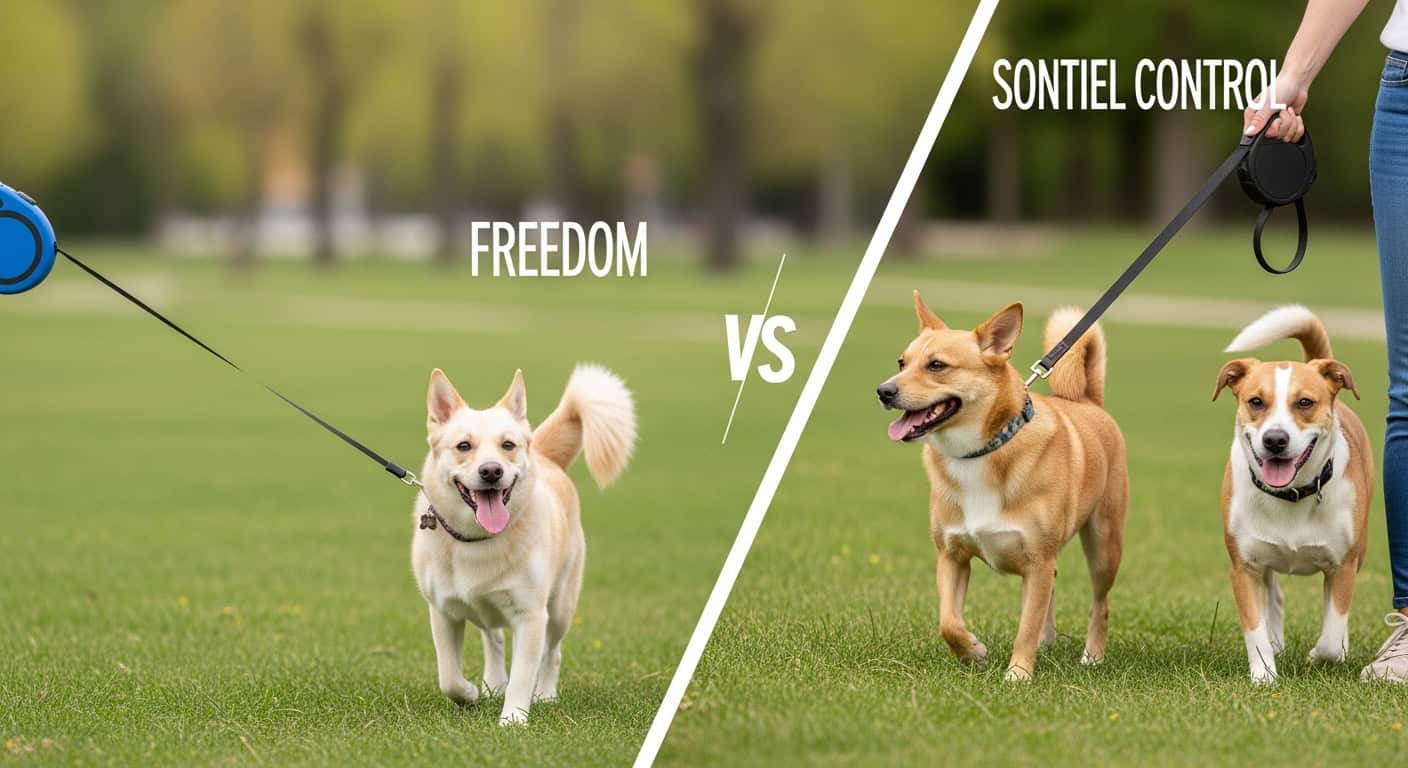
A standard leash is the right default for most dogs in most situations — it provides consistent control, works for training, and is safe in all environments. A retractable leash is the right choice for a specific scenario: a calm, trained dog in a low-traffic open space who benefits from freedom to sniff and explore. Outside that scenario, the standard leash wins on every meaningful measure. The retractable is a specialist tool, not an upgrade.
Retractable vs Standard — Full Comparison
| Factor | Standard Leash | Retractable Leash |
|---|---|---|
| Control | ✅ Full — consistent length, instant response | ❌ Limited — variable length, brake lag |
| Training suitability | ✅ Yes — consistent leash length is essential for training | ❌ No — constant tension actively trains pulling |
| Urban / traffic safety | ✅ Yes — dog stays within safe range | ❌ No — extended range creates traffic risk |
| Dog freedom | ❌ Limited — fixed 5–6 ft range | ✅ Yes — up to 26 ft of exploration range |
| Sniff walk quality | ⚠️ Moderate — dog can sniff but range is restricted | ✅ Excellent — genuine freedom to follow scent trails |
| Injury risk | ✅ Low — no mechanism failure, no wrap-cut risk | ⚠️ Moderate — cord designs cause lacerations; tape safer |
| Reactive dog management | ✅ Yes — close control possible instantly | ❌ No — cannot shorten quickly enough |
| Tangling / pedestrian hazard | ✅ Low — short fixed length | ❌ High — extended tape creates trip hazard |
| Durability | ✅ High — no mechanical parts to fail | ⚠️ Moderate — brake mechanism degrades over time |
| Best environment | Urban, busy paths, training, reactive dogs | Open parks, beaches, low-traffic countryside |
When a Standard Leash Is the Right Choice
A standard 5–6 ft leash is the correct tool in the overwhelming majority of dog walking situations. The reason is simple: control and consistency. A fixed-length leash keeps the dog within a predictable range at all times — you always know exactly where your dog is relative to you, and the response time between a decision and the leash taking effect is zero. There is no brake to engage, no mechanism to fail, no variable length to account for.
Use a standard leash when:
- Walking near traffic — a dog that steps off a curb on a retractable leash before the brake engages is in a genuinely dangerous situation; a standard leash prevents this entirely
- Training loose-leash walking or heel — consistent leash length is non-negotiable for training; a retractable actively undermines it by rewarding forward movement with extended range
- Walking a reactive dog — reactive dogs need instant close-control capability; the brake lag on a retractable is too slow for the half-second response window a reactive dog gives you
- Busy paths, markets, crowded areas — 26 ft of extended tape is a trip hazard for other pedestrians, cyclists, and dogs; a standard leash eliminates the risk
- Walking a puppy — puppies learn leash manners on a standard leash; introducing a retractable during the learning phase teaches them that pulling extends their range — the opposite of what training requires
- Any situation requiring consistent, immediate response — the standard leash has no mechanical lag between your decision and the leash effect
When a Retractable Leash Is the Right Choice
The retractable leash earns its place in one specific scenario: a calm, trained dog in a low-traffic open space who benefits meaningfully from the freedom to sniff and explore beyond 6 ft. Dogs experience the world primarily through scent — a sniff walk at full retractable range provides genuine mental enrichment that a 6 ft standard leash cannot replicate. For a dog that already walks calmly on a standard leash, a retractable in the right environment is an enrichment upgrade, not a risk.
Use a retractable leash when:
- Open parks and fields with low foot traffic — wide space means extended tape isn’t a pedestrian hazard, and the dog benefits from genuine sniff freedom
- Beach walks — open, low-traffic, and the enrichment value of full-range sniffing and exploration is high
- Calm countryside paths — low encounter rate with other dogs and pedestrians; extended range is manageable
- Dogs that are fully trained on loose-leash walking — a dog that already walks calmly on a standard leash won’t be confused by the variable tension of a retractable
- Decompression walks after high-stress periods — veterinary behaviourists increasingly recommend sniff-led decompression walks for anxious or stressed dogs; retractable range enhances this
Always use a tape retractable, never cord. For our full breakdown of the safest retractable options by dog size, see our best retractable dog leashes guide.
Why Retractable Leashes and Training Don’t Mix
This is the most important practical point in the entire debate — and it’s consistently underexplained in comparison articles. Retractable leashes maintain constant light tension on the leash at all times. The mechanism is designed this way — it’s what keeps the tape taut rather than dragging on the ground. That constant tension teaches the dog one thing: pulling moves them forward.
Loose-leash training teaches the opposite: that pulling gets them nowhere, and walking calmly beside you is what results in forward movement and slack. These two signals are directly contradictory. A dog trained on a retractable leash learns to expect tension as the default state — which makes loose-leash training on a standard leash significantly harder to establish. Always train on a standard leash. Introduce the retractable only after loose-leash walking is reliably established.
The Pulling Problem — Neither Leash Fixes It
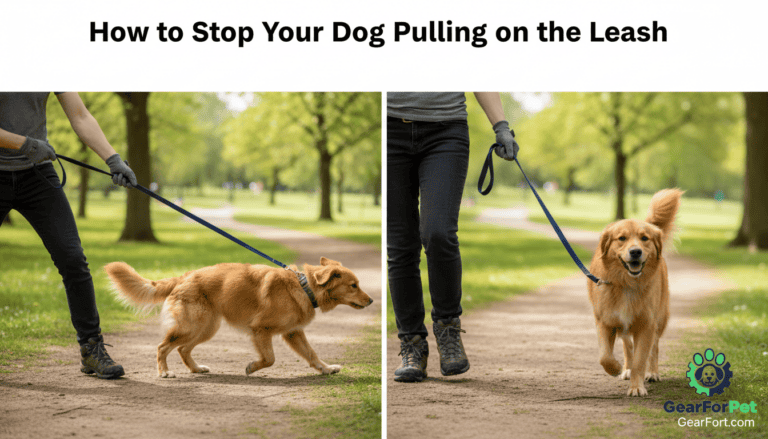
A standard leash doesn’t stop pulling — it just doesn’t make it worse. A retractable leash actively rewards pulling by extending range. Neither leash type is a pulling solution. Pulling is a training and harness issue — specifically, a front-clip no-pull harness redirects a pulling dog’s momentum sideways, making pulling mechanically less effective, while consistent training reinforces the loose-leash behaviour.
If pulling is your primary concern, solve it at the harness and training level first — then choose your leash type based on environment. See our no-pull harness guide for the front-clip designs that address pulling at the source, and our guide on stopping leash pulling for the training approach that works alongside the right gear.
Which Should You Buy? — Decision Guide
| Your Situation | Choose This |
|---|---|
| First leash, new dog or puppy | Standard — always start here |
| Urban walking near traffic | Standard — non-negotiable |
| Training loose-leash walking | Standard — retractable actively harms training |
| Reactive or unpredictable dog | Standard with traffic handle |
| Calm trained dog, open park, sniff walk | Tape retractable — the right tool for this situation |
| Beach or countryside walk, low traffic | Tape retractable — excellent enrichment value |
| You want one leash for everything | Standard — it handles all situations; retractable does not |
| You want the best of both | Own both — standard for daily/training, retractable for enrichment walks |
For specific product picks — best standard leashes and best tape retractable leashes — see our complete dog leash guide which covers every type with full reviews.
Frequently Asked Questions
Are retractable leashes bad for dogs?
Not inherently — but they’re bad in the wrong situations. Retractable leashes near traffic, with reactive dogs, or during training cause real problems. A tape retractable used in open, low-traffic spaces with a calm trained dog is a safe and beneficial tool. The problem isn’t the retractable leash — it’s the context mismatch between the tool and the situation.
Why do dog trainers recommend standard leashes?
Because consistent leash length is fundamental to training. A standard leash gives the trainer and the dog a predictable, consistent physical relationship — the dog learns exactly what range they have and what leash pressure means. A retractable leash creates variable tension and variable range, which confuses the training signal and rewards the pulling behaviour that most training is designed to correct.
Can I use a retractable leash in a park?
Yes — a low-traffic open park is one of the best environments for a tape retractable leash, provided your dog is calm and trained. Avoid areas where other dogs and pedestrians are in close proximity — the extended tape creates a trip hazard and removes close-control capability if your dog reacts to another dog. In a genuinely open, low-foot-traffic section of a park, a retractable gives your dog meaningful enrichment freedom.
What is better — a 6 ft leash or a retractable?
A 6 ft standard leash is better for daily walking, training, urban environments, and reactive dogs. A retractable is better for open-space enrichment walks with a calm trained dog. If you can only own one, the standard 6 ft leash handles every situation adequately. The retractable handles its specific scenario better than any standard leash — but only in that scenario.
Final Verdict
Default to a standard leash. Add a tape retractable for enrichment walks once your dog’s leash manners are reliably established. The standard leash is the foundation — the retractable is the supplement. Used in the right sequence and the right environments, both have a place in your kit. Used in the wrong order or the wrong context, the retractable creates exactly the problems it’s blamed for.
For product picks across both types, see our best dog leashes guide — and our best retractable leashes guide for the tape-only picks that make retractable leashes safe.
Affiliate Disclosure: GearForPet.com participates in affiliate programs. We may earn a small commission if you purchase through our links at no extra cost to you. Read our full disclosure.