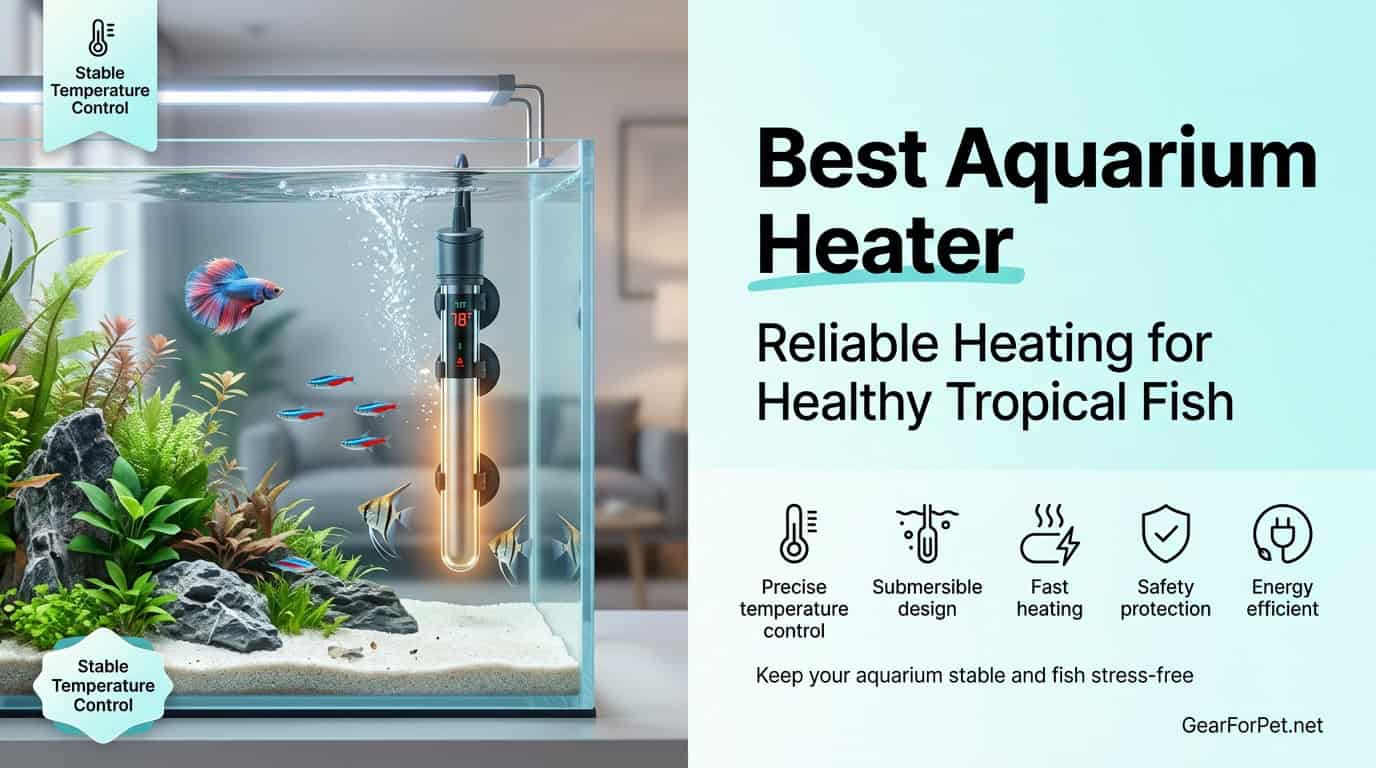
Best Aquarium Heater 2026: 7 Picks That Won’t Cook Your Fish
An aquarium heater has one job: hold your water at the exact temperature your fish need, every hour of every day, without fail. It sounds simple — and most heaters do the job adequately for a while. The problem is “for a while.” A heater that sticks in the on position turns a tropical tank into a boiling pot overnight. A heater that loses calibration slowly drifts 4°F below set temperature without any visible sign — and your fish start exhibiting stress, disease susceptibility, and appetite loss that looks like a mystery illness. Temperature stability isn’t just a comfort feature. It is the single most important environmental parameter in a fish tank — and the right heater is what makes it reliable. These 7 picks cover every tank size and budget, with honest assessments of where each one earns its price and where it falls short.
Best Aquarium Heaters 2026 — Quick Comparison
| Heater | Best For | Tank Size | Wattage | Price Tier | Rating |
|---|---|---|---|---|---|
| Fluval E300 | Best Overall | Up to 100 gal | 300W | Mid-Premium (~$60) | ⭐⭐⭐⭐⭐ |
| Eheim Jager | Best for Reliability / Longevity | Up to 264 gal | 25W–300W | Mid (~$35–55) | ⭐⭐⭐⭐⭐ |
| Hygger Submersible | Best Budget Pick | 10–48 gal | 50W–300W | Budget (~$18–25) | ⭐⭐⭐⭐ |
| Inkbird IBS-M1 | Best Smart / Wi-Fi Controller | Any (controller only) | Paired heater | Mid (~$40–50) | ⭐⭐⭐⭐½ |
| Aqueon Pro | Best Mid-Range All-Rounder | Up to 75 gal | 50W–250W | Mid (~$30–45) | ⭐⭐⭐⭐ |
| Cobalt Aquatics Neo-Therm | Best Slim / AIO Profile | Up to 40 gal | 25W–150W | Mid-Premium (~$40–55) | ⭐⭐⭐⭐ |
| Marina Submersible | Best for Small Tanks / Beginners | 2–10 gal | 25W–50W | Budget (~$12–18) | ⭐⭐⭐½ |
1. Fluval E300 Electronic Heater — Best Overall
The bottom line: The Fluval E300 is the most technologically sophisticated submersible heater in its price range — and one of the few heaters where the technology genuinely improves daily fishkeeping rather than just adding complexity. The dual-sensor VueTech® display and colour-coded temperature alert system mean you know your tank temperature at a glance, every time you walk past. At ~$60, it is not the cheapest pick on this list, but it is the best combination of precision, safety features, and usability available under $80.
Key Specs
- Wattage: 300W (also available as E50, E100, E200)
- Tank size: Up to 100 US gallons / 375 L
- Temperature range: 68–93°F / 20–34°C
- Adjustment increment: ±0.5°F precision
- Display: LCD dual-sensor with colour alert (blue = low, green = safe, red = high)
- Compatible: Freshwater and saltwater
- Safety: Integrated fish guard, automatic safety shutoff
What Makes It Stand Out
The VueTech® dual-sensor system is the defining feature — two independent temperature probes constantly cross-reference each other, and the LCD display changes colour if water temperature drifts more than ±1°C / ±2°F from your set point. At ±3°C / ±5.5°F deviation, the screen flashes. This is not a luxury feature — it is a meaningful safety system that catches heater drift before it becomes fish death. Most heaters in this price range offer none of this feedback.
The external toggle adjustment (±0.5°F increments) allows precise temperature dialling without removing the heater from the tank. The integrated fish guard — a cage around the heating element — prevents direct contact burns for bottom-dwelling fish and invertebrates that rest against tank walls.
The Honest Caveat
The most widely reported installation issue is the E1 error code, which occurs when the heater is mounted fully vertical in low-flow areas — heated water rises directly into the upper thermostat sensor and triggers a false reading. The fix is straightforward: mount at a 45-degree angle, or position near a filter outlet where water circulation carries warm water away from the sensor. This is a positioning requirement, not a flaw — but it is worth knowing before installation. The manual mentions it; many buyers miss it.
Who It’s For
Medium to large tanks (30–100 gallons) where temperature stability is genuinely important — tropical community tanks, planted tanks, cichlid setups. The best overall pick for any fishkeeper who wants real-time visual temperature feedback and precision control without stepping into external controller territory.
Who It’s NOT For
Nano tanks under 15 gallons — the E300 is significantly oversized for small setups. Step down to the E50 or E100 for tanks under 30 gallons, or consider the Marina Submersible below for true nano setups.
Check current price on Amazon →
2. Eheim Jager — Best for Reliability and Longevity
The bottom line: The Eheim Jager is the most trusted aquarium heater in the hobby — not because of flashy technology, but because it has been working reliably in tanks worldwide for decades and consistently delivers what it promises: accurate, stable temperature with minimal drama. If the Fluval E300 is the smartest heater on this list, the Eheim Jager is the most trustworthy. For experienced fishkeepers who have been burned by heater failures before, this is often the default choice — and for good reason.
Key Specs
- Wattage range: 25W–300W (9 sizes)
- Tank size: 5–264 US gallons (20–1,000 L)
- Temperature range: 64–95°F / 18–34°C
- Accuracy: ±0.5°C / ±1°F
- Material: Shatter-resistant laboratory glass jacket
- Safety: Automatic dry-run shut-off (Thermo Safety Control)
- Compatible: Freshwater and saltwater
- Mount: Fully submersible, double suction cup holder
What Makes It Stand Out
The Eheim Jager’s laboratory glass construction and calibration dial set it apart from most competitors in its price range. The recalibration feature — a simple ±2°C adjustment dial — allows you to match the heater’s output to a reference thermometer, accounting for individual unit variation. This is a feature most heaters at any price point skip, and it is the primary reason experienced aquarists trust the Jager’s stated temperature: you can verify it and correct it yourself rather than relying on the manufacturer’s calibration alone.
The Thermo Safety Control automatic dry-run shutoff cuts power instantly if the heater is exposed to air — essential protection during water changes and the most common cause of heater element failure in other brands. The glass jacket construction increases surface area for more even heat distribution across the water column.
The Honest Caveat
The Jager is analogue — there is no digital display, no colour-coded alert, no app connectivity. The dial is manual and requires a separate thermometer for initial calibration. For fishkeepers who want a display and visual temperature feedback, the Fluval E300 is the better choice. The Jager is for hobbyists who prefer proven mechanical reliability over digital convenience.
Who It’s For
Any tank size — with 9 wattage options from 25W to 300W, the Jager covers everything from a 10-gallon betta tank to a 200-gallon display tank. The standout choice for fishkeepers prioritising long-term reliability, anyone setting up multiple tanks who wants a consistent heater standard across all of them, and experienced hobbyists who don’t need a display but do need accuracy they can trust.
Who It’s NOT For
Beginners who want visual temperature feedback without a separate thermometer. The analogue dial setup is simple but requires a calibration step that first-time fishkeepers sometimes skip — leading to a tank running 2–3°F below the dial setting.
Check current price on Amazon →
3. Hygger Submersible Heater — Best Budget Pick
The bottom line: The Hygger delivers temperature accuracy that has no business being at a budget price point. With a ±0.1°F precision smart chip, external controller, built-in thermometer display, and explosion-proof quartz glass construction, this heater outspecifies products costing twice as much on paper. The real-world performance tracks closely — owner feedback patterns consistently highlight accurate temperature holding and reliable shutoff behaviour. For a 10–48 gallon tank on a budget, it is the most capable heater available at the price.
Key Specs
- Wattage: 50W–300W
- Tank size: 10–48 gallons
- Temperature range: 59–93°F
- Accuracy: ±0.1°F (smart chip)
- Material: Explosion-proof quartz glass, nickel-chromium heating wire
- Safety: Auto shutoff if out of water (Er code), auto shutoff >93°F (EE code)
- Controller: External — no hand immersion needed for adjustments
- Display: LED — shows current and set temperature simultaneously
What Makes It Stand Out
The external controller is the feature that sets the Hygger apart from other budget heaters. Adjusting temperature without immersing your hand in the tank is a practical quality-of-life improvement that most heaters at this price point don’t offer. The display shows both current and set temperature simultaneously — so you can see at a glance whether the tank has reached the target. The silicon carbide heat conduction through nickel-chromium wire distributes heat more evenly than simpler designs, and the overheat alarm (audible alert plus EE error code at >93°F) is a genuine safety layer that most budget competitors omit entirely.
The Honest Caveat
The ±0.1°F accuracy claim reflects the smart chip calibration in ideal conditions — real-world accuracy in lower-flow tanks can vary slightly from this figure. The quartz glass, while described as explosion-proof, should still be handled carefully during maintenance — like all glass heaters, drops onto hard surfaces are a risk. Not recommended for tanks with aggressive fish species prone to striking tank equipment.
Who It’s For
Budget-conscious owners setting up a first freshwater tropical tank in the 10–50 gallon range. An excellent choice for a second or quarantine tank where budget restraint is a priority without wanting to sacrifice reliable temperature control. The best value heater on this list by a significant margin.
Who It’s NOT For
Tanks over 50 gallons — the Hygger’s tank size rating tops out where the mid-range picks begin. For larger tanks, step up to the Aqueon Pro or Eheim Jager.
Check current price on Amazon →
4. Inkbird Wi-Fi Aquarium Temperature Controller — Best Smart Pick
The bottom line: The Inkbird IBS-M1 approaches aquarium heating differently from every other product on this list — it is a Wi-Fi gateway and temperature controller that pairs with your existing heater (or a new one), adds remote monitoring via smartphone app, and sends push notifications when temperature goes outside your set range. If you have ever come home to a temperature spike, returned from a week’s holiday to a tank problem, or simply want the peace of mind of real-time temperature alerts on your phone, the Inkbird system is the most practical smart upgrade available at its price.
Key Specs
- Connectivity: 2.4GHz Wi-Fi + Bluetooth (requires 2.4GHz router)
- App: iOS and Android — real-time monitoring, push notifications, historical data
- Max devices: Up to 50 Inkbird sensors simultaneously
- Connection range: Up to 164 ft (Bluetooth), 300 ft (Wi-Fi)
- Data storage: Local, up to 30,000 data points; CSV export
- Notifications: Temperature and connection alerts pushed to phone
What Makes It Stand Out
Remote monitoring is the defining feature — the ability to check your tank temperature from anywhere, receive an instant push notification if temperature rises or falls outside your set range, and review historical temperature trends via CSV export. For fishkeepers who travel, work long hours, or maintain high-value tanks (reef, discus, breeding setups) where a 4-hour temperature swing is a serious risk, this monitoring layer is not an optional extra — it is the difference between catching a problem and returning home to a disaster.
The multi-device capability means a single IBS-M1 gateway can monitor temperature across multiple tanks simultaneously, making it excellent value for multi-tank households and fish rooms.
The Honest Caveat
The IBS-M1 is a monitoring and control gateway — it monitors and controls your heater but does not replace it. You still need a quality heater connected to the system. Budget the controller price alongside a heater cost. The system also requires a 2.4GHz Wi-Fi network — 5GHz-only routers will not pair with the device. For straightforward single-tank setups without a travel or remote monitoring requirement, the simpler heaters above deliver better value.
Who It’s For
Multi-tank fishkeepers, hobbyists who travel regularly, reef or discus keepers where temperature precision is critical, and anyone who has experienced a heater failure and wants early warning before it happens again. The best smart upgrade available at this price point.
Who It’s NOT For
Beginners setting up a first 20-gallon community tank. The added complexity of a controller/gateway setup is unnecessary for simple tropical freshwater tanks where a good standalone heater is all that is needed.
Check current price on Amazon →
5. Aqueon Pro Submersible Heater — Best Mid-Range All-Rounder
The bottom line: The Aqueon Pro is a clean, no-frills submersible heater that does exactly what a mid-range heater should: holds temperature accurately, shuts off safely when needed, and stays out of the way. It lacks the display sophistication of the Fluval E300 and the long-established trust of the Eheim Jager, but it is widely available, consistently rated well by verified purchasers, and is a practical choice for 20–75 gallon freshwater setups where budget sits firmly in the mid tier.
Key Specs
- Wattage: 50W–250W
- Tank size: Up to 75 gallons
- Temperature range: 68–88°F (adjustable)
- Safety: Automatic shutoff if out of water
- Construction: Shatter-resistant glass
- Compatible: Freshwater
What Makes It Stand Out
Consistent verified owner feedback across a large sample size is the Aqueon Pro’s strongest endorsement — this is a heater that behaves predictably over months of use without drifting significantly from calibration. The shatter-resistant glass is a practical durability feature for aquarists who frequently rearrange décor or conduct regular maintenance. Wide availability at major pet retailers (Petco, PetSmart, Amazon) means replacement is straightforward if a unit fails.
The Honest Caveat
The 250W maximum wattage means one Aqueon Pro is appropriately sized only up to approximately 75 gallons — for tanks above 75 gallons you would need two units, which increases cost and cable management complexity. For large tanks in the 75–100 gallon range, the Fluval E300 or Eheim Jager 300W are the cleaner single-heater solutions. The Aqueon Pro also covers freshwater only — not suitable for saltwater or reef setups.
Who It’s For
Freshwater community tanks in the 20–75 gallon range where budget is mid-tier and the owner wants a reliable, easily sourced heater without digital display features. A strong secondary pick for quarantine tanks and backup heaters where a premium spend is not warranted.
Who It’s NOT For
Saltwater or reef tanks; tanks over 75 gallons as a single unit; or owners who want visual temperature feedback without a separate thermometer.
Check current price on Amazon →
6. Cobalt Aquatics Neo-Therm — Best Slim Profile for AIO and Sump Tanks
The bottom line: The Neo-Therm’s defining feature is physical — at just 8mm thick, it is genuinely the slimmest submersible heater on the market, and the only heater that fits comfortably in the tight rear compartments of AIO (all-in-one) aquariums, sump baffles, and nano reef builds where standard heaters simply don’t fit. Temperature accuracy is rated at ±0.5°F and the 3-year warranty is among the best in the category. For the specific problem it solves — fitting a quality heater into a restricted space — nothing else competes.
Key Specs
- Wattage: 25W–200W
- Tank size: Up to 40 gallons (150W), up to 55 gallons (200W)
- Thickness: ~8mm (4/5″) — the slimmest profile available
- Accuracy: ±0.5°F
- Safety: Automatic shutoff, UL listed
- Warranty: 3 years
- Compatible: Freshwater, saltwater, reef, terrarium
What Makes It Stand Out
The slim flat profile is genuinely unique — no other heater in this price range approaches 8mm thickness, and for AIO tanks like the Fluval Flex, Waterbox, or Nuvo Fusion, the rear filtration compartment is simply too narrow for standard cylindrical heaters. The Neo-Therm drops straight in where other heaters cannot go. The 3-year warranty is also exceptional in a category where most manufacturers offer 12–18 months.
The Honest Caveat
This is the one product on this list that comes with a significant reliability caveat that must be stated clearly. A pattern of reported failures in reef tank owner forums — specifically units sticking in the “on” position and causing temperature spikes — is well-documented enough to warrant attention. This is not universal, and many owners report years of reliable service, but the reef community’s concern about heater runaway with the Neo-Therm is a legitimate documented pattern. For high-value reef setups, pairing the Neo-Therm with the Inkbird Wi-Fi controller above for temperature monitoring and shutoff protection is strongly recommended as a precaution. For freshwater tanks, the risk profile is lower and the slim design benefit remains compelling.
Who It’s For
AIO tank owners where the rear compartment is too narrow for standard heaters; sump builds with tight baffle spacing; nano reef setups; and anyone for whom visual profile and discreet placement are genuine priorities. Pair with a temperature controller in reef tanks.
Who It’s NOT For
Standalone heater for a high-value reef tank without a controller — the runaway risk pattern is documented enough that unsupervised use in reef tanks is a risk worth mitigating. Also not suitable for tanks above 55 gallons.
Check current price on Amazon →
7. Marina Submersible Heater — Best for Nano Tanks and Beginners
The bottom line: The Marina Submersible is the entry-level pick for nano tanks in the 2–10 gallon range — betta tanks, desktop aquariums, shrimp tanks, and first setups where the priority is simplicity and low cost rather than precision control. It is not the most accurate or feature-rich heater on this list, and experienced fishkeepers with larger tanks will find it limiting. But for its specific use case — a small, inexpensive, easy-to-use heater for a beginner’s first tank — it does the job reliably enough to earn its place here.
Key Specs
- Wattage: 25W–50W
- Tank size: 2–10 gallons
- Temperature range: Pre-set or adjustable depending on model
- Construction: Submersible glass body
- Safety: Indicator light (shows heating status)
- Compatible: Freshwater
What Makes It Stand Out
Simplicity and size are the Marina’s strengths. At under $18, it is the lowest-cost heater on this list by a significant margin. For a 5-gallon betta tank or a 10-gallon beginner community setup, a $60 heater is unnecessary — and the Marina provides adequate function at a price that makes sense for the tank it serves. The indicator light that shows whether the heating element is active is a basic but genuinely useful feature for beginners learning to monitor their tank environment.
The Honest Caveat
The Marina is not a precision instrument. Temperature accuracy and long-term calibration stability are not its strong points — experienced aquarists keeping sensitive species will find its temperature holding less consistent than the Eheim or Hygger. Always pair with a separate digital thermometer to verify actual tank temperature rather than relying on the heater alone. For freshwater tropical fish at standard temperatures (76–80°F), it holds adequately. For sensitive species requiring tight temperature windows (discus, cardinal tetras, specialty shrimp), step up to the Hygger or Eheim Jager.
Who It’s For
Nano tanks of 2–10 gallons; first-time fishkeepers setting up a beginner betta or community tank on a tight budget; quarantine or hospital tanks where temporary use is the goal.
Who It’s NOT For
Any tank over 10 gallons; saltwater or reef setups; sensitive species requiring precise temperature stability.
Check current price on Amazon →
How to Choose the Best Aquarium Heater — Buying Guide
Step 1 — Match Wattage to Tank Size
The industry-standard sizing rule is 5 watts per gallon — a 20-gallon tank needs a 100W heater, a 50-gallon tank needs a 250W heater. In practice, this formula assumes the heater is working in a room at approximately 68–72°F. In colder rooms (basement tanks, winter in poorly heated homes) or tanks requiring higher target temperatures (discus at 82–86°F), size up by one tier. In consistently warm rooms, standard sizing is sufficient.
| Tank Size | Recommended Wattage | Best Pick |
|---|---|---|
| 2–10 gallons | 25–50W | Marina Submersible |
| 10–30 gallons | 50–150W | Hygger / Eheim Jager |
| 30–65 gallons | 150–200W | Eheim Jager / Aqueon Pro / Fluval E200 |
| 65–100 gallons | 250–300W | Fluval E300 / Eheim Jager 300W |
| 100+ gallons | Two heaters — split load | 2x Eheim Jager or paired setup with Inkbird controller |
Step 2 — Glass vs Titanium vs Stainless Steel
- Glass (most common) — affordable, functional for freshwater and standard saltwater. Shatter risk during maintenance is the only practical concern.
- Titanium — corrosion-proof, superior for reef and heavy saltwater use. Higher cost. Best for long-term high-salinity setups.
- Stainless steel — avoid in saltwater — stainless steel can leach in saltwater environments and has no advantage over glass in freshwater.
Step 3 — What Safety Features Actually Matter
Two safety features are non-negotiable in any heater worth recommending: automatic dry-run shutoff (cuts power if the element is exposed to air — prevents element failure during water changes) and automatic overheat shutoff (cuts power if water temperature exceeds the safe upper limit). Every product on this list has both. Avoid any heater that omits dry-run protection — it is a common cause of heater element failure and a leading source of the one-star reviews that flood budget heater listings.
Step 4 — Fully Submersible vs Hang-On
Fully submersible heaters are the current standard and the only format worth considering for most setups. Hang-on (partially submersible) heaters restrict placement and are outdated technology with no meaningful advantage for modern freshwater or saltwater tanks. Every pick on this list is fully submersible.
Step 5 — Do You Need a Separate Controller?
For most freshwater community tanks, a quality standalone heater with accurate calibration is all you need. A separate controller becomes worthwhile in three situations: high-value tanks (reef, rare fish, breeding setups) where temperature failure has serious consequences; large tanks running two heaters simultaneously that need unified temperature management; and multi-tank fishkeeping rooms where centralised monitoring is more efficient than checking each unit individually. The Inkbird IBS-M1 covers all three scenarios.
The Most Common Aquarium Heater Mistakes
- Buying based on the included thermometer — many heaters ship with stick-on external thermometers that read ambient glass temperature, not actual water temperature. Always verify with a digital submersible thermometer after setup. Never assume the heater dial = tank temperature without verification.
- Placing the heater too close to the substrate — heaters placed near the bottom of the tank in low-flow areas heat inconsistently. Mount near a filter outlet or powerhead where water circulation distributes heat across the column.
- Changing temperature too quickly — adjusting temperature more than 2°F per 24 hours stresses fish. When changing set temperature significantly, adjust in 0.5–1°F increments over several days, not in one large step.
- Running a heater in air during water changes — even “30 seconds in air won’t hurt” can damage or stress an element over time. Always unplug before water changes. Always wait 20–30 minutes after refilling before replugging — let the glass equalise to water temperature before applying power again.
- Undersizing for a cold room — the 5W/gallon rule assumes room temperature is ~68°F. In basements, garages, or in winter in cold climates, this rule undersizes. For cold environments, use 7–8W/gallon and confirm the heater can reach your target temperature before adding livestock.
- Never replacing an old heater — aquarium heaters are wear items. Internal components fatigue over time and calibration drifts. Replace every 3–5 years regardless of apparent function, or when verified temperature readings show consistent drift from the dial setting.
Frequently Asked Questions — Aquarium Heaters
How many watts do I need for my aquarium heater?
The standard sizing formula is 5 watts per gallon of tank volume. A 10-gallon tank needs approximately 50W, a 30-gallon tank needs 150W, and a 75-gallon tank needs 300–375W. In rooms colder than 68°F, increase to 7W per gallon. For tanks over 100 gallons, running two mid-wattage heaters (e.g., 2x 200W) is safer than one oversized single unit — if one fails, the other maintains baseline temperature while you replace it.
Should the aquarium heater be on all the time?
Yes — aquarium heaters are designed to cycle on and off automatically as needed to maintain your set temperature. You do not need to manually switch them on and off. The thermostat triggers the heating element only when water temperature drops below the set point, and the element cuts off when the target is reached. The heater should remain plugged in continuously. The only exceptions are during water changes (unplug before removing water) and when the tank will be empty for an extended period.
Where should I place my aquarium heater?
Position the heater near a filter outlet or powerhead so that water circulation carries warm water away from the heater’s thermostat sensor and distributes heat evenly across the tank. Avoid placing directly on the substrate, in a low-flow corner, or directly against the glass with no water movement around it. For the Fluval E300 specifically, a 45-degree angle in moderate flow prevents the E1 false-reading error caused by heated water rising directly into the upper sensor in still conditions.
How do I know if my aquarium heater is working correctly?
Use a separate, independent digital submersible thermometer — never rely solely on the heater’s dial or display for confirmed tank temperature. After setting your target temperature and allowing 24 hours for the tank to stabilise, compare the independent thermometer reading to the heater’s set point. A discrepancy of more than 2°F suggests the heater needs calibration (Eheim Jager has a calibration dial), replacement, or repositioning. Check temperature at the same time daily for a week after any new heater installation to confirm stable holding.
How long do aquarium heaters last?
Most quality aquarium heaters last 3–5 years with proper care — including unplugging during water changes, allowing glass to temperature-equalise before repowering, and avoiding physical impact. Budget heaters typically last 1–3 years. The Eheim Jager has a well-documented history of 5–8 year lifespans with careful use. Regardless of apparent function, proactively replace heaters approaching 5 years of continuous use — internal thermostat components fatigue invisibly and calibration drift accelerates with age.
Can I use a freshwater heater in a saltwater tank?
Most glass-bodied heaters rated for saltwater will function in saltwater — the Fluval E300, Eheim Jager, Hygger, and Cobalt Neo-Therm are all explicitly rated for saltwater. The Aqueon Pro and Marina Submersible are freshwater only. For reef tanks specifically, titanium-element heaters or glass heaters paired with an external controller (like the Inkbird system) provide better long-term reliability and protection against runaway heating events that can devastate coral.
Final Verdict — Which Aquarium Heater Should You Buy?
- Best overall for most tanks: Fluval E300 — dual-sensor display, colour-coded alerts, ±0.5°F precision. The smartest standalone heater at this price.
- Best for long-term reliability: Eheim Jager — the aquarium hobby’s most trusted heater. No display, no drama — just decades of consistent performance.
- Best budget pick: Hygger Submersible — external controller, LED display, ±0.1°F accuracy. Punches far above its price.
- Best smart upgrade: Inkbird IBS-M1 — Wi-Fi monitoring, push alerts, multi-tank coverage. Essential for anyone who travels or keeps high-value livestock.
- Best mid-range freshwater pick: Aqueon Pro — clean, reliable, widely available. The safe default for a standard 20–75 gallon community tank.
- Best for AIO / sump tight spaces: Cobalt Neo-Therm — 8mm slim profile goes where no other heater fits. Pair with a controller in reef tanks.
- Best for nano tanks and beginners: Marina Submersible — simple, affordable, correctly sized for 2–10 gallon setups. Don’t overthink a 5-gallon betta tank.
Affiliate Disclosure: GearForPet.com participates in affiliate programs. We may earn a small commission if you purchase through our links at no extra cost to you. Read our full disclosure.