
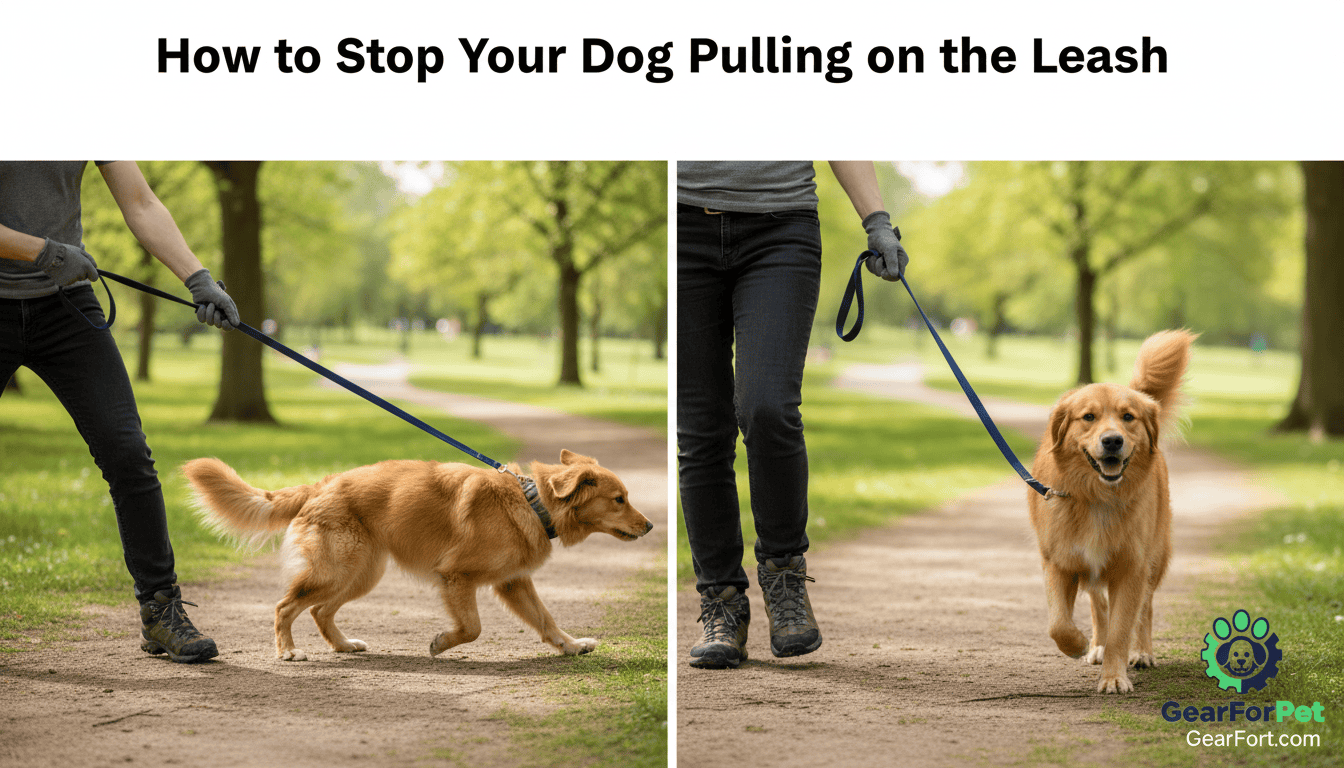
How to Stop Your Dog Pulling on the Leash
Leash pulling is the most common dog walking complaint — and the most commonly misunderstood. Most owners try to out-muscle their dog or jerk the leash to correct it. Neither approach works, and both make the walk miserable for everyone. Pulling is not a defiance problem — it’s a communication gap. Dogs pull because they haven’t been taught that walking calmly is what gets them where they want to go. Teach that clearly and consistently, with the right gear to support it, and virtually every dog improves within 2–3 weeks.
How to Stop Leash Pulling — Quick Answer
The method that works: stop moving the moment the leash goes taut — every single time. The dog learns that pulling produces zero forward progress, while a loose leash produces movement toward where they want to go. Pair this with a front-clip harness that redirects pulling momentum sideways, and most dogs show meaningful improvement within 7–14 days of consistent practice. The key word is consistent — one application out of ten teaches nothing.
Why Dogs Pull — The Root Cause
Understanding why pulling happens is what makes the fix make sense. Dogs pull for one reason: it works. Every time a dog has pulled on a leash and continued moving forward, the pulling behaviour was reinforced. The dog learned — correctly — that pulling is the mechanism that produces forward movement. They’re not being dominant, stubborn, or disobedient. They’re doing exactly what their experience has taught them to do.
This is also why punishment-based corrections (leash jerks, choke chains, prong collars) don’t fix pulling long-term. They add an aversive to the pulling moment, but they don’t teach the dog what to do instead. The dog still doesn’t know that not pulling produces forward movement — they only know that pulling sometimes produces a correction. The behaviour persists because the underlying learning hasn’t changed. The only fix that works permanently is teaching the dog that loose leash = forward movement, taut leash = complete stop.
The Stop-and-Wait Method — Step by Step
This is the foundation technique recommended by professional trainers and certified behaviourists. It requires no equipment beyond your standard leash, no punishment, and no physical strength. It does require patience and absolute consistency.
- Start in a low-distraction environment — your garden, a quiet street, an empty car park. High-distraction environments (busy parks, other dogs nearby) make early training harder. Build the skill where it’s easiest first.
- Begin walking at your normal pace — leash in hand, dog on whatever side you prefer.
- The moment the leash goes taut — stop completely. Not slow down. Not say “no.” Stop. Plant your feet. Say nothing. Do nothing. Wait.
- Wait for the dog to release the tension. They will — eventually. They’ll look back at you, step toward you, or sit. The moment the leash goes slack, mark it with a quiet “yes” and start walking again.
- Repeat every single time the leash tightens. On a first training walk this may happen 30–40 times in 10 minutes. That’s normal. It will reduce dramatically by sessions 3–5.
- Never move forward on a tight leash — not even once, not even when you’re running late, not even when the dog seems close to getting it. One inconsistency teaches the dog that persistence occasionally wins, which is the worst possible lesson.
Typical timeline:
- Sessions 1–3: Frequent stops, dog confused — this is normal
- Sessions 4–7: Dog begins self-correcting before the leash goes fully taut
- Sessions 8–14: Loose leash walking becomes the default in low-distraction environments
- Weeks 3–6: Skill generalises to moderate distraction environments
- Weeks 6–12: Reliable loose-leash walking in most real-world environments
The Direction Change Method — For Dogs That Don’t Respond to Stopping
Some dogs — particularly high-drive breeds, young adolescent dogs, and dogs with a long history of successful pulling — find stopping interesting rather than frustrating. They’ll wait at the end of a taut leash perfectly happily. For these dogs, direction changes are more effective.
- The moment the leash goes taut, calmly turn and walk in the opposite direction — no yanking, no drama, just a smooth 180° turn
- The dog, now behind you, has to catch up and naturally ends up back at your side on a loose leash
- Continue walking in the new direction until the leash tightens again, then turn again
- The dog learns that pulling causes them to go away from where they want to be, not toward it
Most owners combine both methods — stopping first, switching to direction changes if the dog isn’t releasing tension within 15–20 seconds. Both methods communicate the same core message: a taut leash produces no forward progress.
The Gear That Makes Training Faster
Training is the solution. Gear is the accelerant. The right equipment doesn’t replace training — it supports it by making the physical consequences of pulling clearer and less rewarding for the dog.
Front-Clip Harness — The Single Most Effective Tool
A front-clip harness attaches the leash at the dog’s chest rather than between the shoulders. When the dog pulls forward, the front clip redirects their momentum sideways — they end up turning toward you rather than dragging you forward. This redirection doesn’t hurt the dog, but it makes sustained forward pulling mechanically awkward and physically unrewarding. Most dogs show immediate pulling reduction on a front-clip harness even before training takes full effect — and the training works faster because the dog is starting each walk in a less reinforced pulling state.
For the best front-clip harnesses by breed and size, see our no-pull harness guide — it covers the top front-clip designs for dogs of every size.
Standard 5–6 ft Leash — Not a Retractable
During active pulling training, always use a standard fixed-length leash — never a retractable. A retractable maintains constant tension and extends range when the dog pulls forward, which directly rewards the behaviour you’re trying to eliminate. A standard 5–6 ft leash gives consistent feedback and a consistent training signal. Once loose-leash walking is reliably established, a retractable can be introduced for enrichment walks in appropriate environments.
High-Value Treats — Your Most Important Training Tool
Loose-leash training requires reinforcement, not just correction. Every time the dog walks beside you on a slack leash for 3–5 steps, mark it (“yes!”) and deliver a high-value treat. This teaches the dog not just that pulling is unrewarding, but that walking calmly beside you is actively profitable. Use treats your dog genuinely values — small pieces of cooked chicken, cheese, or commercial high-value training treats — not dry kibble, which most dogs find insufficiently motivating to compete with the distraction of the outside world.
The 5 Most Common Pulling Training Mistakes
- Inconsistency — moving forward on a tight leash even once undoes multiple successful training repetitions; the dog learns that persistence sometimes wins
- Training only in familiar environments — loose-leash walking learned in your garden doesn’t automatically transfer to the park; deliberately train across different environments and distraction levels
- Expecting fast results on high-distraction routes — start in low-distraction environments, build the skill, then gradually increase distraction level as the dog demonstrates competence at each stage
- Using a retractable leash during training — this directly reinforces pulling; switch to a standard leash for every training session without exception
- Only correcting, never rewarding — stopping when the leash tightens teaches the dog what not to do; marking and rewarding a loose leash teaches them what to do instead; both are needed
Breed-Specific Notes
| Breed Type | Pulling Tendency | Training Note |
|---|---|---|
| Sled breeds (Husky, Malamute) | Very high — bred to pull | Expect longer training timeline; front-clip harness essential; consider structured loose-leash sessions separate from exercise walks |
| Scent hounds (Beagle, Bloodhound) | High when scenting | Pulling is often scent-triggered, not constant; allow sniff breaks on a loose leash as reward for calm walking |
| Working breeds (Malinois, GSD) | High drive — variable | High motivation makes training fast when applied consistently; these breeds respond well to clear rules |
| Toy breeds | Low to moderate | Usually the easiest to train; physical pulling force is low; treat motivation typically high |
| Adolescent dogs (6–18 months) | Very high regardless of breed | Adolescent brain development reduces impulse control temporarily; be patient, maintain consistency, pulling typically improves significantly by 18–24 months |
When to Get Professional Help
Most pulling is resolved with consistent application of the stop-and-wait method over 4–8 weeks. Seek a professional trainer if:
- The dog is reactive — lunging at other dogs, people, or vehicles requires behaviour modification beyond loose-leash training
- The dog is so strong that walks are physically unsafe — very large breeds with extreme pulling behaviour may need a trainer to establish safe management while training progresses
- There has been no improvement after 6–8 weeks of daily consistent training — a professional trainer can assess whether there’s an underlying anxiety or arousal issue driving the behaviour
Look for trainers certified by the CCPDT (Certified Council of Professional Dog Trainers) or IAABC (International Association of Animal Behaviour Consultants) — both organisations certify trainers in force-free methods with a proven evidence base.
Frequently Asked Questions
How long does it take to train a dog to stop pulling on the leash?
Most dogs show meaningful improvement within 7–14 days of consistent daily training using the stop-and-wait method. Full loose-leash reliability in varied environments typically takes 6–12 weeks. Adolescent dogs, high-drive breeds, and dogs with a long history of successful pulling may take longer — 3–6 months is not unusual for a Husky or young working breed. Consistency matters more than duration — 15 minutes of perfect training daily is more effective than an hour of inconsistent application.
Does a no-pull harness stop dogs from pulling?
A front-clip no-pull harness reduces the physical effectiveness of pulling by redirecting momentum sideways — this makes walking on a taut leash mechanically awkward for the dog and often produces immediate pulling reduction. However, it doesn’t teach the dog not to pull — it manages the behaviour. Combine a front-clip harness with the stop-and-wait training method for the fastest and most permanent results. The harness makes training easier; it doesn’t replace it.
Should I use a choke chain or prong collar to stop pulling?
No — choke chains and prong collars apply aversive pressure to correct pulling but don’t teach the dog the alternative behaviour. They suppress pulling through pain or discomfort, which creates negative associations with walks and other dogs encountered during those walks. Evidence-based training organisations including the CCPDT and APDT strongly advise against their use. The stop-and-wait method combined with a front-clip harness achieves better long-term results without the welfare and relationship costs.
My dog only pulls toward other dogs — is that different?
Pulling toward other dogs is often a reactivity or over-arousal issue rather than a pure leash-manners problem. The stop-and-wait method still applies, but you’ll also need to work on threshold management — keeping the dog far enough from other dogs that they can respond to cues before the arousal level becomes too high to think. For dogs that lunge or bark at other dogs, a professional behaviourist assessment is recommended alongside the leash training work.
What is the best leash for training loose-leash walking?
A standard 5–6 ft flat nylon leash attached to a front-clip harness. Fixed length gives consistent feedback; front-clip redirects pulling momentum. Never use a retractable leash for training — the constant tension and extendable range reward exactly the behaviour you’re trying to eliminate. See our complete dog leash guide for the best standard leash picks and our no-pull harness guide for the best front-clip harnesses.
The Bottom Line
Pulling is a learned behaviour — which means it’s an unlearnable behaviour. Stop every time the leash tightens, without exception, and most dogs transform into loose-leash walkers within weeks. Add a front-clip harness to reduce the physical reward of pulling during the training period, use high-value treats to build the loose-leash habit actively, and be patient with adolescent dogs and working breeds who need more time and repetition than others.
The walk your dog is capable of is far more enjoyable than the one most owners are currently having. The gap between the two is consistency — and a few weeks of it is all that separates them.
Affiliate Disclosure: GearForPet.com participates in affiliate programs. We may earn a small commission if you purchase through our links at no extra cost to you. Read our full disclosure.