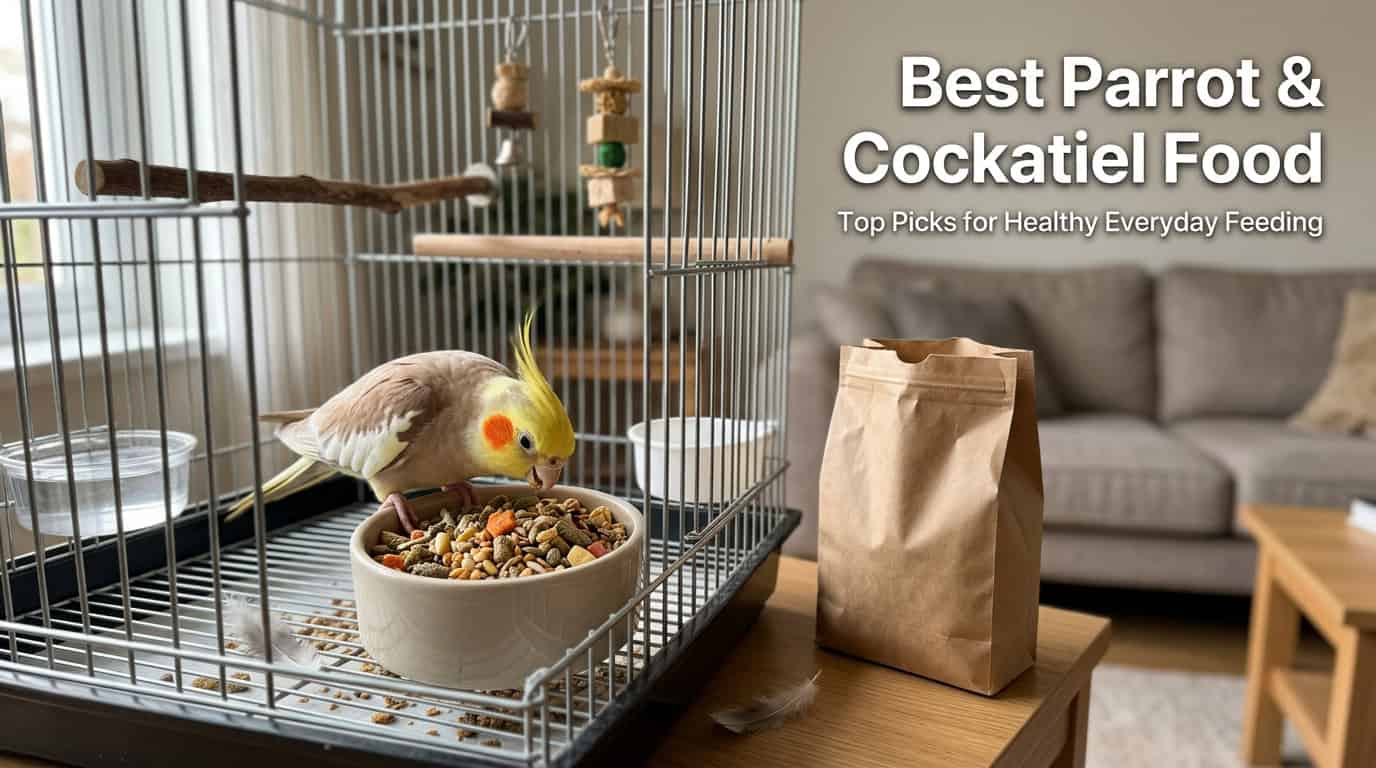
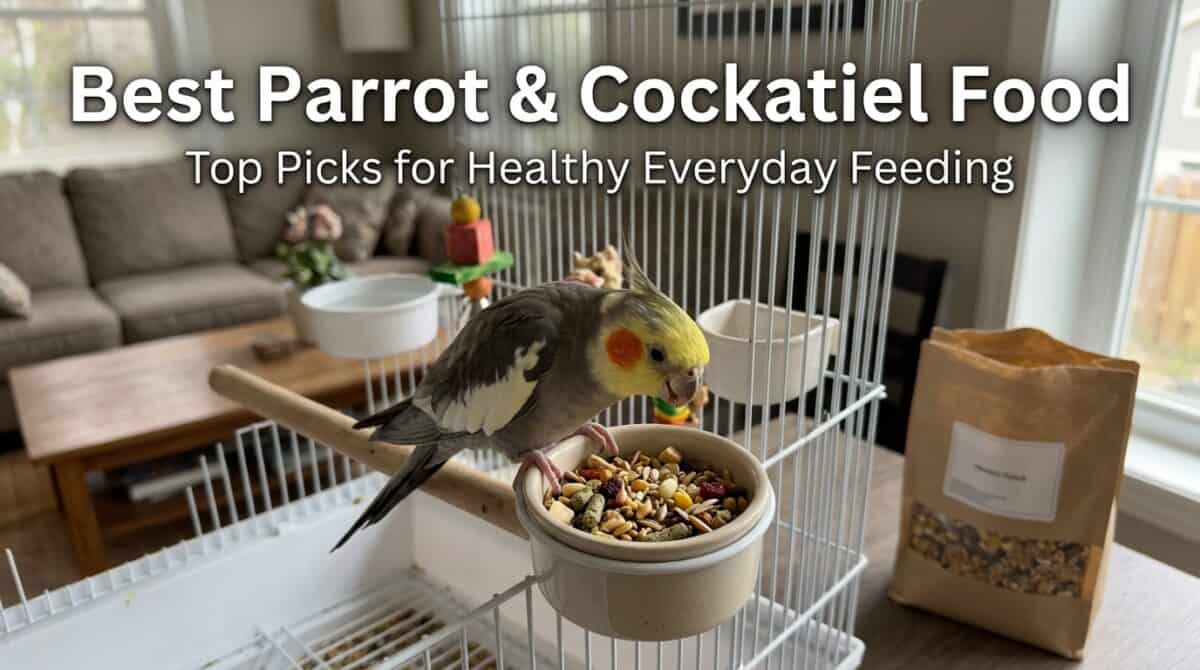
9 Best Parrot & Cockatiel Food 2026: Pellets, Seeds, and Getting the Ratio Right
Most bird food shopping starts and ends with a seed bag, because that’s what’s stacked at the front of the pet store. The problem is that avian vets have been saying the same thing for years: a seed-only diet is one of the most common causes of obesity, fatty liver disease, and a shortened lifespan in pet parrots and cockatiels. The general guidance is 60-80% fortified pellets, 20-30% fresh vegetables, and seeds treated as roughly 10% of the diet, a treat, not the main course.
This guide covers 9 foods across pellets, fortified seed blends, and natural toppers, organized so you can actually build a real diet instead of just grabbing whatever bag looks colorful. Each pick notes what role it should play in the bowl, not just whether your bird will eat it.
Quick Comparison
| Food | Best For | Type | Bird Size |
|---|---|---|---|
| RoudyBush Daily Maintenance, Mini | Best Overall Pellet Diet | Pellet | Small to medium |
| Zupreem FruitBlend, Medium | Best Widely-Trusted Pellet Brand | Pellet | Medium |
| Psittacus Mini 6.6 lb | Best Premium European Pellet | Pellet | Medium |
| LAFEBER’S Nutri-Berries 4-Pack | Best Foraging/Treat Hybrid | Pellet-seed hybrid | All sizes (variety pack) |
| Kaytee Forti-Diet Pro Health Conure & Lovebird | Best Fortified Seed Blend | Fortified seed | Medium |
| Wild Harvest Universal Blend | Best Seed Mix for Medium/Large Birds | Seed | Medium to large |
| Wild Harvest Daily Blend | Best Seed Mix for Small Birds | Seed | Small |
| Cockatiel & Conure Cuisine, 20 lb | Best Bulk-Value Seed Mix | Seed | Medium |
| Dr. Harvey’s Exotic Parrot Blend | Best Natural Whole-Food Topper | Seedless whole food | Large |
1. RoudyBush Daily Maintenance, Mini – Best Overall Pellet Diet
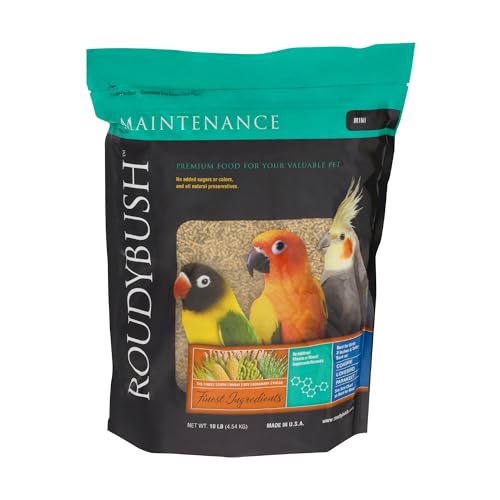
RoudyBush has been formulating pellet diets since 1985, and Daily Maintenance is the food most consistently named alongside Harrison’s and ZuPreem when avian vets get asked what to feed. It’s steam-pelleted to retain nutrients while eliminating harmful bacteria, contains 11% protein and 7% fat, and needs no additional vitamin or mineral supplementation since it’s formulated as a complete diet on its own.

The Mini size is built for birds three inches or taller, which covers conures, lovebirds, and parakeets well. If you’re transitioning a seed-only bird, RoudyBush is also one of the easier pellets to mix into an existing seed bowl since the pellet size doesn’t overwhelm a bird used to picking through loose seed.
Not the right fit if: you have a very small bird like a budgie that needs an even smaller pellet, or a large parrot that needs a bigger kibble size. Check RoudyBush’s other size options (Nibbles, Small, Medium, Large) for those cases.
Pros: Complete nutrition with no supplements needed, no artificial colors or animal by-products, established formulation since 1985, good transition food from seed diets.
Cons: Pellet-only diets need fresh vegetables added separately for full dietary variety. Some seed-committed birds take real patience to transition.
Buy it on Amazon today with FREE returns
2. Zupreem FruitBlend, Medium – Best Widely-Trusted Pellet Brand
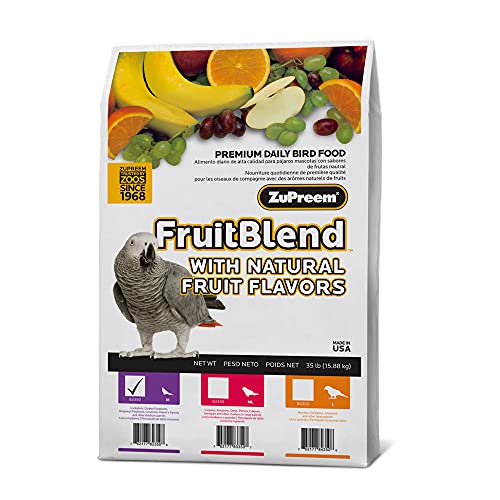
Zupreem is one of the most recognized pellet brands in avian nutrition, and FruitBlend specifically uses natural fruit flavors and shapes to make the switch from seeds easier on picky birds. It’s formulated for cockatiels, quakers, ringneck parakeets, lovebirds, and other medium parrots that do well with this pellet size, and it holds a 4.6-star rating across 360 reviews, a real, established track record rather than a new listing.

The fruit flavoring is specifically there to help win over birds that are resistant to pellets in the first place, which is a common sticking point when converting an older, seed-raised bird.
Not the right fit if: your bird has a known sensitivity to added flavoring or dye, in which case an unflavored pellet like RoudyBush is the safer starting point.
Pros: Strong, established review history, natural fruit flavoring helps with pellet transition, widely stocked and recommended by avian vets.
Cons: Flavored pellets aren’t necessary for every bird and add a small ingredient complexity some owners prefer to avoid. Sized for medium birds only.
Buy it on Amazon today with FREE returns
3. Psittacus Mini 6.6 lb – Best Premium European Pellet

Psittacus is a European-manufactured pellet line built specifically around what different parrot species actually eat in the wild. Mini is formulated for species that naturally consume mostly seeds with low fat content, like cockatiels, sun conures, other conures, and Galah cockatoos. It’s 100% non-GMO, with no artificial coloring or synthetic antioxidants, and is designed to make up 70-80% of the bird’s total diet by weight.

What sets Psittacus apart from a lot of US pellet brands is that the formulation research is built around species-specific wild diets rather than a single general parrot formula, which is worth knowing if you want a pellet chosen with that level of specificity in mind.
Not the right fit if: you want a widely available, big-box pellet brand. Psittacus is a specialist European import, so pricing and availability can run higher than domestic brands.
Pros: Species-specific formulation research, 100% non-GMO with no synthetic antioxidants, suitable for both young and adult birds.
Cons: Premium pricing compared to domestic pellet brands. Less commonly stocked than RoudyBush or Zupreem.
Buy it on Amazon today with FREE returns
4. LAFEBER’S Nutri-Berries 4-Pack – Best Foraging/Treat Hybrid

Lafeber Company was founded by an avian veterinarian, and Nutri-Berries take a genuinely different approach: hulled seeds are coated with stabilized vitamins and chelated minerals, then bound into a round berry shape that gives a bird the same beak and tongue exercise as foraging in the wild, while still delivering pellet-level balanced nutrition. This 4-pack bundle is a variety sampler, so you get several flavors to see what your bird actually prefers.

Because they’re 100% edible with no seed husks to sort through, Nutri-Berries also cut down on the mess and waste that comes with a loose seed mix, while still giving the bird something to physically work at rather than just eating flat pellets from a dish.
Not the right fit if: you’re looking for a primary, everyday sole diet at the lowest cost per pound. Nutri-Berries work best layered in alongside a base pellet diet as a foraging-focused treat, not as the entire food source.
Pros: Vet-founded company with a long-standing reputation, genuine foraging enrichment built into the food itself, non-GMO and human-grade ingredients, variety pack lets you find your bird’s preference.
Cons: Costs more per pound than a standard pellet or seed mix. Best used as a supplement to a base diet rather than the sole food source.
Buy it on Amazon today with FREE returns
5. Kaytee Forti-Diet Pro Health Conure & Lovebird – Best Fortified Seed Blend
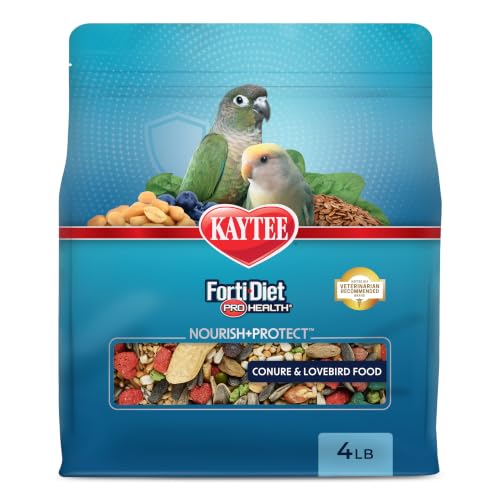
If you’re not ready for a full pellet switch, this is the strongest fortified seed option on this list. It’s a seed and grain base built with superfoods like flaxseed, peanuts, blueberries, and spinach, plus prebiotics and probiotics for gut health and omega-3s for brain and skin support. It holds a 4.6-star rating across 4,468 reviews, a genuinely large, established sample size.
This isn’t a substitute for a pellet-forward diet long-term, but as a fortified seed blend it’s a meaningfully better option than a plain, unfortified seed mix, and a reasonable bridge while you work on a pellet transition.
Not the right fit if: you’re already feeding a full pellet diet and don’t need a seed component at all. In that case, skip straight to a pellet like RoudyBush or Zupreem.
Pros: Large, strong review history, added superfoods and probiotics beyond a standard seed mix, formulated specifically for conure and lovebird nutritional needs.
Cons: Still a seed-based food at its core, so it shouldn’t be the sole diet long-term. Higher fat content than a pellet-only diet.
Buy it on Amazon today with FREE returns
6. Wild Harvest Universal Blend – Best Seed Mix for Medium/Large Birds
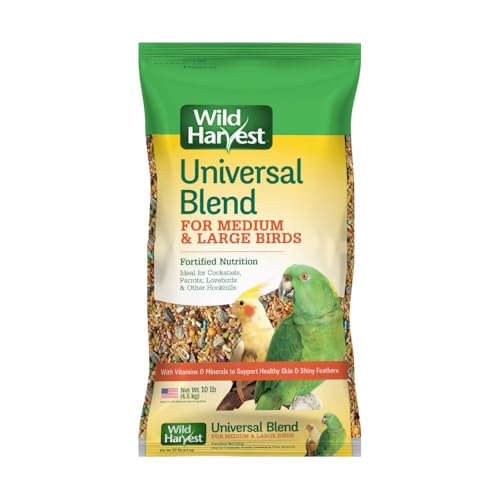
This is a straightforward, fortified seed blend of sunflower seeds, safflower seeds, and dried peas, built for cockatiels, parrots, lovebirds, and other hookbills. It’s enriched with vitamins and minerals to support skin and feather health, and it’s priced as a budget-friendly option compared to the specialty and pellet foods on this list.

The honest framing here matters: this is a treat-portion food, not a primary diet. Used as roughly 10% of a bird’s daily intake alongside a pellet base, it’s a reasonable, affordable seed component. Used as the whole diet, it runs into the same problems every seed-only diet does.
Not the right fit if: you’re looking for a complete, standalone diet. This works best as a supplemental seed portion layered on top of a pellet-based diet, not the entire bowl.
Pros: Budget-friendly, fortified with vitamins and minerals, works across a range of medium to large hookbill species.
Cons: Not nutritionally complete on its own. Higher fat content than pellet diets if overfed.
Buy it on Amazon today with FREE returns
7. Wild Harvest Daily Blend – Best Seed Mix for Small Birds
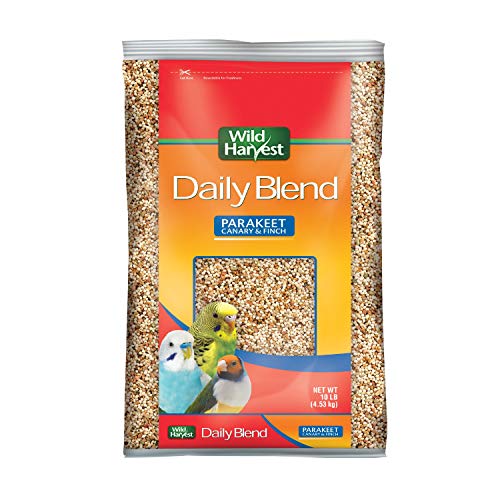
Sized specifically for parakeets, canaries, and finches, this seed blend uses red and white millet, canary grass seed, and select grains, with an added orange essence for flavor. It’s fortified with vitamins and minerals for these smaller species, and comes in a resealable bag to keep the seed fresh.

Small birds like budgies and finches have different nutritional needs and portion sizes than a cockatiel or conure, and a seed mix built specifically for them, rather than a scaled-down version of a bigger bird’s food, tends to fit better.
Not the right fit if: you have a cockatiel, conure, or larger bird. This blend is sized and formulated specifically for small species and won’t provide appropriate portions or seed sizes for anything bigger.
Pros: Correctly sized for small birds specifically, fortified with vitamins and minerals, resealable packaging for freshness.
Cons: Like all seed mixes, best used as a treat portion rather than the sole diet. Not appropriate for medium or large parrot species.
Buy it on Amazon today with FREE returns
8. Cockatiel & Conure Cuisine, 20 lb – Best Bulk-Value Seed Mix
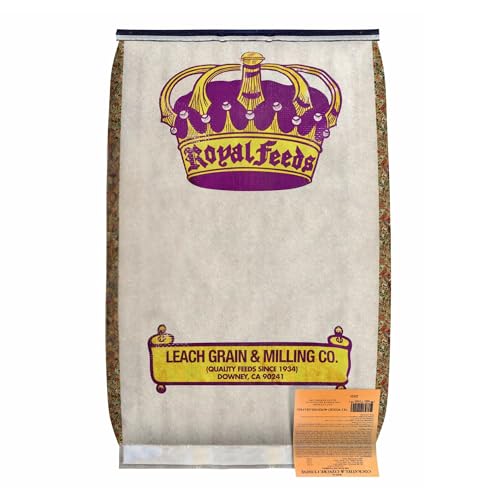
This is a bulk 20-pound bag built specifically for cockatiels and conures, with a genuinely varied ingredient list beyond basic seed: canary seed, millet, oat groats, safflower, sunflower, and add-ins like red bell pepper granules, carrots, hemp, papaya, and orange peel, all vitamin-coated. For households with more than one bird, the bulk size brings the cost per pound down meaningfully compared to smaller bags.

The variety of real fruit and vegetable pieces mixed into the seed base gives it more nutritional range than a plain sunflower-and-millet mix, though it’s still a seed-forward food that works best as part of a pellet-led diet rather than the entire feeding plan.
Not the right fit if: you have a single small bird and don’t need a 20-pound bag, or if you’re specifically looking for a pellet-only diet. This is a bulk seed blend, not a pellet.
Pros: Strong cost-per-pound value for multi-bird households, genuinely varied ingredient list beyond basic seed, vitamin-coated for added nutrition.
Cons: Large bag size isn’t practical for a single small bird or households worried about freshness over time. Still a seed-based food, not a complete standalone diet.
Buy it on Amazon today with FREE returns
9. Dr. Harvey’s Exotic Parrot Blend – Best Natural Whole-Food Topper
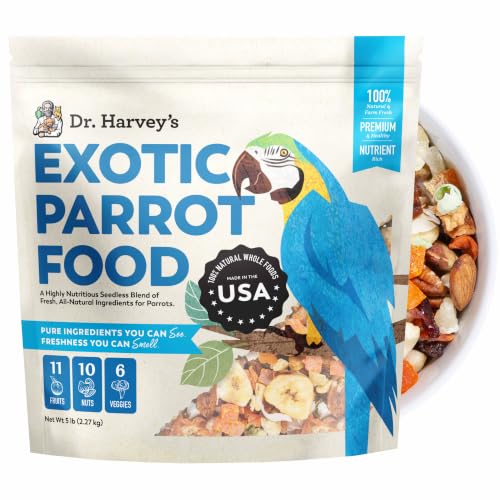
This is the one food on this list that skips seeds entirely. It’s a blend of 11 fruits, 10 nuts, and 6 vegetables, including papaya, mango, cranberries, walnuts, almonds, carrots, and broccoli, with no chemicals, dyes, preservatives, or synthetic ingredients of any kind. It’s built specifically for large parrots and designed to promote natural foraging behavior with the same variety of foods a parrot would encounter in the wild.

This works best as a whole-food topper or supplement to a pellet-based diet rather than a sole food source. It brings real dietary variety and natural foraging value that a uniform pellet or seed mix can’t replicate on its own.
Not the right fit if: you want a single, nutritionally complete standalone diet. This is a variety and enrichment addition, best paired with a pellet base rather than used alone.
Pros: Genuinely seedless and free of any artificial ingredients, wide variety of whole fruits, nuts, and vegetables, promotes natural foraging behavior.
Cons: Not a nutritionally complete standalone diet on its own. Premium pricing for the bag size.
Buy it on Amazon today with FREE returns
Pellets vs. Seeds: What Avian Vets Actually Recommend
The general guidance from avian veterinary sources is consistent: a healthy adult parrot or cockatiel’s diet should be roughly 60-80% fortified pellets, 20-30% fresh vegetables, and no more than about 10% seeds as a treat portion. Seeds are high in fat and low in the full range of vitamins and minerals a bird needs, which is why a seed-only diet is one of the more common, and most preventable, causes of obesity, fatty liver disease, and nutritional deficiency in pet birds.
Pellets solve this by being formulated as a complete, balanced food in every bite, so a bird can’t selectively pick out just the parts it likes and skip the rest, which is exactly what happens with a loose seed mix. That’s not a reason to eliminate seeds entirely. Used in the right proportion, they still offer enrichment value and a food a bird genuinely enjoys working at.
Matching Food to Bird Size
Pellet size matters as much as pellet quality. A pellet built for a macaw is too large for a budgie to manage, and a small pellet meant for a parakeet won’t give a large parrot enough to work with per bite.
Small birds (budgies, canaries, finches): need small seed pieces and fine pellet sizes, like the Wild Harvest Daily Blend on this list.
Medium birds (cockatiels, conures, lovebirds, quakers): do well with a mini or medium pellet size, which is where RoudyBush Mini, Zupreem Medium, and Psittacus Mini all fit.
Large parrots (African greys, Amazons, macaws, cockatoos): need a larger pellet size and more calorie-dense nutrition per bite, and typically benefit from whole-food variety like Dr. Harvey’s Exotic Parrot Blend layered in alongside a large-format pellet.
How to Transition a Seed-Only Bird to Pellets
Switching a seed-committed bird to pellets takes patience, and doing it too abruptly risks a bird refusing to eat at all. A gradual approach works better: mix a small amount of pellets into the existing seed bowl, slowly increasing the pellet ratio over 1 to 2 weeks. Offering pellets first thing in the morning, when a bird is hungriest, and seeds later in the day as more of a treat, also helps build the association. Flavored pellets, like Zupreem FruitBlend, or foraging-shaped hybrids, like Lafeber Nutri-Berries, tend to have an easier time winning over a resistant bird than a plain, unflavored pellet. If a bird refuses to eat for more than 24 hours during a transition, that’s a reason to slow the process down and talk to an avian vet rather than push through.
Foods to Never Feed
Regardless of which base diet you choose, some foods are unsafe for parrots and cockatiels at any amount: avocado, chocolate, caffeine, alcohol, and xylitol are all toxic. Onion and garlic can cause anemia in birds over time. Salty or heavily processed human food should also stay off the menu, even in small amounts.
Frequently Asked Questions
How much should I feed my parrot daily?
Portion size depends heavily on species and body size, but a rough starting point is 1 to 2 tablespoons of pellets daily for a small to medium bird, adjusted based on body condition and any guidance from an avian vet.
Can cockatiels eat only seeds?
They can survive on a seed-only diet, but it’s not a healthy long-term choice. Seed-only diets are linked to obesity, fatty liver disease, and nutritional deficiencies, which is why avian vets recommend a pellet-forward diet instead.
How do I switch my bird from seeds to pellets?
Gradually mix pellets into the existing seed bowl over 1 to 2 weeks, offering pellets first in the morning when your bird is hungriest. Flavored or foraging-shaped pellets tend to make the switch easier for a resistant bird.
What’s the difference between Nutri-Berries and pellets?
Nutri-Berries bind hulled, vitamin-coated seeds into a round shape that gives a bird the same balanced nutrition as a pellet diet, while still offering the physical foraging and shredding experience of whole seeds. Straight pellets are uniform and don’t offer that same foraging texture.
Bottom Line
If you’re building a diet from scratch, start with a pellet base. The RoudyBush Daily Maintenance Mini is the most consistently vet-recommended choice, and Zupreem FruitBlend is the easier sell if your bird is resistant to plain pellets. Layer in a foraging-focused food like Lafeber Nutri-Berries for enrichment, and use a seed blend like Kaytee Forti-Diet Pro Health or Wild Harvest Universal Blend as the smaller treat portion, not the main course. For large parrots specifically, Dr. Harvey’s Exotic Parrot Blend is worth adding for real dietary variety alongside a pellet base.
Affiliate Disclosure: GearForPet.com participates in affiliate programs. We may earn a small commission if you purchase through our links at no extra cost to you. Read our full disclosure.