10 Best Aquarium Filters 2026: Hang-On-Back, Canister, Internal and Sponge Picks Matched to Your Tank
Most people think an aquarium filter is there to keep the water clear. That’s only part of the job. The bigger job is giving good bacteria a place to live. Those bacteria turn fish waste into less harmful compounds, and they keep your fish alive between water changes. The best aquarium filter for your tank is the one that fits your tank size, your fish and how much upkeep you want to do. Pick the filter type first, then the product. A great canister on a 5-gallon betta tank is still the wrong filter. This guide compares 10 filters across all four main types: hang-on-back, canister, internal and sponge.
Quick Picks: Best Aquarium Filters
- Best overall: AquaClear 50 Power Filter, with the most media room of any hang-on-back here.
- Best premium hang-on-back: Seachem Tidal 55, self-priming with a surface skimmer.
- Easiest for beginners: Aqueon QuietFlow 30 LED Pro, with drop-in cartridges.
- Best for small and desktop tanks: FZONE HOB 106 GPH, for 5-24 gallon tanks.
- Best canister: Fluval 307, for 40-70 gallon tanks.
- Best value for big tanks: Penn-Plax Cascade 1000, for tanks up to 100 gallons.
- Best small canister: FZONE 48 GPH Canister Kit, for planted nano tanks.
- Best internal filter: Fluval U2, for tanks up to 30 gallons.
- Best budget internal: Atlantis Aqua Submersible Filter, for 20-55 gallon tanks.
- Best for bettas, shrimp and fry: AQUANEAT Bio Sponge Filter.
Comparison Table
Ratings and review counts were taken from the Amazon.com listings on October 26, 2026. Prices change often, so check the current price before you buy. Flow rates are the maker’s figures.
| Filter | Type | Tank Size | Flow | Best For | Amazon Rating |
|---|---|---|---|---|---|
| AquaClear 50 | Hang-on-back | 20-50 gal | 200 GPH | Most community tanks | 4.2 (7,700+) |
| Seachem Tidal 55 | Hang-on-back | Up to 55 gal | 250 GPH | Low-fuss upkeep | 4.5 (2,400+) |
| Aqueon QuietFlow 30 | Hang-on-back | 20-30 gal (see note) | 200 GPH | Beginners | 4.2 (6,400+) |
| FZONE HOB (S) | Hang-on-back | 5-24 gal | 106 GPH | Small and rimless tanks | 4.3 (90+) |
| Fluval 307 | Canister | 40-70 gal | 303 GPH pump | Planted and larger tanks | 4.4 (10,000+) |
| Penn-Plax Cascade 1000 | Canister | Up to 100 gal | 265 GPH | 75-100 gallon tanks | 4.3 (10,300+) |
| FZONE Canister Kit | Canister | Small tanks | 48 GPH | Planted nano tanks | 4.2 (10 reviews) |
| Fluval U2 | Internal | Up to 30 gal | 106 GPH | Turtle and low-water tanks | 3.9 (4,700+) |
| Atlantis Aqua | Internal | 20-55 gal | Not clearly listed | Budget internal | 4.3 (990+) |
| AQUANEAT Sponge | Sponge | Up to 10 gal | Air-driven | Bettas, shrimp, fry | 4.7 (3,700+) |
Which Filter Type Do You Need?
There are four main filter types. Each one suits a different kind of tank. Start here before you look at products.
| Type | Best Tank Size | Good For | Upkeep | Noise | Cost |
|---|---|---|---|---|---|
| Hang-on-back | 5-75 gal | Most community tanks | Easy, every 2-4 weeks | Low, can trickle | $-$$ |
| Canister | 40 gal and up | Planted tanks, big or messy fish | Harder, every 1-3 months | Very low | $$-$$$ |
| Internal | Up to 55 gal | Turtle tanks, low water, no room behind the tank | Easy, but hands in the tank | Low | $ |
| Sponge | Up to 60 gal | Bettas, shrimp, fry, quarantine tanks | Very easy | Air pump hum, bubbles | $ |
- Hang-on-back: the safe default for most tanks under 55 gallons.
- Canister: worth it for planted tanks and tanks over 40 gallons, if you don’t mind a bigger cleaning job.
- Internal: pick one when there’s no room behind the tank or the water level is low.
- Sponge: the gentlest choice for small, slow or tiny animals.
Best Hang-On-Back Filters
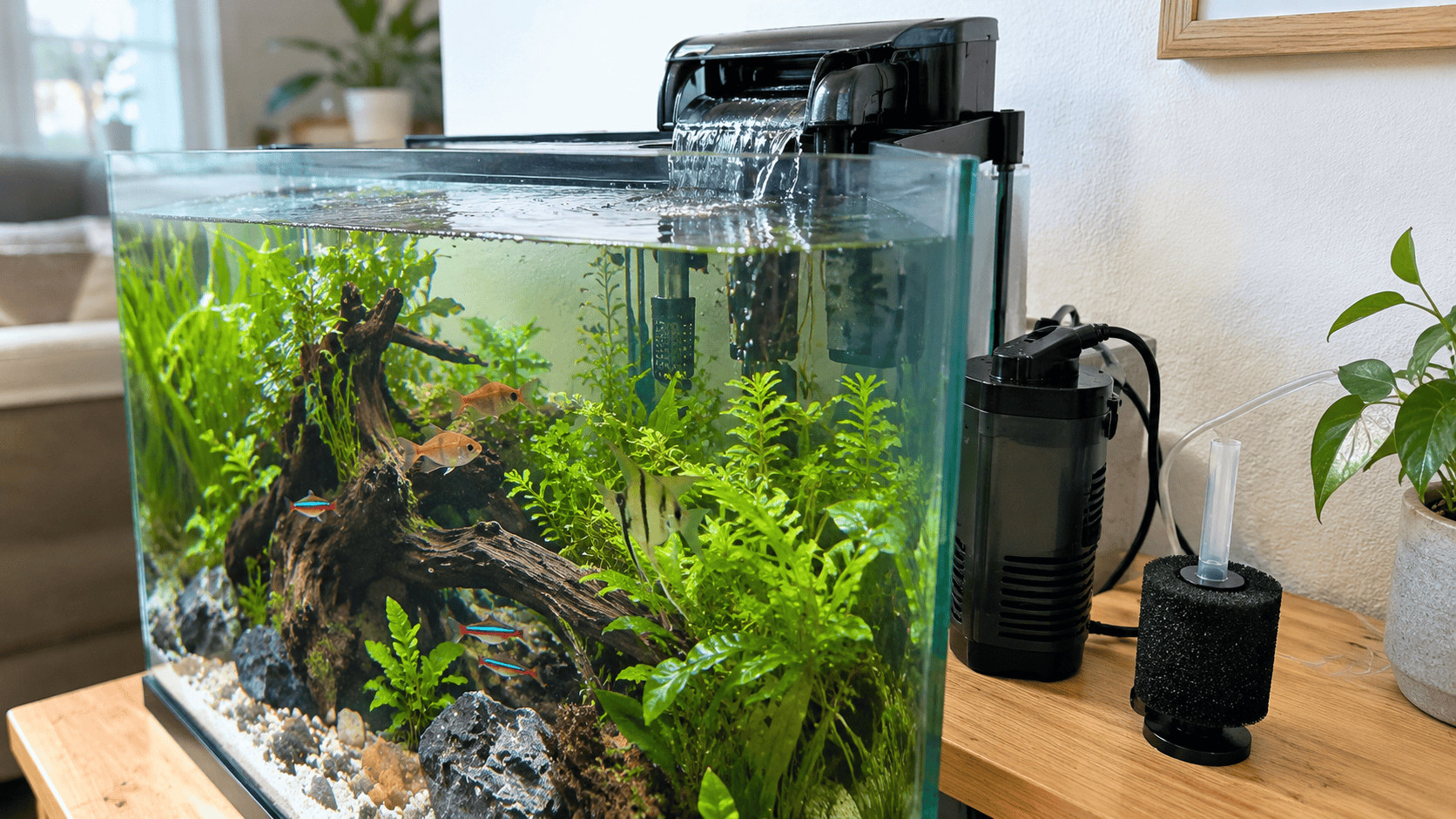
A hang-on-back filter hooks over the back rim of the tank. A tube pulls water up into a box, through the media, and back over a lip like a small waterfall. It’s the easiest type to set up and clean.
1. AquaClear 50 Power Filter – Best Overall

The AquaClear has been a go-to hang-on-back filter for years, and it has more than 7,700 ratings on Amazon. The reason is the box. It’s deep, and water flows up through stacked media instead of across a thin cartridge. That gives the bacteria far more room to live.

It comes with a foam block, activated carbon and BioMax ceramic rings. You can swap any of these for your own media, which you can’t do with most cartridge filters. The flow is adjustable, so you can turn it down for slower fish. Fluval rates it for 20 to 50 gallons, at 200 gallons per hour (GPH).
Key specs: 20-50 gallons. 200 GPH. Foam, carbon and BioMax included. Adjustable flow. Refillable media basket.
Not the right fit if: you want something silent in a bedroom. Some owners report a hum or rattle from the impeller as it ages.
Pros: Huge media space. Cheap, generic refills. Easy to customize. Long track record.
Cons: 4.2 stars, with some noise complaints. Turning the flow down also cuts how much water goes through the media. The intake can pull in shrimp and fry without a sponge guard.
Check current price on Amazon →
2. Seachem Tidal 55 – Best Premium Hang-On-Back

The Seachem Tidal, made by Sicce, fixes two common hang-on-back problems. First, it’s self-priming. If the power goes out or the water level drops, it restarts by itself. Most hang-on-back filters need you to refill them by hand first, or the motor runs dry.

Second, it has a built-in surface skimmer. That pulls off the oily film that can form on top of the water. The Tidal 55 also has a self-cleaning impeller, a leveling dial, a heater holder and an alert that shows when the media needs cleaning. Seachem rates it at 250 GPH for tanks up to 55 gallons. It works in freshwater and saltwater.
Key specs: Up to 55 gallons. 250 GPH. Self-priming. Surface skimmer. Adjustable intake. Heater holder. Freshwater or saltwater.
Not the right fit if: you keep bettas or shrimp in a small tank. It’s too strong without a sponge on the intake.
Pros: 4.5 stars, the highest-rated hang-on-back here. Restarts by itself. Skimmer included. Large media basket.
Cons: It sticks out further from the tank than slimmer filters. Water can be loud as it falls if the tank isn’t full.
Check current price on Amazon →
3. Aqueon QuietFlow 30 LED Pro – Easiest for Beginners

If you want a filter you don’t have to think about, the Aqueon QuietFlow is the simple choice. It uses drop-in cartridges. When the LED light flashes, it’s time to change or rinse the cartridge. The pump sits inside the tank, which helps keep noise down and stops leaks.

It’s also self-priming, so it restarts after cleaning or a power cut. Aqueon lists 200 GPH. The Amazon listing says up to 45 gallons, but some retailers rate it for up to 30 gallons. We’d use it on a 20 to 30 gallon tank to be safe.
Key specs: 200 GPH. Self-priming. LED change alert. Internal pump. Drop-in cartridges.
Not the right fit if: you want low running costs. Branded cartridges add up over a year.
Pros: Very easy. Quiet. Restarts by itself. 6,400+ ratings.
Cons: Cartridges hold less bacteria than a media basket. Throwing out the whole cartridge also throws out good bacteria (see the cleaning section below).
Check current price on Amazon →
4. FZONE HOB Filter 106 GPH (S) – Best for Small and Desktop Tanks

Most hang-on-back filters are too bulky or too strong for a small tank. The FZONE is built for 5 to 24 gallon tanks. It fits rimless glass up to 20 mm thick, which suits the modern nano and planted tanks a lot of people buy now.

Inside are four layers: three sponge densities and ceramic balls. You get three outlets to choose from: rainfall, duckbill and direct flow. The flow is adjustable up to 106 GPH, and FZONE says the brushless motor runs under 30 dB. That’s very quiet, but it’s the maker’s figure, not ours.
Key specs: 5-24 gallons. Up to 106 GPH. 4-stage media. 3 outlet styles. Fits rimless glass up to 20 mm.
Not the right fit if: you want a filter with a long track record. It’s newer, with fewer than 100 ratings.
Pros: Sized for small tanks. Adjustable flow. Choice of outlets. Rated quiet.
Cons: Small review base. Pricier than basic nano filters.
Check current price on Amazon →
Best Canister Filters
A canister filter sits in the cabinet under the tank. Hoses carry water down to it and back up. Because the canister is big, it holds far more media than a hang-on-back. It’s also nearly silent and hides out of sight.
The trade-offs: you have to prime it when you set it up, cleaning takes longer, and every hose joint is a possible leak. Check the fittings after every clean.
5. Fluval 307 Performance Canister – Best Canister Overall
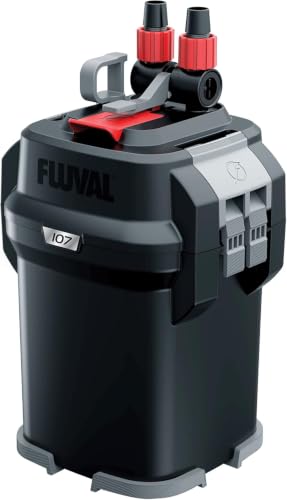
The Fluval 307 is one of the most popular canisters on Amazon, with more than 10,000 ratings. It’s rated for 40 to 70 gallon tanks, which covers the classic 55-gallon tank well. The Amazon listing covers the whole 07 series, so pick the 307 (70 gallon) size when you order.

Fluval made this version about 25% quieter than the one before it, and rubber feet help stop vibration. The AquaStop valves let you shut off the water and unhook the hoses without a flood. A large primer handle makes starting it easier. The media baskets lift out with one handle, and a separate pre-filter catches dirt before it reaches the main media. Fluval lists a pump output of 303 GPH, with 206 GPH of real flow through the media.
Key specs: 40-70 gallons. 303 GPH pump, 206 GPH through the media. 16 W. AquaStop valves. Pre-filter. Fluval media included.
Not the right fit if: your tank is under 30 gallons. It’s oversized and costly for small tanks.
Pros: Quiet. Lots of media. Easy-lift baskets. Huge review base.
Cons: Around $218. Priming can take a few tries at first. Like any canister, the seals need checking over time.
Check current price on Amazon →
6. Penn-Plax Cascade 1000 – Best Value for Big Tanks
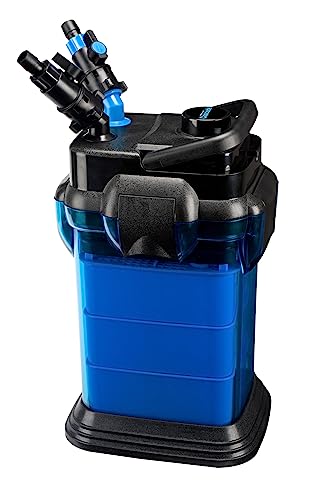
The Cascade 1000 isn’t a cheap filter, at around $175. But it’s rated for tanks up to 100 gallons. Per gallon, that’s less than most big canisters cost. It has more than 10,300 ratings.

It pushes 265 GPH and has three big stackable media baskets with handles. In the box you get three poly fiber floss pads, a coarse bio-sponge, a bag of activated carbon and a spray bar. The valves turn 360 degrees, so you can point the hoses where they fit your cabinet.
Key specs: Up to 100 gallons. 265 GPH. 3 stackable baskets. Floss, bio-sponge and carbon included. Spray bar.
Not the right fit if: you want the quietest canister. Some owners report more noise than with Fluval or Eheim models.
Pros: Covers big tanks. Lots of media in the box. Flexible valves. Big review base.
Cons: Still a big spend. The push-button primer can be fussy.
Check current price on Amazon →
7. FZONE 48 GPH External Canister Kit – Best Small Canister

Canisters are usually made for big tanks. This FZONE kit is a mini canister for small, planted tanks, where you want no equipment showing inside the glass.

It comes as a full kit, with 8 mm stainless steel lily pipes for a clean look. The pump runs on USB power (5 V), and there’s a 1-year warranty. The listing title says 48 GPH. One of its bullet points mentions up to 79 GPH, which matches the larger FZONE size, so check which one you’re buying.
Key specs: 48 GPH (larger 79 GPH size also sold). USB powered. Stainless steel lily pipes. 1-year warranty.
Not the right fit if: you want a proven product. It only had about 10 ratings when we checked.
Pros: Hides the filter under the tank. Clean lily pipe look. Low power.
Cons: Very few reviews. Around $110, which is a lot for a small tank. A nano hang-on-back does a similar job for less.
Check current price on Amazon →
Best Internal Filters
An internal filter sits fully underwater, stuck to the glass with suction cups. It’s a good choice for turtle tanks, low-water tanks, and tanks with no room behind them.
8. Fluval U2 Underwater Filter – Best Internal Filter

The Fluval U2 works in freshwater, saltwater and reptile setups up to 30 gallons. Fluval lists a 400 L per hour output (about 106 GPH) from a 5 W motor. It’s a common pick for turtle tanks, where the water level is often too low for a hang-on-back.

The flow can be pointed in different directions. It can also mix air into the outflow, which helps in tanks with low surface movement. The media sits in cartridges that slide out of the body.
Key specs: Up to 30 gallons. About 106 GPH (400 L/h). 5 W. Fully underwater. Freshwater, saltwater and reptile tanks.
Not the right fit if: you want something you can’t see. It takes up space inside the tank.
Pros: Works at low water levels. Adjustable flow direction. Optional aeration.
Cons: 3.9 stars, the lowest here. Common complaints are suction cups letting go and flow dropping as the media clogs. Cleaning means taking it out of the water.
Check current price on Amazon →
9. Atlantis Aqua Submersible Filter (20-55 Gallon) – Best Budget Internal

The Atlantis Aqua is a cheap internal filter, often around $32. It’s made of sections that come apart, so you can use it from 20 up to 55 gallons. It works in tropical, goldfish and saltwater tanks, and in turtle tanks too.

Each section holds sponge and biological media. You get a 1-year warranty. The listing comes in two sizes: pick the 20-55 gallon option for most tanks, or the 55-100 gallon option for bigger setups. It holds 4.3 stars across about 990 ratings.
Key specs: 20-55 gallons. Detachable sections. Sponge and bio media. 1-year warranty.
Not the right fit if: you want a clear flow rate before you buy. The listing doesn’t make the GPH obvious.
Pros: Low price. Grows with your tank. Works in many tank types.
Cons: Bulky inside the tank. Smaller review base than big-name brands.
Check current price on Amazon →
Best Sponge Filter
A sponge filter is the simplest filter there is. An air pump pushes bubbles up a tube, and that pulls water through a sponge. Bacteria grow all over the sponge. The flow is gentle, and nothing can get sucked in.
10. AQUANEAT Bio Sponge Filter – Best for Bettas, Shrimp and Fry

The AQUANEAT 3-pack is rated for tanks up to 10 gallons, and it costs about the same as one fancy filter cartridge. It holds 4.7 stars across more than 3,700 ratings, the highest on this list.

It’s ideal for bettas, guppies, dwarf cichlids, shrimp and baby fish. These are all animals that struggle in strong flow or could get pulled into an intake. Having three in a pack is handy too. Keep a spare sponge in your main tank’s filter, and you’ll always have a ready-made filter for a quarantine or hospital tank. For bigger tanks, AQUANEAT also sells a large version for tanks up to 60 gallons (B07234RMMT).
You’ll need an air pump. Sponge filters don’t come with one. For a single tank up to 10 gallons, a small, quiet pump like the Tetra Whisper 10 is plenty. If you run several tanks or a fish room, a bigger pump like the VIVOSUN 634 GPH commercial air pump can run many sponge filters at once. Add a check valve so water can’t siphon back into the pump.
Key specs: Up to 10 gallons. 3 filters per pack. Air-driven. Air pump and tubing sold separately.
Not the right fit if: you want a hidden filter. The sponge sits in plain view, and the bubbles make a gentle sound.
Pros: Very cheap. Gentle flow. Safe for shrimp and fry. Easy to clean. Highest rating here.
Cons: Needs an air pump. No room for carbon. It looks plain.
Check current price on Amazon →
How to Choose an Aquarium Filter
Flow Rate: The 4x to 6x Rule
Flow rate is measured in gallons per hour (GPH). A common guideline is that your filter should move four to six times your tank’s volume every hour. So a 20-gallon tank needs a filter rated for roughly 80 to 120 GPH.
| Tank Size | Minimum Flow (4x) | Comfortable Flow (6x) | Good Picks |
|---|---|---|---|
| 5-10 gal | 20-40 GPH | 30-60 GPH | AQUANEAT sponge, FZONE HOB (turned down) |
| 20 gal | 80 GPH | 120 GPH | FZONE HOB, Aqueon QuietFlow 30 |
| 29-30 gal | 120 GPH | 180 GPH | AquaClear 50, Aqueon QuietFlow 30, Fluval U2 |
| 40 gal | 160 GPH | 240 GPH | AquaClear 50, Seachem Tidal 55 |
| 55 gal | 220 GPH | 330 GPH | Seachem Tidal 55, Fluval 307 |
| 75-100 gal | 300-400 GPH | 450-600 GPH | Penn-Plax Cascade 1000, or two filters |
This is a guide, not a law. Goldfish, cichlids and other messy fish need more. Bettas and shrimp need less flow, but still need filtering.
Why the Box Rating Isn’t the Whole Story
Flow numbers on the box are usually measured with an empty filter and no height to pump against. Once media is in and starts to clog, real flow drops. The Fluval 307 shows this well: 303 GPH from the pump, but 206 GPH through the media. A simple rule: if your tank sits at the top of a filter’s range, choose the next size up.
Mechanical, Biological and Chemical Filtration
- Mechanical: sponges and floss that trap dirt and bits of food. This is the part that keeps water clear.
- Biological: ceramic rings, bio balls and the sponges themselves. This is where bacteria live and break down waste. It’s the most important part.
- Chemical: activated carbon that removes smells, color and some medicines. It’s optional, and it stops working after a few weeks.
A good filter has lots of room for biological media. That’s why the AquaClear and the canisters on this list are worth their price.
Gentle Flow for Bettas, Shrimp and Fry
Bettas have long fins and are weak swimmers. Shrimp and baby fish can get sucked into an intake. For these tanks:
- Use a sponge filter, or turn a hang-on-back down to its lowest setting.
- Slip a pre-filter sponge over the intake tube. It protects shrimp and adds extra space for bacteria.
- Aim the outflow at the glass, or add a plant near it, to break up the current.
If you keep a betta, also check our tropical fish temperature guide. Bettas need warm, steady water as well as gentle flow.
Noise: Why Filters Rattle and Trickle
Most filter noise has a simple cause:
- Trickling: the water level is too low under a hang-on-back’s lip. Top up the tank so the water falls a shorter distance.
- Rattling or grinding: the impeller is dirty or worn. Take it out and rinse it, or replace it.
- Humming or buzzing: vibration against the glass or cabinet. A rubber pad or a slight nudge usually fixes it.
- Gurgling in a canister: trapped air. Tilt the canister gently or run the primer again.
How to Clean an Aquarium Filter Without Crashing the Cycle
The bacteria in your filter took weeks to grow. If you clean it the wrong way, you can wipe them out in a minute. Ammonia then rises, and fish get sick. Here’s how to avoid that.
- Rinse media in old tank water, not tap water. Tap water has chlorine or chloramine, which kills bacteria. Take a bucket of water out during your water change and swish the sponges in that.
- Don’t scrub it clean. You only want the dirt gone. A slightly brown sponge is fine.
- Never replace all the media at once. Replace one part at a time, a few weeks apart.
- Don’t clean the filter and deep-clean the gravel on the same day. Both hold bacteria. Space them out by a week.
- Keep the filter running. Don’t switch it off at night. Bacteria need a steady flow of oxygen-rich water.
Rough cleaning schedule:
- Hang-on-back: rinse every 2 to 4 weeks.
- Canister: every 1 to 3 months, or when the flow drops.
- Internal: every 2 to 4 weeks.
- Sponge: every 2 to 4 weeks, or when the bubbles slow down.
New to the nitrogen cycle? Our guide on how to set up a fish tank walks through how it works and how to cycle a new tank safely.
Common Aquarium Filter Mistakes
- Throwing out the cartridge every month. Packaging often says to, but that throws away your bacteria. Rinse it and only replace it when it falls apart.
- Buying a filter that’s rated for exactly your tank size. Ratings assume light stocking. Size up one step.
- No intake guard with shrimp or fry. A pre-filter sponge costs a few dollars.
- Turning the filter off at night. The bacteria start dying within hours without flow.
- Putting the heater far from the filter. Place the heater near the filter outflow so warm water spreads evenly. See our best aquarium heater guide for more on placement.
Frequently Asked Questions
What type of aquarium filter is best for beginners?
A hang-on-back filter. It’s easy to set up, easy to clean and works for most community tanks. The Aqueon QuietFlow is the simplest, and the AquaClear 50 gives you more room to grow.
Is a canister filter better than a hang-on-back filter?
For big or planted tanks, usually yes. A canister holds more media and runs quieter. For tanks under 40 gallons, a good hang-on-back does the job for less money and less work.
Can an aquarium filter be too strong for fish?
Yes. If fish are pushed around, hide all the time, or can’t swim to the front of the tank, the flow is too strong. Turn it down, aim the outflow at the glass, or add plants to break it up.
How many GPH do I need for a 20, 29 or 55 gallon tank?
Using the 4x to 6x guideline: about 80-120 GPH for 20 gallons, 120-180 GPH for 29 gallons, and 220-330 GPH for 55 gallons. Messy fish need the higher end.
Should I turn my aquarium filter off at night?
No. Keep it on all the time. The bacteria in the filter need constant water flow to survive. A quiet filter is a better fix than turning it off.
How often should I clean or replace filter media?
Rinse it every 2 to 4 weeks for most filters, or every 1 to 3 months for a canister. Replace sponges and ceramic media only when they’re falling apart. Change carbon every 3 to 4 weeks if you use it.
Why is my new filter making noise?
Most new filters are loud because of trapped air or a low water level. Let it run for a day, top up the tank, and gently tilt it to let air bubbles out. If it still rattles, check that the impeller is seated properly.
Can I use two filters on one tank?
Yes, and it’s a smart move on big tanks. If one filter fails, the other keeps the bacteria alive. Many fishkeepers run a hang-on-back or canister plus a sponge filter.
Do bettas need a filter?
Yes. Bettas need clean, stable water like any other fish. Use a gentle filter, like a sponge filter, or a small hang-on-back turned down low.
Bottom Line: Which Aquarium Filter Should You Buy?
- Most community tanks, 20-50 gallons: AquaClear 50.
- Want it to restart by itself and skim the surface: Seachem Tidal 55.
- First tank, want it simple: Aqueon QuietFlow 30.
- Small or rimless tank, 5-24 gallons: FZONE HOB (S).
- Planted or 55-gallon tank: Fluval 307.
- 75-100 gallon tank: Penn-Plax Cascade 1000.
- Planted nano, want nothing in the tank: FZONE Canister Kit.
- Turtle tank or low water: Fluval U2.
- Cheapest internal filter: Atlantis Aqua.
- Betta, shrimp, fry or quarantine tank: AQUANEAT Sponge Filter.
Still building your first setup? Our guide to the best aquarium starter kits covers tanks that come with a filter included, and when it’s worth upgrading it.
Affiliate Disclosure: GearForPet.com participates in affiliate programs. We may earn a small commission if you purchase through our links at no extra cost to you. Read our full disclosure.