
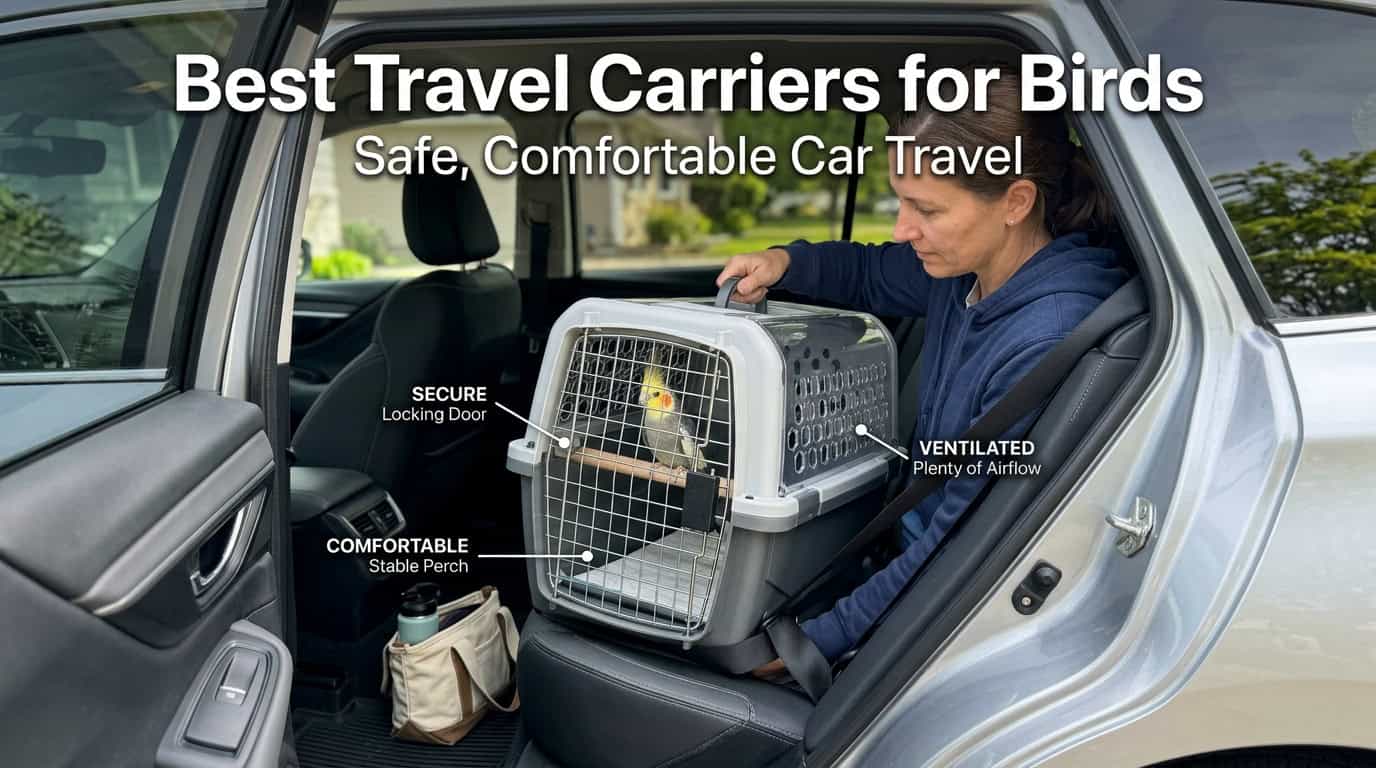
Best Travel Carriers for Birds 2026: Most Aren’t Actually Airline-Approved
Search “airline approved bird carrier” on Amazon and you’ll get dozens of listings using that phrase. Almost none of them are approved by any specific airline. There’s no such thing as a universal “airline-approved” bird carrier certification. Every airline sets its own size limits, material rules, and live-animal policies, and most only accept birds in cargo or through a pet relocation service, not in the cabin. If a listing doesn’t name the airline it supposedly clears, treat the claim as marketing, not a guarantee, and call your airline directly before you book anything.
That distinction matters more than most buying guides admit. What actually separates a good bird carrier from a bad one is ventilation that doesn’t put your bird in a direct draft, a size that matches your bird’s wingspan and tail length (not just its body), and a door or latch your bird can’t work open with its beak. We looked at seven carriers that cover the realistic range of what people actually need: a quick trip to the vet, a car ride, a hike, or day-to-day portability for a bird that travels often.
Quick Comparison
| Carrier | Best For | Bird Size | Style |
|---|---|---|---|
| Perch & Go Large | Vet visits, short trips | Conures to large macaws | Hard-shell polycarbonate |
| Colorday Lightweight (Large) | Budget hard-sided option | African Grey, Amazon, small Cockatoo down to Cockatiel | Mesh-panel hard case |
| VIVOHOME 19″ Wrought Iron | Home base + travel dual use | Conures, cockatiels, small-medium parrots | Metal cage with handle |
| Birds Day Backpack | Hands-free carrying, walks | Small to medium (not cockatoos) | Soft backpack |
| Seat Belt Car Carrier | Regular car travel | Small to medium | Soft carrier with seat belt strap |
| Suertree Stainless Mesh Bag | Birds that chew at mesh | Small to medium | Soft bag, steel mesh panels |
| Compact Standing Perch Carrier | Budgies, small parakeets | Small birds only | Lightweight soft carrier |
1. Perch & Go Bird Carrier – Large

This is the carrier most avian vets already have sitting in their waiting rooms, and there’s a reason for that. It’s built from high-impact polycarbonate, the same category of plastic used in safety glasses, so it holds its shape when a parrot slams into the side of it, which happens more often than owners expect on the first few trips. The door is stainless steel with 5/8″ bar spacing, and the whole thing gives your bird a 360-degree view instead of the tunnel vision you get with a soft-sided bag.
The perch situation is the standout feature: it adjusts to five different positions, so the same carrier works whether you’re moving a conure or something closer to a small macaw. Caitec (the manufacturer) also includes a locking food cup and an adjustable shoulder strap.
Skip this if you want something you can unbox and use in five minutes. Petco’s review data flags recurring assembly complaints: misaligned panels and a latch mechanism that a few owners had to modify to get it to close cleanly. The included plastic perch also gets criticized often enough that a lot of buyers swap it for a natural wood one immediately. And despite carrying “travel” branding, this is not airline-approved for cabin travel, per Chewy’s own product listing. Budget 15 to 20 minutes for first assembly and expect to test the latch a few times before your first real trip.
2. Colorday Lightweight Bird Carrier Travel Cage – Large (19x12x13″)

Colorday’s large size is built for the bigger end of the parrot world: African Greys, Amazons, small Cockatoos, and Eclectus, though the same case also covers smaller birds like conures, cockatiels, and budgies if you don’t need the extra room. The shell is thick-gauge polyethylene with hexagonal mesh panels, which gives your bird a wide viewing angle without the fully-enclosed feel of a solid-walled case.

What stands out here is the airflow-to-weight ratio. The mesh panels move a lot more air than a solid polycarbonate shell like the Perch & Go, which matters if you’re driving somewhere warm or your bird runs hot generally. It ships with feeder cups, a standing perch, and a tray, so there’s nothing extra to buy before the first trip.
Skip this if your bird is a determined chewer. Mesh panels give up more easily to a beak than stainless steel bars do, and hexagonal plastic mesh isn’t rated the same way a metal cage is. This is a better fit for calmer travelers or shorter trips where the bird isn’t spending hours alone in the carrier working on the material.
3. VIVOHOME 19″ Wrought Iron Travel Bird Cage
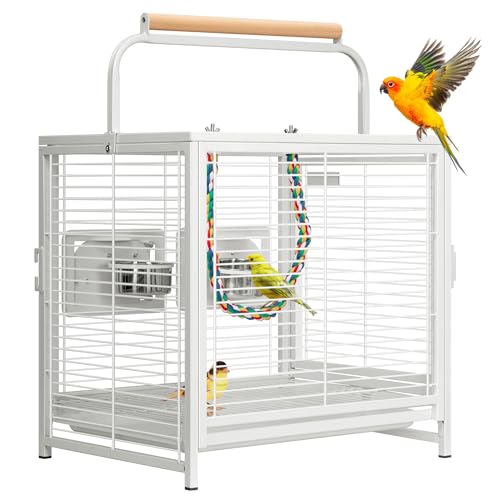
This one blurs the line between a travel carrier and a small secondary cage, which is exactly why some owners buy it: it doubles as a spare or overnight cage at a relative’s house, not just a transport box. It’s built from low-carbon steel with a coated finish, bar spacing around 0.79″ (20mm), a slide-out tray for cleanup, and a wooden bar on the handle that functions as a second perch.
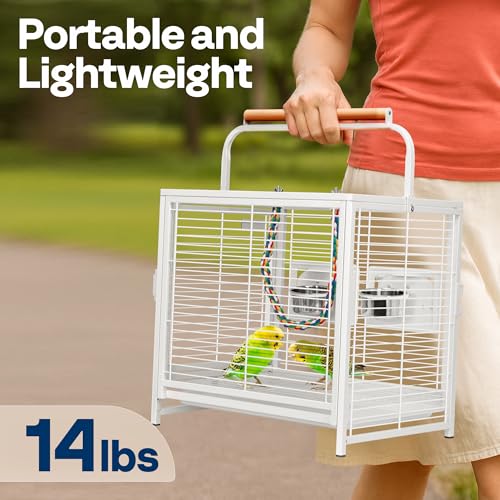
The metal build means it holds up to a bored or anxious bird chewing on the bars in a way mesh and polycarbonate can’t match. It requires assembly (VIVOHOME estimates about 30 minutes with basic tools), and it’s the heaviest option on this list at roughly 13 pounds before your bird goes in, so it’s not the one you’re throwing over your shoulder for a walk. Think car trunk or a stationary setup at a destination, not hands-free carrying.
Skip this if portability matters more than durability. It’s not designed to be worn or carried for any real distance, and the assembly step is one more thing that can go wrong right before a trip if you haven’t done a practice run at home first.
4. Birds Day Bird Carrier Backpack

At 2.72 pounds empty, this is the lightest carrying option here, and it’s built to actually be worn, with padded straps and a back panel instead of just a strap looped through the top. It measures 12.6″L x 10.4″W x 16.3″H and comes with a stainless steel tray, a wooden perch, a rope perch, a feeding cup, and a carrying case, which is a genuinely complete kit for the price.

Two details worth calling out: it includes two different perch types specifically because standing on one surface for an entire trip can contribute to bumblefoot, and it has flap covers for the mesh panels for heat protection, since a bird in a clear plastic or dark mesh carrier in direct sun heats up fast. The manufacturer notes the white mesh reflects heat better than darker colors.
Skip this if you have a cockatoo or another large-bodied parrot. The manufacturer is explicit that this is sized for small to medium birds only, lovebirds up through Quakers, Indian ringnecks, and similar. Anything bigger won’t have the room it needs.
5. Bird Carrier with Seat Belt for Car Travel

If most of your bird’s “travel” is actually just car rides (vet, family visits, road trips), this is built around that specific use case instead of treating car travel as an afterthought. It includes a seat belt strap that ties the carrier itself to the car’s seat belt system, so it isn’t sliding around the seat or floor on turns and stops the way a loose carrier does. The design is also heightened compared to a flat carrier, which gives the bird room to hop up rather than being stuck flat-footed the whole ride.

The trade-off is access. Cleaning the bottom tray means unzipping a compartment rather than sliding a tray straight out, which is a minor annoyance on a quick trip and a bigger one if your bird has an accident mid-drive and you’re pulled over on the shoulder trying to deal with it.
Skip this if car travel isn’t your main use case. The seat belt attachment is the entire point of this design, and if you’re mostly walking, flying, or doing vet visits on foot, you’re paying for a feature you won’t use.
6. Bird Carrier Bag with Indestructible Stainless Steel Mesh

This is the answer if the Colorday’s plastic mesh (option 2 above) makes you nervous about a chewer. The side panels use 304 stainless steel mesh instead of plastic, which a beak isn’t going to work through the way it can with hexagonal plastic. It also has a roll-up sunshade over a transparent window, so you can go from full visibility to a calmer, covered environment without switching carriers.

The standout practical feature is the extra zippered opening at the bottom, separate from where the bird goes in and out. That means you can pull the tray and clean it mid-trip without having to open the main compartment or handle the bird, which matters more than it sounds like on a long drive or a multi-stop day.
Skip this if weight is your top priority. Steel mesh adds noticeable heft compared to fabric-only carriers, and if you’re already deciding between this and the Birds Day backpack above, that one is going to feel lighter on your shoulders over a full day out.
7. Portable Bird Carrier with Standing Perch and Stainless Steel Tray

This is the smallest and lightest carrier on the list, at roughly 8″x10″x12″ and about 1 pound empty, and it’s priced accordingly. It’s built for budgies, small parakeets, and similarly sized birds, not medium or large parrots. It has a side mesh pocket for snacks or small accessories and a separate side zip specifically for cleaning access, plus a soft mat and wooden perch included.
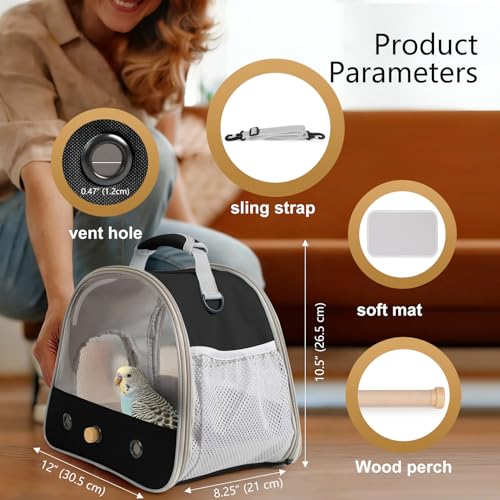
For a quick vet run with a small bird, this is genuinely enough carrier. It’s not trying to do more than that, which keeps the price low and the weight down.
Skip this if your bird is anything past parakeet or small conure size. The dimensions aren’t a suggestion here; this is built to a specific small footprint, and forcing a bigger bird into it defeats the point of a carrier that’s supposed to reduce stress, not add to it.
How to Actually Size a Bird Carrier
Body length alone undersells what a carrier needs to hold. Measure your bird beak-to-tail-tip while it’s perched normally, then add enough height that it can stand fully upright without its head brushing the top, and enough length that a long-tailed bird (conures, macaws) isn’t folding its tail against the wall. A carrier that’s technically “large enough” for the body but cramped on tail room will stress a bird out faster than one that’s slightly oversized.
As a rough starting point: budgies and lovebirds do fine in carriers around 12″ tall. Conures and cockatiels need closer to 16-19″. Amazons, African Greys, and small cockatoos need 19″ or more, with extra depth for tail clearance. Always check the specific carrier’s listing for the manufacturer’s own bird-size recommendations before buying, since bar spacing and door size vary even within similar overall dimensions.
Frequently Asked Questions
Is any bird carrier actually airline-approved?
Not universally. Airlines set their own rules for live animal transport, and most require it to go through cargo or a professional pet relocation service rather than the cabin. If a listing claims “airline approved” without naming the specific airline and rule it meets, call your airline before you fly, not after you’ve bought the carrier.
How long can a bird stay in a travel carrier?
For trips under two hours, most of these carriers work fine as long as ventilation isn’t blocked. Beyond that, your bird needs access to food, water, and a chance to stretch, so plan stops accordingly rather than treating any carrier as suitable for extended confinement.
Hard-shell or soft-sided, which is safer?
Hard-shell (polycarbonate or metal) protects better against impacts and against a bird chewing its way through a wall. Soft-sided is lighter and easier to carry hands-free but is more vulnerable to a persistent chewer and offers less structural protection in a car accident or a drop.
Affiliate Disclosure: GearForPet.com participates in affiliate programs. We may earn a small commission if you purchase through our links at no extra cost to you. Read our full disclosure.