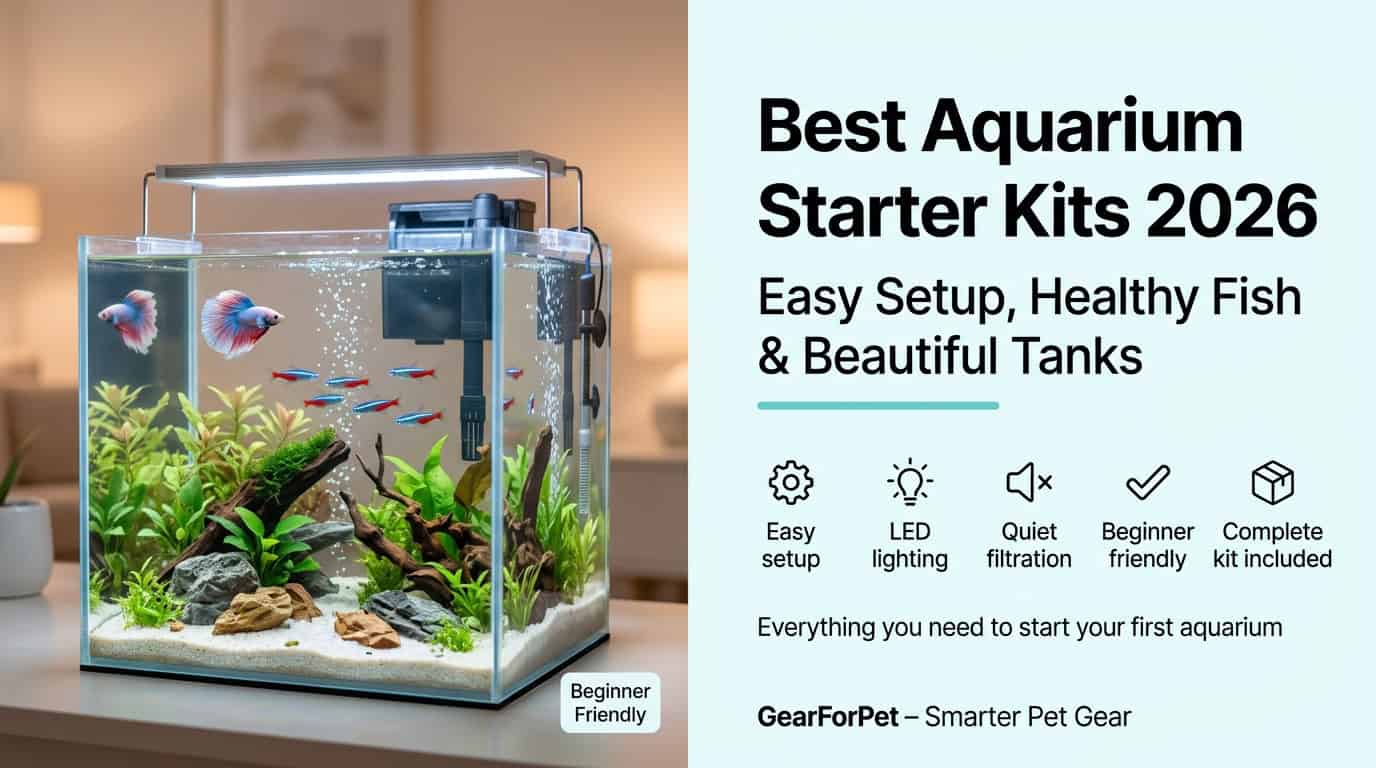
Best Aquarium Starter Kits 2026: Top Picks for Beginners
The most common beginner aquarium mistake isn’t choosing the wrong filter or the wrong fish — it’s buying a tank that’s too small. A 1-gallon desktop tank looks manageable, costs less, and seems like a sensible starting point. Within weeks, the water quality crashes, the fish die, and the owner concludes they’re bad at fishkeeping. They weren’t. Small tanks are harder to maintain than larger ones – water parameters swing faster, error margins are smaller, and fish have less room to establish natural behaviour. This guide starts where the other beginner guides don’t: with the right tank size for your situation, then the right kit for that size, then everything you need to know to keep fish alive that your starter kit box won’t tell you.
Best Aquarium Starter Kit 2026 – Quick Answer
The best aquarium starter kit for most beginners is the Aqueon 10 Gallon LED Starter Kit — the right size for a first tank, complete hardware included, and widely available replacement parts. For small spaces or a single betta, the Fluval Spec V 5 Gallon is the most thoughtfully designed small tank on the market. For a first tropical community tank with room to stock properly, the Tetra 20 Gallon Complete Kit gives beginners the volume they actually need.
- Best Overall: Aqueon 10 Gallon LED Starter Kit — the ideal beginner size, complete kit
- Best Small Tank / Betta: Fluval Spec V 5 Gallon — best-designed small tank available
- Best for Tropical Community: Tetra 20 Gallon Complete Kit — room to stock properly
- Best Budget: Marina LED 10 Gallon Kit — solid entry-level at lowest price
- Best Desktop / Small Space: Marineland Portrait 5 Gallon — compact, elegant, space-efficient
- Best for Kids / Visual Impact: GloFish Aquarium Kit — LED colour effects, high engagement
- Best Premium: Fluval Flex 15 Gallon — design-forward, powerful filtration, long-term quality
Quick Comparison — Best Aquarium Starter Kits 2026
| Product | Best For | Tank Size | Filter | Heater | Price Tier | Link |
|---|---|---|---|---|---|---|
| Aqueon 10 Gallon LED | Best Overall | 10 gal | ✅ Yes | ✅ Yes | Mid | Check price → |
| Fluval Spec V | Best Small / Betta | 5 gal | ✅ Yes | ❌ No | Mid–Premium | Check price → |
| Tetra 20 Gallon | Best Tropical Community | 20 gal | ✅ Yes | ✅ Yes | Mid | Check price → |
| Marina LED 10 Gallon | Best Budget | 10 gal | ✅ Yes | ❌ No | Budget | Check price → |
| Marineland Portrait 5 Gal | Best Desktop | 5 gal | ✅ Yes | ❌ No | Mid | Check price → |
| GloFish Aquarium Kit | Best for Kids | 5–10 gal | ✅ Yes | ❌ No | Budget–Mid | Check price → |
| Fluval Flex 15 Gallon | Best Premium | 15 gal | ✅ Yes | ❌ No | Premium | Check price → |
Best Aquarium Starter Kits 2026 – Full Reviews
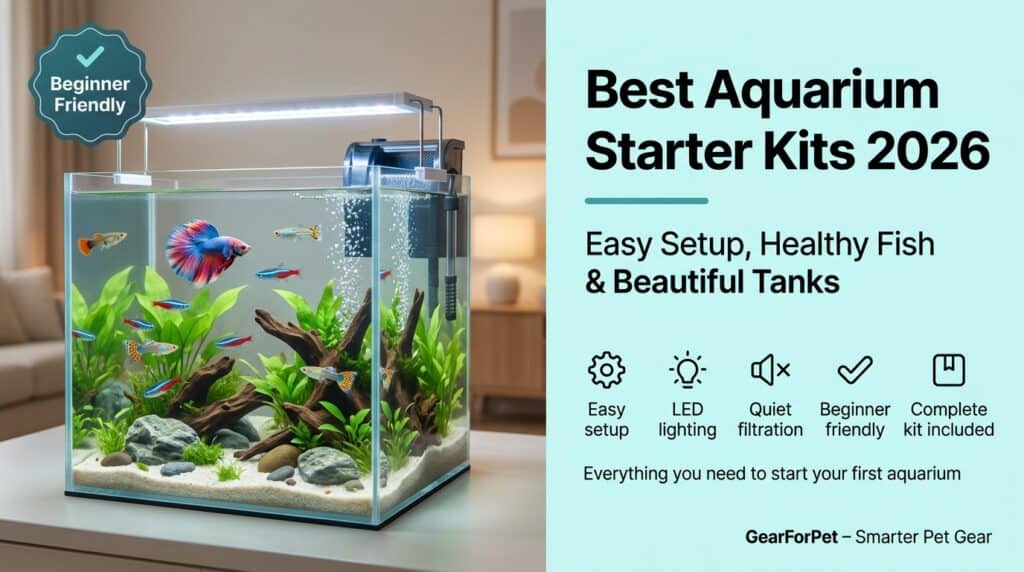
1. Aqueon 10 Gallon LED Starter Kit — Best Overall for Beginners
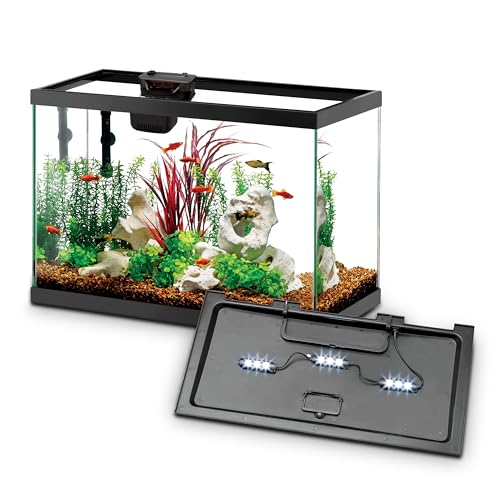
The Aqueon 10 Gallon LED Starter Kit earns the best overall pick for one reason above all others: it gets the tank size right. Ten gallons is the sweet spot for first-time fishkeepers — large enough that water parameters stay stable between maintenance sessions, small enough to fit on a desk or dresser without dominating a room, and the right volume for a beginner stock of 6–8 small fish that interact visibly and behave naturally. The Aqueon ships as a genuinely complete kit — tank, LED hood, quiet flow filter, submersible heater, water conditioner sample, fish food sample, and a thermometer. You add substrate, décor, and fish. Everything functional is in the box.

Why the Aqueon filter matters: The QuietFlow filter included in the Aqueon kit is a genuine step above the basic hang-on-back filters bundled with most entry-level kits. It runs quietly — motor noise is the detail that turns living room tanks into background annoyances — and the cartridge replacement system is one of the simplest available, which matters because a filter that’s inconvenient to maintain gets maintained less frequently, and infrequent filter maintenance is how water quality crashes. Aqueon replacement cartridges are widely stocked at PetSmart, Petco, and Amazon — no proprietary supply issues.

Honest limitation: The heater included in the Aqueon kit is functional but not the most precise — it maintains temperature in the tropical range (74–78°F) reliably in normal room temperature conditions, but in cold rooms or during winter months in cooler climates, a separate adjustable heater gives better temperature control for sensitive tropical species. For a beginner keeping hardy fish (guppies, tetras, danios), the included heater is perfectly adequate. For more temperature-sensitive species, budget for a heater upgrade.
Best for: First-time fishkeepers, 6–10 small tropical fish, desk or dresser placement, owners who want everything in one box.
Not ideal for: Goldfish (need 20+ gallons); owners who want precise temperature control for sensitive species.
—
2. Fluval Spec V 5 Gallon — Best Small Tank for Betta Fish
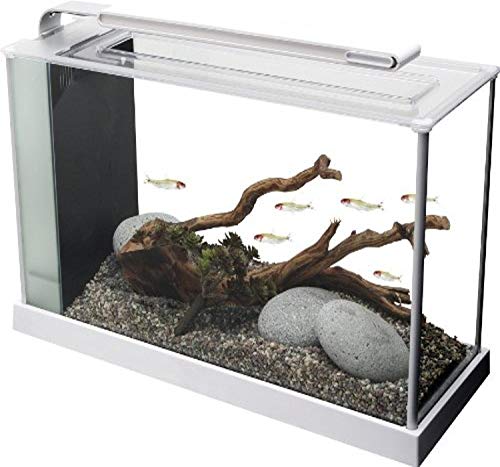
If a betta fish is your starting point — and for many beginners it is — the Fluval Spec V is the tank designed specifically for that scenario. The 5 gallon volume is the minimum recommended size for a single betta to exhibit natural territory behaviour, turn fully without fin contact with the glass, and live a full healthy lifespan. The Spec V’s design reflects a level of engineering attention rare at this size: the filter is concealed in a rear compartment (invisible from the front, no equipment breaking the visual line), the output flow is adjustable to low — critical for bettas whose flowing fins are damaged by strong currents — and the etched glass is optically clear rather than the greenish tint of budget tank glass.

The betta-specific design details: The Spec V’s rear filtration chamber houses a 3-stage filter — mechanical foam, activated carbon, and BioMax ceramic rings for beneficial bacteria colonisation. The adjustable output means you can dial flow down to a gentle circulation that keeps water oxygenated and clean without creating the strong current that causes bettas to hide at the bottom or struggle to reach the surface. The LED lighting is bright enough for live plants — many betta keepers add low-light plants like java fern or anubias, which improve water quality and give the betta natural shelter.

Honest limitation: No heater included — this is the Spec V’s main practical gap. Bettas are tropical fish requiring 76–82°F water; in any room that drops below 72°F, a small submersible heater is non-negotiable. At 5 gallons, a 25W adjustable heater fits easily in the rear chamber and costs $15–25. Budget for it as part of the Spec V purchase. Also, the 5 gallon volume means the nitrogen cycle is less forgiving than a 10 gallon — new owners should cycle the tank fully before adding the betta and test water weekly for the first month.
Best for: Single betta fish, desktop or office placement, owners who want a visually clean design, live planted setups.
Not ideal for: Multiple fish; owners who want a heater included; community tank aspirations.
—
3. Tetra 20 Gallon Complete Kit — Best for Tropical Community Fish
No products found.Twenty gallons is where beginner fishkeeping genuinely becomes enjoyable — enough volume to stock a proper community of 12–15 small fish, enough water mass that a missed water change or a slight overfeeding doesn’t immediately crash the parameters, and enough visual space for a planted layout that actually looks like an aquarium rather than a glass box with gravel. The Tetra 20 Gallon Complete Kit is built around this reality: it includes a heater calibrated for tropical temperatures, a whisper-quiet power filter, and a full-hood LED light that covers the entire tank length. For beginners who want a community tank with multiple species, this is the starting point that actually works.
No products found.Stocking possibilities at 20 gallons: At this volume, a beginner can responsibly keep a genuine community — a school of 6 neon tetras for mid-water colour movement, 4–5 corydoras catfish working the substrate, 2–3 platies for surface activity, and a single centerpiece fish like a small gourami. That combination fills the tank visually, covers all water column levels, and is hardy enough that beginner-level maintenance keeps them healthy. None of this is possible in a 5 or 10 gallon tank without overstocking — the 20 gallon is where community fishkeeping actually begins.
No products found.Honest limitation: The Tetra Whisper filter included performs well for its size, but at a full stock of 15 fish, upgrading to a higher-flow filter after the first 6 months is worth considering. The included filter is rated for 20 gallons at light stock; a fully stocked community tank benefits from filtration rated at 1.5–2x the tank volume. This is a 6-month upgrade consideration, not a day-one issue — the included filter is fully adequate for cycling and early stocking phases.
Best for: Community tropical fish, beginners wanting multiple species, owners ready to commit to a proper setup, households where the tank is a room feature.
Not ideal for: Small spaces; beginners who want the simplest possible maintenance routine (larger tanks require more water change volume).
—
4. Marina LED 10 Gallon Kit — Best Budget Starter Kit

The Marina LED 10 Gallon is the most recommended budget starter kit across fishkeeping communities — and the recommendation persists because Marina consistently delivers better build quality than most competitors at the same price. The hang-on-back filter uses a clip-in cartridge system that’s simple to maintain and replace; the LED lighting covers the full tank length without the dark corners that cheap single-bulb hoods create; and the glass is genuinely clear rather than the green-tinted product of low-grade glass manufacturing. For beginners who want a functional 10 gallon setup at the lowest honest entry price, the Marina delivers it.

Where Marina earns its reputation: The Marina brand has been the default recommendation in budget fishkeeping for over a decade — long enough that the filter cartridges are stocked in virtually every pet store and available from multiple third-party manufacturers on Amazon, eliminating the proprietary supply problem that affects some budget brands. The filter’s biological stage — the section that houses the beneficial bacteria essential to the nitrogen cycle — is sized adequately for a 10 gallon beginner stock, which is the detail that separates functional budget filters from ones that fail to maintain water quality under normal use.

Honest limitation: No heater included — the Marina kit is priced at the budget tier partly by omitting the heater. For tropical fish, a 50W submersible heater ($12–20) is a required addition. The LED lighting, while adequate for viewing, is not strong enough for light-demanding live plants — low-light species (java moss, anubias, java fern) work fine; high-light plants will struggle. For a beginner keeping artificial plants, this is irrelevant. For anyone interested in a planted tank long-term, the Fluval Flex’s lighting is a better foundation.
Best for: Budget-conscious beginners, first-time fishkeepers testing the hobby before investing, 6–8 hardy tropical fish, straightforward low-maintenance setups.
Not ideal for: Tropical fish without a separate heater purchase; light-demanding live plants; owners who want everything in one box.
—
5. Marineland Portrait 5 Gallon — Best Desktop Tank for Small Spaces
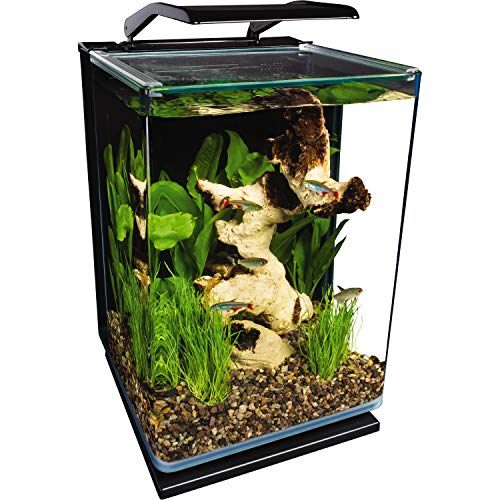
Most 5 gallon tanks are wide rectangles that occupy desk space horizontally. The Marineland Portrait is tall rather than wide — its portrait orientation takes up roughly the footprint of a large book while standing 17 inches tall, making it genuinely compatible with desk corners, bathroom counters, and bedroom side tables where a standard rectangular tank won’t fit. The curved front glass eliminates the visual distortion of flat-pane corners, creating a clean viewing panel that makes the 5 gallon interior appear more spacious than its volume suggests. For a betta fish in a space-constrained home, the Portrait is the thoughtfully designed solution.

The hidden filtration design: Like the Fluval Spec V, the Marineland Portrait conceals its filtration in a rear compartment — the three-stage filter (foam, activated carbon, ceramic bio-balls) is invisible from the front viewing panel. The LED lighting runs along the top of the rear chamber and illuminates from above and behind, creating a natural-looking light distribution rather than the flat top-light of standard hood designs. The sliding glass canopy on top is a practical detail — it allows feeding without fully removing the hood, reducing the chance of a betta jumping during feeding, which bettas are capable of in open-top tanks.

Honest limitation: No heater included — the same gap as the Fluval Spec V at this size. The rear chamber accommodates a small submersible heater easily, but it’s a required purchase for tropical fish. The portrait orientation, while space-efficient horizontally, limits the swimming space for fish that prefer horizontal movement — bettas, which naturally patrol territories, adapt well to the taller format; schooling fish that move in horizontal groups do not. Keep this tank to a single betta or a small betta-compatible companion (snails, small shrimp).
Best for: Desk, bathroom, or bedroom placement where horizontal space is limited, single betta fish, owners who want a visually elegant small tank, gift purchase for a first-time fish owner.
Not ideal for: Schooling fish; owners who want a heater included; anyone wanting more than 1–2 fish.
—
6. GloFish Aquarium Kit — Best for Kids and Visual Impact
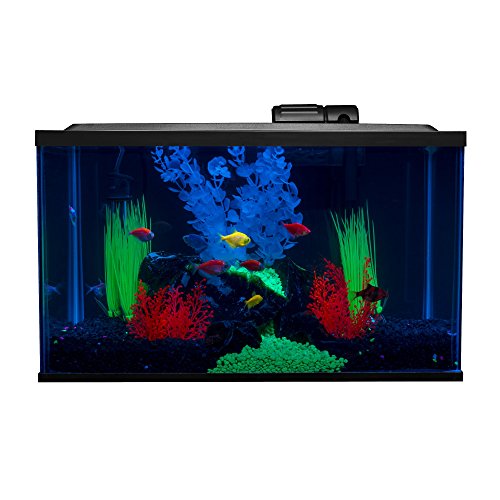
GloFish are genetically fluorescent fish — bred from zebrafish and tetras with a naturally occurring fluorescence gene that produces vivid pink, orange, green, and blue colouration under blue LED lighting. The GloFish Aquarium Kit is built specifically around this visual effect: the included LED light produces the blue-spectrum light that makes GloFish colours glow, the kit includes fluorescent décor that complements the effect, and the result is an aquarium that looks genuinely spectacular to a child seeing it for the first time. For parents buying a first fish tank for a child, the GloFish kit creates immediate engagement and sustained interest in a way that a standard fish-in-plain-gravel setup does not.
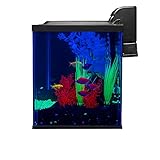
The fishkeeping reality behind the visuals: GloFish are not decorative props — they’re real fish with real care requirements. GloFish tetras and danios are hardy, forgiving species that handle beginner-level water quality variability better than most tropical fish, making them genuinely appropriate for a child-managed tank with adult supervision. The nitrogen cycle still applies, water changes are still required, and the tank still needs cycling before fish are added. The GloFish kit is an excellent child’s first aquarium precisely because it combines beginner-appropriate fish species with an aesthetic that holds a child’s interest through the learning curve of basic fishkeeping.

Honest limitation: The GloFish LED produces the blue-spectrum light optimised for fluorescence — it’s visually striking but not ideal for live plant growth, which requires a broader light spectrum including red and green wavelengths. This is a dedicated GloFish aesthetic tank; the visual effect works best with the fluorescent artificial décor rather than live plants. Also no heater included — GloFish tetras and danios are tropical fish requiring 72–80°F water; a small heater is a required addition in any room that drops below 70°F.
Best for: Children’s first aquarium, families who want visual impact, GloFish species specifically, bedrooms and play rooms where the glowing effect is a feature.
Not ideal for: Live planted tanks; owners who prefer natural aesthetics; anyone not keeping GloFish species.
—
7. Fluval Flex 15 Gallon — Best Premium Starter Kit
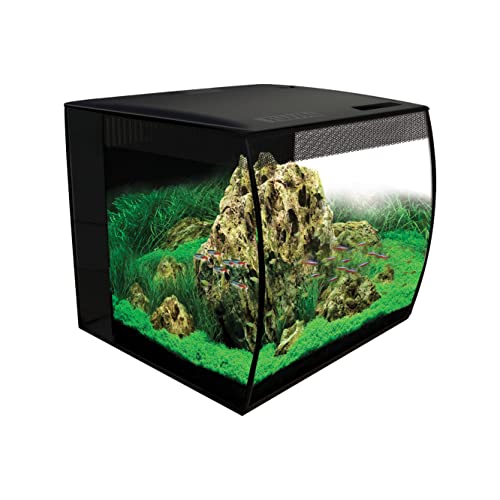
The Fluval Flex is what happens when aquarium engineering is treated as a design problem rather than just a hardware problem. The curved front glass wraps around the viewing angle, creating a panoramic effect that makes 15 gallons appear significantly larger than its volume. The rear filtration chamber is hidden entirely behind a black panel — from the front, there is no visible equipment whatsoever, just the tank and its inhabitants. The multicolour LED system produces over 80 colour combinations controllable by remote, covering daylight simulation, moonlight cycles, and the kind of ambient colour programming that makes the tank a room feature rather than a piece of pet equipment.

Why the Fluval Flex is a long-term investment: Most starter kit owners outgrow their first tank within a year — the equipment is inadequate, the aesthetics are basic, and the desire to do more with the hobby collides with the limitations of entry-level gear. The Fluval Flex is designed to grow with the owner. The 3-stage filtration system (mechanical, chemical, biological) handles the bioload of a fully stocked 15 gallon comfortably without upgrades. The lighting system supports live plants across the spectrum. The build quality — thick curved glass, quality pump, premium LED housing — means this tank is still performing well five years into the hobby, not replaced after two.

Honest limitation: No heater included at this price point — which is the one genuine gap in an otherwise complete premium kit. A quality adjustable heater for 15 gallons costs $20–35 and fits in the rear chamber without affecting the clean front aesthetic. The premium price is also a real consideration — the Fluval Flex costs significantly more than the Aqueon or Marina budget picks. For beginners who are committed to the hobby and want gear that won’t need replacing, the investment is justified. For beginners who aren’t sure they’ll stick with fishkeeping, start with the Aqueon and upgrade to a Flex when the hobby is confirmed.
Best for: Design-conscious buyers, beginners committed to the hobby long-term, live planted tanks, rooms where the aquarium is a visual centrepiece, owners who don’t want to upgrade equipment within 2 years.
Not ideal for: Budget-first buyers; undecided beginners testing the hobby; anyone who needs a heater included.
What Size Aquarium Should a Beginner Get? — The Honest Guide
Tank size is the single most important decision a beginner makes — and the one most commonly made wrong. The instinct to start small is understandable but counterproductive: smaller tanks are harder to maintain, not easier. In a small volume, ammonia from fish waste, uneaten food, and plant decay accumulates faster, oxygen depletes more quickly, and temperature swings more dramatically with room temperature changes. Every beginner mistake — overfeeding, a skipped water change, adding fish too quickly — has smaller consequences in a larger tank than a smaller one.
| You Want… | Minimum Size | Recommended Kit |
|---|---|---|
| One betta fish | 5 gallons | Fluval Spec V or Marineland Portrait |
| A few hardy fish (guppies, danios) | 10 gallons | Aqueon 10 Gallon or Marina LED 10 |
| Small community tank (2–3 species) | 15–20 gallons | Fluval Flex 15 or Tetra 20 Gallon |
| Full community (5+ species) | 20+ gallons | Tetra 20 Gallon Complete Kit |
| Goldfish (single) | 20 gallons minimum | Tetra 20 Gallon — goldfish produce significant waste |
| Children’s first tank | 10 gallons | GloFish Kit or Aqueon 10 — forgiving volume for beginner mistakes |
Under 5 Gallons — When to Avoid It
Tanks under 5 gallons (including 1 and 2.5 gallon “betta bowls” sold widely in pet stores) are the single most common source of beginner failure. At this volume, ammonia spikes within 24–48 hours of feeding. Temperature holds at room temperature rather than the tropical 76–80°F bettas require. There is no room for a filter that creates meaningful water circulation without stressing the fish with current. The humane minimum for any fish, including betta fish, is 5 gallons. Under 5 gallons is suitable only for shrimp colonies or snails where the bioload is negligible.
5–10 Gallons — The Beginner Sweet Spot
Ten gallons is where fishkeeping becomes manageable for a beginner. Water parameters stay stable for 5–7 days between maintenance sessions. A hang-on-back filter maintains water quality at light stock without constant attention. The tank is large enough to hold a school of 6 small fish (neon tetras, ember tetras, guppies) that display natural schooling behaviour — one of the most satisfying things to watch in a beginner aquarium. For most first-time fishkeepers, 10 gallons is the answer.
20 Gallons — Where Community Fishkeeping Begins
A 20 gallon tank opens up the full range of beginner-appropriate community fish and allows a layout with enough depth and height for live plants, driftwood, and rock arrangements that create genuine visual interest. At this volume, weekly 25% water changes maintain excellent water quality with hardy fish even if other maintenance is occasionally imperfect. For beginners who have done any research into the hobby and know they want a community tank, starting at 20 gallons rather than 10 saves the cost and disruption of upgrading within a year.
The Nitrogen Cycle — The Most Important Thing Your Starter Kit Box Won’t Tell You
More beginner fish die from new tank syndrome than from any other cause — and new tank syndrome is caused entirely by the nitrogen cycle not being established before fish are added. Understanding the nitrogen cycle is the single most impactful piece of knowledge a beginner can have. It takes five minutes to grasp and saves fish lives.
What the Nitrogen Cycle Is — In Plain Language
Fish produce ammonia as waste — through their gills, urine, and decomposing uneaten food. Ammonia is toxic to fish at very low concentrations. In a functioning aquarium, two types of beneficial bacteria colonise the filter media: the first converts ammonia to nitrite (also toxic), the second converts nitrite to nitrate (much less toxic at low concentrations). This bacterial colony is called the biological filter — and it doesn’t exist in a brand new tank.
The 3-Stage Cycle
- Ammonia rises — fish waste accumulates, no bacteria yet to process it (Days 1–14)
- Nitrite rises, ammonia falls — first bacteria colony establishes, converts ammonia (Days 14–28)
- Nitrate rises, nitrite falls — second colony establishes, cycle complete (Days 28–42)
The cycle is complete when ammonia reads 0, nitrite reads 0, and nitrate reads below 20 ppm. At this point the tank is safe for fish.
How Long Does Cycling Take?
Typically 4–6 weeks for a standard fishless cycle. This can be shortened to 1–2 weeks by adding a bottle of beneficial bacteria (Tetra SafeStart, Fritz Zyme 7, or Seachem Stability are the most recommended brands) alongside a small ammonia source. Never add fish to an uncycled tank — the ammonia spike in the first 2 weeks will kill most fish within days, which is what most beginners attribute to “bad luck” or “bad fish” rather than the preventable chemistry problem it actually is.
Testing Your Cycle
A liquid test kit (API Freshwater Master Test Kit is the most recommended) tests ammonia, nitrite, nitrate, and pH accurately. Strip tests are less reliable for the ammonia and nitrite readings that matter most during cycling. Test every 2–3 days during the cycle, record the results, and add fish only when ammonia and nitrite have both reached and held at 0 for at least 3 consecutive days.
What Aquarium Starter Kits Include — And What You Still Need to Buy
Every starter kit on this list describes itself as “complete” — which is true for the hardware, but meaningfully incomplete for the actual setup. Here is what’s honestly in the box and what you’ll need to purchase separately:
| Usually Included | Usually NOT Included — Buy Separately |
|---|---|
| Tank + lid or canopy | Gravel or substrate ($10–25) |
| Hang-on-back or internal filter | Water conditioner / dechlorinator ($8–12) |
| LED light | Beneficial bacteria starter ($10–15) |
| Heater (some kits — check listing) | Aquarium thermometer ($5–10) |
| Water conditioner sample (small) | Liquid test kit ($25–35) |
| Fish food sample (small) | Fish food full size ($8–15) |
| Fish net (some kits) | Décor / plants ($15–40) |
| Heater (if not included) ($15–30) | |
| Fish themselves |
Realistic total setup budget beyond the kit: $60–100 for substrate, water conditioner, bacteria starter, test kit, thermometer, and basic décor. Factor this into your total budget when comparing kit prices — a $30 cheaper kit that doesn’t include a heater costs the same once you add the heater separately.
5 Beginner Aquarium Mistakes — And How to Avoid Each One
- Buying a tank that’s too small
The instinct to start small backfires — small tanks are harder to maintain, not easier. Water quality crashes faster, temperature swings are larger, and the margin for beginner errors is smaller. Start at 10 gallons minimum. The fish will be healthier, the maintenance will be more manageable, and you’ll enjoy the hobby more. - Adding fish before the tank is cycled
The most common cause of fish death in the first month. Run the nitrogen cycle to completion (4–6 weeks, or 1–2 weeks with a bacteria starter) before adding any fish. Test the water — don’t guess. Ammonia and nitrite must both read 0 before fish are introduced. - Overstocking — too many fish for the tank volume
The general rule is 1 inch of fish per gallon — but this understates the bioload of fat-bodied fish and overstates the capacity for small slim fish. A more practical guideline: stock at 75% of the theoretical maximum for the first 3 months, test water weekly, and add more fish only when parameters remain stable. - Overfeeding
Feed only what fish consume in 2 minutes, once or twice daily. Uneaten food decomposes rapidly, producing ammonia that overloads the biological filter. More fish die from overfeeding than underfeeding. If there is food on the substrate 5 minutes after feeding, you fed too much — remove it with a net or siphon and reduce the amount next time. - Skipping water testing
A tank that looks clean can have lethal ammonia or nitrite levels — the water appears identical to healthy water at toxic concentrations. A liquid test kit takes 5 minutes per test and is the only reliable way to know what’s actually happening in the water. Test weekly for the first 3 months, then every 2 weeks once the tank is stable.
Best Starter Fish for Each Tank Size
The fish you can keep depends directly on the tank size you choose. These are the species consistently recommended for beginners — hardy, widely available, visually rewarding, and forgiving of the water quality variations that occur during the learning curve of the first few months.
5 Gallon — Betta and Small Companions
- Betta fish — the classic 5 gallon choice; solitary, territory-based, interactive with owners
- Nerite snails — excellent algae cleaners, don’t reproduce in freshwater, compatible with bettas
- Ghost shrimp — active, visible, assist with substrate cleaning; most bettas leave them alone
- Malaysian trumpet snails — substrate aerators, breed slowly, useful cleanup crew
10 Gallon — Hardy Schooling Fish
- Neon tetras — iconic beginner fish; school of 6 minimum for natural behaviour; peaceful community fish
- Guppies — extremely hardy, colourful, easy to breed (can become a management issue — consider all-male)
- Zebra danios — fast, active, temperature-tolerant; good cycling fish if doing a fish-in cycle
- Ember tetras — smaller than neon tetras, orange-red colouration, thrive in schools of 8+
- Corydoras catfish — bottom dwellers, work in groups of 3–4, peaceful and practical
20 Gallon — Community Tank Possibilities
- Platies — colourful, hardy, peaceful; one of the most recommended beginner community fish
- Mollies — active mid-water fish, available in multiple colour morphs, easy to keep
- Dwarf gouramis — excellent centrepiece fish for a 20 gallon; peaceful, slow-moving, visually striking
- Harlequin rasboras — distinctive copper and black colouration, school beautifully in groups of 8+
- Bristlenose plecos — excellent algae control, stays small (4–5 inches), compatible with most community fish
Frequently Asked Questions — Aquarium Starter Kits
What is the best aquarium starter kit for beginners?
The Aqueon 10 Gallon LED Starter Kit is the best overall choice for most beginners — 10 gallons is the ideal starting size, the kit includes filter, heater, and LED lighting, and Aqueon replacement parts are widely available. For a betta fish specifically, the Fluval Spec V 5 Gallon is the best-designed small tank on the market. For a community tropical tank, the Tetra 20 Gallon Complete Kit gives you the volume you actually need.
What size fish tank should a beginner get?
Ten gallons for most beginners — it’s the minimum size where water quality stays stable enough for beginner-level maintenance, and it’s large enough for a school of 6–8 small fish that display natural behaviour. Five gallons is acceptable for a single betta fish only. Under 5 gallons is not recommended for any fish. If you already know you want a community tank with multiple species, start at 20 gallons rather than upgrading from a 10 within a year.
Do aquarium starter kits include everything you need?
No — starter kits include the hardware (tank, filter, light, sometimes heater) but not the consumables and additions required to actually set up and run the aquarium. You’ll need to purchase separately: substrate (gravel or sand), water conditioner, beneficial bacteria starter, a liquid test kit, fish food, and décor. Budget an additional $60–100 beyond the kit price for these items. Some kits include sample sizes of water conditioner and fish food — these last days, not months.
How long does it take to set up a fish tank for the first time?
Physical setup — assembling the tank, adding substrate and décor, filling with treated water, and starting the filter — takes 1–2 hours. The nitrogen cycle, which must complete before fish are added, takes 4–6 weeks (or 1–2 weeks with a bacteria starter like Fritz Zyme or Tetra SafeStart). Total time from unboxing to fish-ready: plan for 2 weeks minimum with a bacteria starter, 4–6 weeks for a fishless cycle without one. Adding fish to an uncycled tank is the most common cause of beginner fish death.
What fish can I put in a 10 gallon starter tank?
The best choices for a 10 gallon beginner tank are neon tetras (school of 6), guppies (5–6, consider all-male to prevent breeding), zebra danios (school of 5–6), ember tetras (school of 8), and corydoras catfish (group of 3–4 as bottom dwellers). Avoid goldfish (need 20+ gallons), cichlids (territorial), and any fish labelled “grow to 6+ inches” — they will outgrow a 10 gallon rapidly and their waste output will overwhelm the filtration.
Are aquarium starter kits worth it?
Yes — starter kits provide the essential hardware at a lower combined cost than buying each component separately, and they’re designed to work together without compatibility issues. The main limitation is that kit filters and lights are occasionally entry-level — after 6–12 months in the hobby, some owners upgrade specific components. For a beginner, the kit components are more than adequate for the first year. The Fluval Flex 15 Gallon is the exception — its components are premium enough that upgrades aren’t needed long-term.
How often do you clean a beginner fish tank?
Weekly 25% water changes are the standard maintenance schedule for a stocked aquarium — siphon the substrate while removing water, replace with dechlorinated tap water at the same temperature. The filter media should be rinsed in old tank water (never tap water — chlorine kills the beneficial bacteria) every 3–4 weeks. A full breakdown clean is not needed or recommended — removing and cleaning everything destroys the biological filter and effectively restarts the nitrogen cycle.
What do I need to buy that isn’t included in a starter kit?
Essential purchases beyond the kit: substrate (gravel, sand, or planted substrate), water conditioner (Seachem Prime or API Stress Coat), beneficial bacteria starter (Fritz Zyme 7 or Tetra SafeStart), a liquid test kit (API Freshwater Master Test Kit), a heater if not included, and fish food appropriate for your species. Optional but recommended: live or artificial plants, driftwood or rock décor, and a small gravel vacuum for water changes. Total additional cost: $60–100 depending on décor choices.
Final Verdict — Which Aquarium Starter Kit Should You Buy?
- Most beginners: Aqueon 10 Gallon LED Starter Kit — right size, complete hardware, easy to maintain
- Betta fish only: Fluval Spec V 5 Gallon — best-designed small tank, betta-appropriate flow
- Community tropical tank: Tetra 20 Gallon Complete Kit — the volume you actually need to stock properly
- Tightest budget: Marina LED 10 Gallon Kit — proven brand, quality at minimum cost
- Small space, desktop: Marineland Portrait 5 Gallon — portrait orientation, elegant, space-efficient
- Children’s first tank: GloFish Aquarium Kit — visual impact that sustains a child’s interest
- Long-term investment: Fluval Flex 15 Gallon — premium build, won’t need replacing as the hobby grows
Whichever kit you choose – cycle the tank before adding fish, test the water, and start with hardy species. The learning curve in the first month is real, but it’s short. Get past the nitrogen cycle and beginner fishkeeping is one of the most rewarding and low-maintenance pet hobbies available.
Affiliate Disclosure: GearForPet.com participates in affiliate programs. We may earn a small commission if you purchase through our links at no extra cost to you. Read our full disclosure.