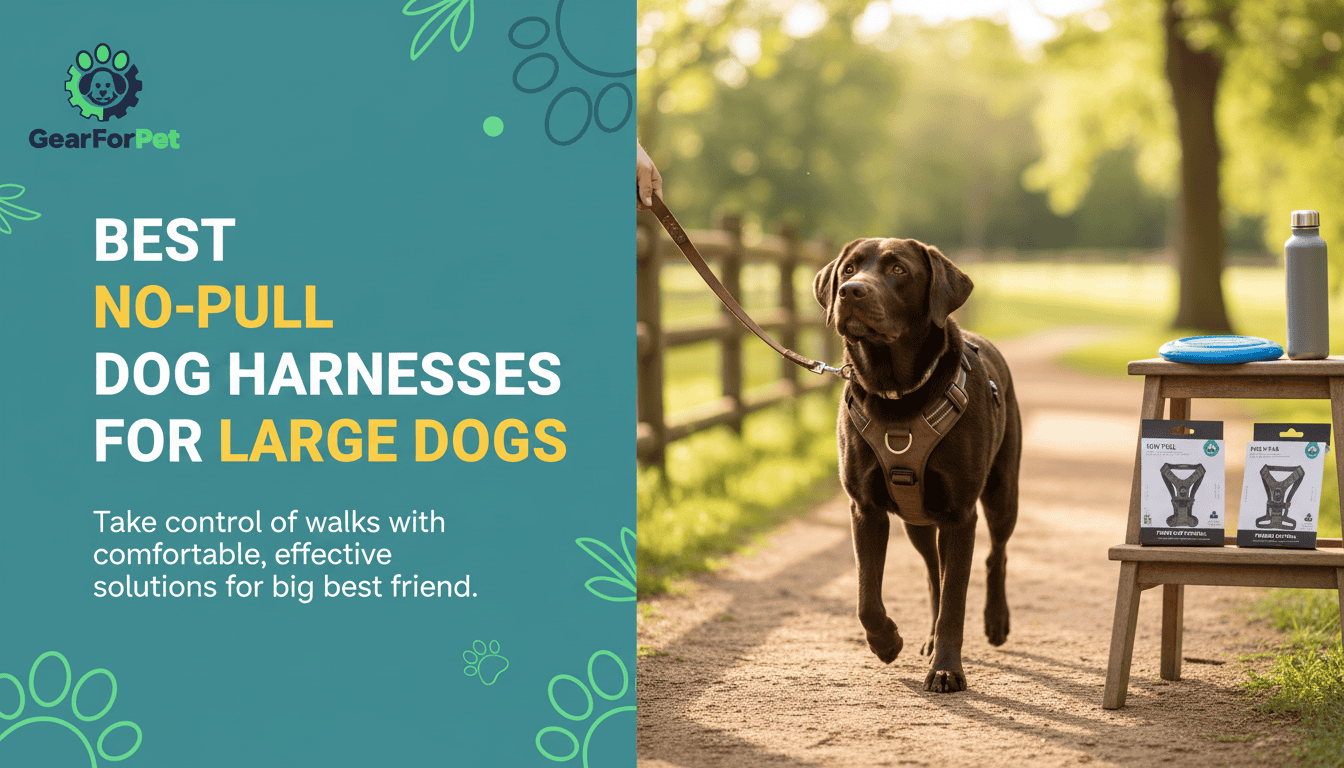
Best No-Pull Dog Harnesses for Large Dogs 2026: The Only 4 That Handle the Force
The no-pull harnesses that work on a 20 lb Cocker Spaniel do not necessarily work on a 70 lb Labrador. The problem is not the no-pull mechanism — front-clip redirection works on dogs of any size. The problem is hardware. Plastic side-release buckles rated to “80 lbs” on the label creep and release under the sustained repetitive force of a large dog that pulls on every walk. The front-clip ring shifts off-centre when a dog lunges sideways, and the chest strap rides up into the armpits of deep-chested large breeds because the geometry was calibrated for medium-dog proportions. This guide covers the four harnesses that solve all three of those problems — built specifically for the weight, force, and body proportions of large and giant breeds.
Quick Comparison: Best No-Pull Harnesses for Large Dogs
| Product | Best For | Hardware | Handle | Weight Range | Link |
|---|---|---|---|---|---|
| WINGOIN Tactical Heavy Duty | 🏆 Best Overall Large Dog | All metal | ✅ Yes | 50–120 lbs | Check price on Amazon |
| rabbitgoo No Pull (Large) | 🥇 Best Daily Walker | Metal rings | ✅ Yes | 40–90 lbs | See price on Amazon |
| 2 Hounds Design Freedom | 🎓 Best for Training | Metal rings | ❌ No | 30–100+ lbs | Compare prices on Amazon |
| BARKBAY Reflective Large | 🌙 Best for Night Safety | Metal rings | ✅ Yes | 40–100 lbs | View deal on Amazon |
Why Most No-Pull Harnesses Fail on Large Dogs
Front-clip harnesses work by attaching the leash at the chest and redirecting a pulling dog sideways rather than allowing straight-ahead momentum. This mechanism works at any size. What does not scale reliably to large dog force is the hardware those clips are mounted on.
Plastic buckle creep is the most common failure mode. Plastic side-release buckles on budget and mid-range harnesses are manufactured and rated for dogs up to approximately 40–50 lbs in real continuous use. Above that weight, sustained pulling force causes the buckle to micro-release — a partial release event that is invisible until the buckle opens completely and the dog escapes. This most commonly happens at the worst possible moment: mid-lunge at a passing dog on a busy road. For large and giant breeds, metal hardware is not a premium option — it is a safety requirement.
Front-clip ring migration is the second problem. On large dogs that lunge sideways, the chest ring on a poorly constructed harness migrates off-centre — rotating to the side rather than staying centred on the sternum. A ring that has migrated to the side no longer redirects the dog forward and to you; it redirects them in a partial arc that still allows significant forward momentum. The chest ring must be anchored by adequate strap geometry on both sides to stay centred under lateral force.
Chest strap armpit migration is the third. Deep-chested large breeds — Labradors, German Shepherds, Golden Retrievers, Rottweilers — have a significantly longer distance from neck to chest girth than the medium dog proportions most harnesses are designed around. The chest strap on a standard harness rides up into the armpits on these breeds, causing chafing and restricting shoulder movement during a normal walking gait. Harnesses designed specifically for large-breed proportions place the chest strap lower and provide more adjustment travel in the lateral straps.
🏆 Best Overall for Large Dogs: WINGOIN Tactical Dog Harness

The WINGOIN Tactical is the clearest recommendation for large and giant breed owners because it solves all three of the failure modes above simultaneously. All-metal hardware eliminates buckle creep as a concern entirely — metal does not yield under sustained pulling force. The chest ring is mounted on a rigid sternum plate anchored by two independent lateral straps, preventing ring migration under lateral lunges. The webbing is heavy-duty nylon with reinforced stitching at every load point, built to hold up under daily use with dogs that genuinely pull hard on every walk rather than occasionally.

The top handle is the feature that separates this harness from harness-plus-hardware alternatives. For large dogs in urban environments — traffic crossings, crowded pavements, encounters with reactive dogs — a handle at the dog’s back gives the owner a direct, high-control grip point that leash management alone cannot provide. When a 70 lb dog spots a squirrel at two metres, the difference between having a handle and not having a handle is the difference between holding the dog and being pulled over. The WINGOIN’s handle is reinforced with a secondary webbing layer and padded for sustained grip — not a decorative loop that would fail under real load.

Sizing guidance for large breeds: measure chest girth at the widest point behind the front legs and compare against the WINGOIN size chart. For deep-chested breeds (German Shepherd, Rottweiler, Dobermann), size up from your measurement — the harness sits lower on the chest than standard designs and needs the additional adjustment room. For barrel-chested breeds (Mastiff, Bulldog types), measure carefully as these breeds often have chest-to-neck ratios outside standard large-breed ranges.
Honest trade-off: the tactical construction is heavier and warmer than mesh harnesses. In hot weather, the thicker nylon webbing retains heat against the dog’s body. For summer use in warm climates, consider the rabbitgoo for everyday walks and the WINGOIN for high-control situations where its hardware superiority matters most.
Best for: dogs 50–120 lbs; reactive dogs that lunge; urban large-dog owners who need a handle for traffic safety; any owner where plastic hardware has failed before. Skip if: your dog is a calm walker who does not pull or lunge; you live in a hot climate and need a breathable all-day harness.
🥇 Best Daily Walker: rabbitgoo No Pull Harness (Large)

The rabbitgoo is the right choice for large dogs that pull consistently but do not lunge reactively, and for owners who want the most reliable everyday harness without the weight and bulk of a tactical build. Four adjustment points give it the fitting precision needed for large breed body proportions — crucially, both the chest strap height and the lateral strap width are independently adjustable, addressing the armpit migration problem that single-adjustment large harnesses produce on deep-chested breeds. The metal front and back leash rings have a track record of holding under large-dog pulling force in daily use that the rabbitgoo’s review profile reflects across thousands of verified purchases.

Where the rabbitgoo specifically outperforms the field for large breeds: the padding placement. The chest panel padding and the two lateral strap pads that contact the armpits are positioned correctly for a large dog’s walking gait — wide enough to cover the contact zone during full shoulder extension rather than narrowing to a ridge that rubs during movement. Large-breed owners who have gone through multiple harnesses for armpit chafing consistently identify the rabbitgoo as the harness that eliminates the problem, specifically because the pad width matches the contact zone of a large dog’s stride rather than a medium dog’s.

Sizing note for large breeds: for dogs at the upper end of the large size range (80–90 lbs), check the XL adjustment range before ordering — some deep-chested large breeds with wide chest girths are more comfortable in XL than L even if the weight falls in the L range. Chest girth measurement is the reliable guide; weight is not.
Honest trade-off: the rabbitgoo’s side-release buckles are reinforced plastic rather than metal. For dogs under 70 lbs that pull consistently but do not lunge reactively, these are adequate for daily use. For dogs that surge and lunge hard — at traffic, dogs, wildlife — the WINGOIN’s all-metal construction is the safer specification.
Best for: large dogs 40–80 lbs that pull on walks; deep-chested breeds where armpit chafing has been a problem; owners who want a lighter everyday harness over a tactical build. Skip if: your dog lunges reactively and plastic buckle failure is a genuine concern; your dog exceeds 90 lbs.
🎓 Best for Training: 2 Hounds Design Freedom No Pull Harness
No products found.The 2 Hounds Design Freedom is the harness that professional dog trainers reach for when owners specifically need to address serious pulling behaviour in large breeds — dogs that have defeated every single-clip harness and continue pulling despite consistent training effort. The dual-connection martingale system connects both the front chest ring and the back ring simultaneously through a specific coupler leash that comes with the harness, distributing the pulling correction across two points and maintaining a centred sternum ring under lateral force. For large dogs that pull with their full body weight, this dual-connection geometry produces faster, more consistent loose-leash improvement than any single front-clip harness achieves.
No products found.Why this is specifically effective on large pullers: a single front-clip harness on a large dog that pulls hard produces a partial redirection — the dog turns toward you briefly and then re-establishes forward momentum within a stride or two. The 2 Hounds Freedom’s dual connection maintains the redirection effect throughout the stride cycle because both the front and back rings load simultaneously, preventing the dog from re-establishing forward leverage before the correction completes. Large dogs with established pulling habits — dogs that have been pulling on walks for months or years — respond faster to this two-point system than to single-clip alternatives.
No products found.Important setup note: the Freedom harness must be used with the included coupler leash or a compatible dual-connection leash to produce the martingale effect. Attaching a standard single-clip leash to the front ring only defeats the dual-connection mechanism and reduces the Freedom to a standard single front-clip harness. If you buy the harness without the leash, you are not getting the system that makes it work.
Honest trade-off: no top handle. For reactive large dogs where close-control grip is a safety requirement, the WINGOIN is the better choice. The 2 Hounds Freedom is specifically a training tool for pulling reduction, not a reactive-dog management harness.
Best for: large dogs with persistent pulling that has not responded to other harnesses; owners working through structured loose-leash training; dogs that surge against a single front clip and re-establish momentum immediately. Skip if: your dog lunges reactively and you need a handle; you want a simple single-leash setup.
🌙 Best for Night Safety: BARKBAY No Pull Dog Harness Large Reflective
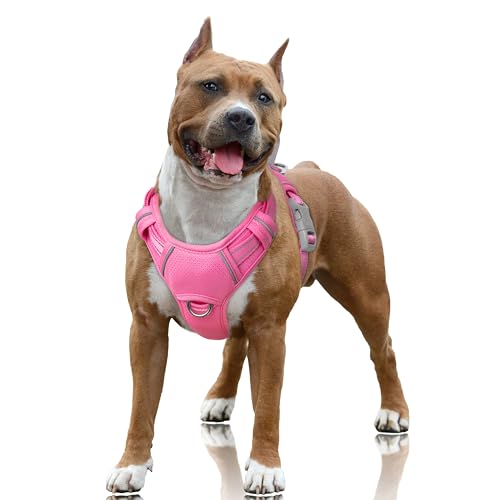
For large-breed owners who walk in the early morning or evening — the default pattern for working owners with high-energy dogs that need a proper walk before and after the workday — reflective coverage is a meaningful safety specification that most harnesses treat as an afterthought. The BARKBAY’s 360-degree reflective strips run across the chest panel, both lateral straps, and the back, making a large dog visible from all approach angles at distances that prevent vehicle and cyclist collisions. A standard harness with a small reflective patch on the back is visible from directly behind at moderate distances. The BARKBAY is visible from the front and sides at the distances that matter for oncoming traffic.

Large-breed specific considerations on the BARKBAY: the harness sizes up to XXL and is proportioned for the longer torso and wider chest of large breeds rather than scaled from a medium-dog template. The chest panel width at size L and XL covers the full sternal width of deep-chested large breeds including Labradors, German Shepherds, and Golden Retrievers without the chest ring pulling off-centre under load. The top handle is present and reinforced — adequate for directional guidance in most situations, though not the heavy-duty tactical reinforcement of the WINGOIN for dogs that surge hard.

Honest trade-off: the BARKBAY’s no-pull front-clip mechanism is effective for moderate pullers but less consistent than the 2 Hounds Freedom system for large dogs with serious, established pulling habits. If your primary problem is reflectivity for night walks and your dog pulls moderately, the BARKBAY covers both. If your primary problem is serious pulling behaviour, use the 2 Hounds Freedom and add a separate light attachment for night visibility.
Sizing note: the BARKBAY runs large on some breeds. Measure chest girth specifically and compare against the size chart. Dogs at the lower end of the L range (chest 26–28 inches) are sometimes better fitted in M with the straps let out, as the L can leave too much lateral strap slack to adjust down properly on narrower-chested large breeds.
Best for: large-breed owners with early morning or evening walk routines; urban night walkers where road visibility is a safety priority; moderate pullers who need reflectivity more than a specialised training system. Skip if: your dog has serious pulling behaviour that needs the dual-connection system; daytime-only walking where reflectivity is not a priority.
Large Dog Harness Buying Guide
How to Measure a Large Dog for a Harness
For large breeds, two measurements are essential: chest girth (widest point of the chest, just behind the front legs — not the rib cage measurement) and neck girth (base of the neck). For deep-chested large breeds, also note the sternum-to-withers distance — the length from the base of the neck to between the shoulder blades — which determines whether the chest strap will sit at the correct height or migrate up into the armpits. A chest strap that sits more than 3 cm below the top of the front legs is in the correct position. Above that line, it will chafe.
Always use chest girth — not body weight — as the primary sizing input. A 70 lb Greyhound and a 70 lb Bulldog have completely different chest girths. Weight is an unreliable proxy for any large-breed harness purchase.
Metal vs Plastic Hardware: The Real Weight Limit
Plastic side-release buckles on harnesses begin showing creep behaviour under sustained load from approximately 40–50 lbs of continuous pulling force. For a dog that pulls on every walk rather than occasionally, this is cumulative stress — the buckle micro-releases slightly on each hard pull and gradually loses retention strength over weeks of use. The failure is then sudden rather than gradual, and it happens under peak load. For dogs over 50 lbs that pull consistently, metal hardware is the correct specification regardless of cost difference.
Metal D-rings and clip rings — standard in better harnesses — are a different consideration from metal side-release buckles. Most mid-range harnesses use metal rings with plastic buckles. This is adequate for dogs up to approximately 60–70 lbs that pull moderately. For dogs over 70 lbs or dogs that lunge reactively, all-metal construction including the side-release buckles is the safest specification.
The Handle Question for Large Dogs
A top handle on a large dog harness is not a tactical accessory — it is a practical safety feature for urban large-breed ownership. Three situations make it necessary: traffic crossings (hand-on-handle while the dog waits is significantly more secure than leash-only control), encounters with reactive dogs at short distance (a handle allows body repositioning in a way a taut leash does not), and physical assistance for older or injured large dogs navigating stairs or uneven ground. If you own a large dog in an urban environment with regular traffic exposure, a handle is a functional requirement rather than a nice-to-have.
Escape-Proofing for Large Breeds
Backing out of a harness is a fit problem in most cases — a harness fitted correctly with two fingers of clearance under every strap cannot be backed out of by most dogs. For large breeds specifically, check the fit at the chest strap after the dog has walked for two minutes, as large-dog body movement during walking settles harness straps more than smaller dogs produce. Re-tighten any strap that has loosened after the settling period and re-check the two-finger clearance.
For dogs that back out of correctly fitted harnesses — a smaller number that are genuine escape artists rather than poorly fitted harness wearers — a belly strap or secondary tummy strap is the reliable solution. The belly strap sits behind the dog’s floating rib and creates a geometric pinch point that prevents backing out regardless of how the dog contorts. Not all harnesses include this feature; if your large breed has successfully backed out of a correctly fitted harness, look specifically for a harness with a belly strap or girth band. See our full guide on why dogs escape their harness and how to stop it.
Which Large Dog Harness Is Right for My Situation?
- Dog lunges reactively at traffic, dogs, or wildlife — WINGOIN Tactical. All-metal hardware and top handle for close control.
- Dog pulls consistently but does not lunge reactively — rabbitgoo No Pull. Lighter, more breathable, adequate hardware for moderate daily pulling.
- Dog pulls hard and nothing has worked — 2 Hounds Design Freedom with the included coupler leash. Dual-connection martingale for serious pulling reduction.
- Walk mainly in low-light conditions — BARKBAY Reflective. 360-degree reflective coverage for road safety visibility from all directions.
- Dog is both reactive and a hard puller — WINGOIN Tactical as primary. The handle addresses the reactive safety need; the metal hardware addresses the force. Use the 2 Hounds coupler leash attached to the WINGOIN’s front and back clips as an alternative setup.
FAQ
What is the best no-pull harness for a large dog?
The WINGOIN Tactical for reactive large dogs where hardware strength and a top handle are priorities, and the rabbitgoo No Pull for large dogs that pull consistently but do not lunge reactively. For serious pullers that have defeated single-clip harnesses, the 2 Hounds Design Freedom’s dual-connection martingale system is the step up that produces faster loose-leash results than any single front-clip alternative.
Are no-pull harnesses safe for large dogs?
Yes — front-clip and dual-clip harnesses are safe for large dogs and significantly safer than collar-only walking for breeds prone to tracheal or cervical spine injury under pulling force (Labradors, German Shepherds, Rottweilers). The safety requirement is that the hardware is rated for the dog’s size and pulling force — plastic buckles on budget harnesses can fail under large-dog pulling pressure. Metal hardware harnesses are the correct specification for dogs over 50 lbs that pull consistently. See our full comparison in the best dog harnesses 2026 guide.
How do I stop a large dog from pulling in a harness?
First, ensure you are using a front-clip or dual-clip harness — a back-clip harness gives a large pulling dog full forward leverage and actively makes pulling worse. Most large dogs reduce pulling within 3–5 walks when switched to a front clip. For dogs that continue pulling after the switch, the 2 Hounds Design Freedom dual-connection system is the most effective mechanical intervention. Combine with reward-based loose-leash training — marking and treating the moment the leash slackens — for the fastest permanent results. For a step-by-step fitting and training guide, see how to fit a dog harness correctly.
My large dog keeps escaping its harness. What should I do?
In most cases this is a fit problem — re-measure chest and neck girth and re-fit with the two-finger clearance rule at every strap point. Re-check fit after 2 minutes of walking, as large-dog movement settles straps more than smaller dogs. If the harness is correctly fitted and your dog still escapes, they need a harness with a belly strap — a secondary strap that sits behind the floating rib and prevents the geometric backout manoeuvre that escape-artist dogs use. For a full breakdown, see why dogs escape their harness.
Do large dogs need a harness with a handle?
For urban large-breed ownership, yes. A handle is a practical safety feature for traffic crossings, reactive encounters at short distance, and physical assistance for dogs in medical recovery or old age. For rural or low-traffic environments where close-control grip situations are rare, a handle is less critical. If you walk your large dog in an urban environment with regular road exposure, include a handle in your specification from the start — it is significantly harder to retrofit close-control habits without one.
The Verdict
For most large-breed owners, the decision comes down to two questions: does your dog lunge reactively, and do you walk in low light? Reactive lunger — WINGOIN Tactical for its all-metal hardware and top handle. Consistent puller but not reactive — rabbitgoo No Pull for lighter daily use. Serious puller that has defeated everything else — 2 Hounds Design Freedom with the coupler leash. Night walker — BARKBAY Reflective for 360-degree road visibility.
- 🏆 Best Overall Large Dog: WINGOIN Tactical on Amazon
- 🥇 Best Daily Walker: rabbitgoo No Pull on Amazon
- 🎓 Best for Training: 2 Hounds Design Freedom on Amazon
- 🌙 Best for Night Safety: BARKBAY Reflective on Amazon
For full harness recommendations across all sizes and use cases, see our best dog harnesses 2026 guide. For small breed harness recommendations, see best dog harnesses for small dogs. For sizing, fitting, and training guidance, see how to fit a dog harness correctly.
Affiliate Disclosure: GearForPet.com participates in affiliate programs. We may earn a small commission if you purchase through our links at no extra cost to you. Read our full disclosure.